Introduction
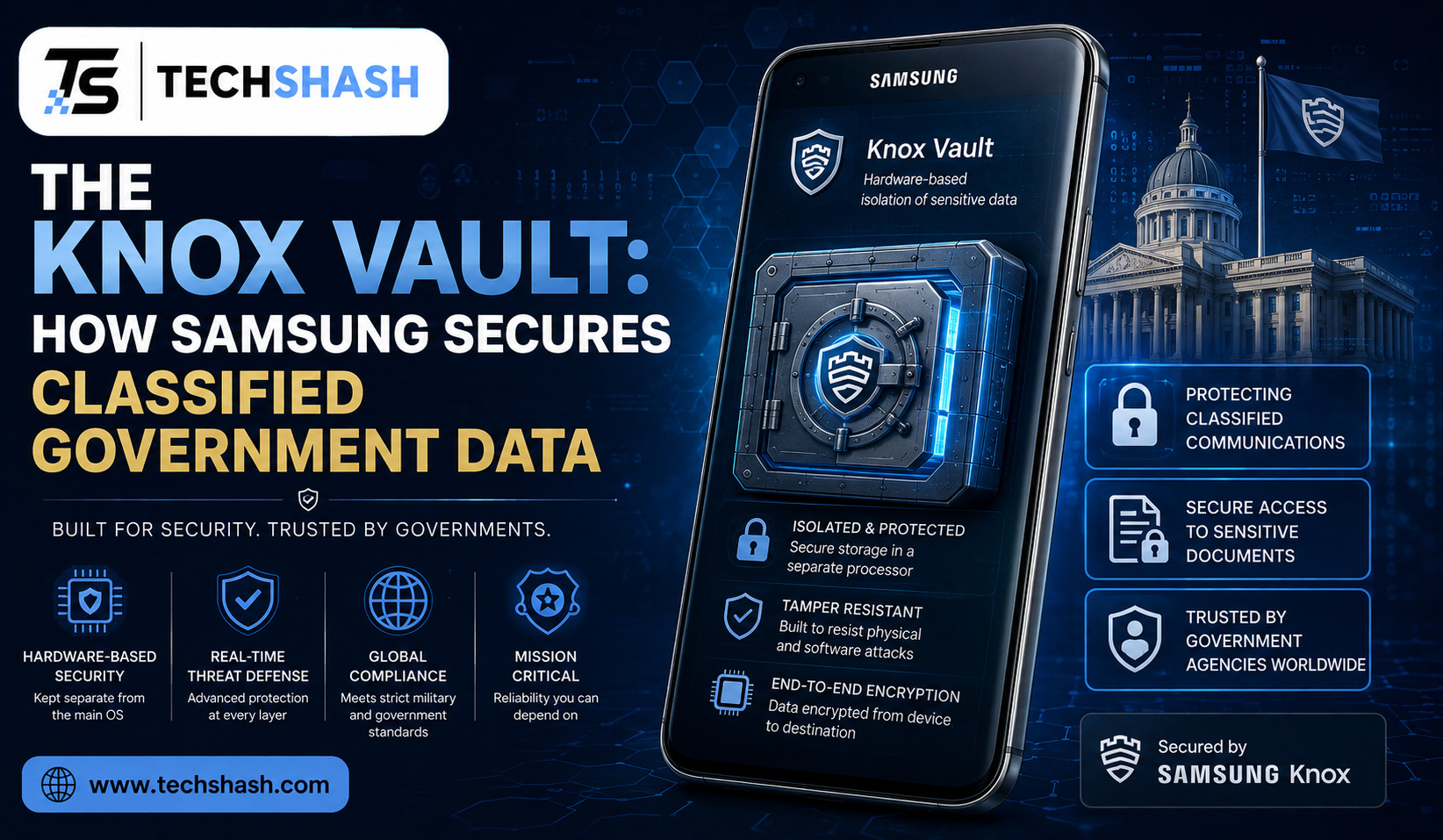
Most phone security lives entirely in software, running alongside the same operating system a phone uses for everything else. Samsung’s approach for its most sensitive data goes further than that. Knox Vault is a physically separate security subsystem built into select Galaxy devices, and it is the specific piece of hardware behind Samsung’s ability to get government certifications that most consumer phones never come close to.
This article explains what Knox Vault actually is, how it differs from ordinary phone security, and what its government certifications actually mean in practice.
What Knox Vault Actually Is
Knox Vault is a dedicated, tamper-resistant subsystem built into select Samsung devices starting with the Galaxy S21. Unlike most mobile security features, which run as software on the same processor handling everything else on the phone, Knox Vault has its own independent processor, its own SRAM, and its own ROM, operating completely separately from the main application processor that runs Android.
That separation is the entire point. If malware or an attacker manages to compromise the primary Android operating system, Knox Vault is designed to remain unaffected, because it was never running on the same hardware in the first place. Samsung describes it as the evolution of an earlier technology called TrustZone, a Trusted Execution Environment that ran a separate operating system alongside Android on the same processor. Knox Vault goes a step further, moving that isolation into genuinely separate physical hardware.
Physical Isolation, Not Just Software Isolation
The distinction between software isolation and physical isolation matters more than it might sound. TrustZone-style protection, still used throughout the Android ecosystem, creates a logically separate environment on the same chip. Knox Vault instead uses a physically separate secure processor, which closes off entire categories of attack that software isolation cannot fully defend against.
Samsung specifically highlights resistance to side-channel attacks as one of Knox Vault’s core protections. These attacks exploit shared hardware resources, like CPU caches or branch predictors, to extract sensitive data indirectly, without ever needing to break through the security software itself. Because Knox Vault runs on its own dedicated processor rather than sharing resources with the main chip, this entire attack category becomes far harder to execute.
Knox Vault also actively monitors its own physical environment. The subsystem includes security sensors capable of detecting laser exposure, voltage anomalies, and extreme temperatures, all of which are techniques attackers have historically used to physically tamper with secure chips in an effort to extract their contents.
What Knox Vault Actually Protects
Knox Vault is not a general-purpose secure storage area for any app that wants one. It is reserved specifically for the most sensitive categories of data a phone handles. According to Samsung’s own documentation, this includes hardware-backed Android Keystore keys, biometric data, blockchain credentials, and the Knox Device Health Attestation Key, a device-unique cryptographic key pair provisioned during manufacturing and used to prove a device’s integrity to remote servers.
Beyond simply storing this data, Knox Vault also runs security-critical code directly, including the authentication logic that governs failed login attempts. That logic enforces increasing timeouts between failed authentication tries and controls access to stored keys based on whether authentication has succeeded, meaning the protection extends to how sensitive operations are gated, not just where the underlying data physically sits.
Because this data never has to leave Knox Vault’s isolated environment to be used, even a fully compromised Android operating system cannot directly read out cryptographic keys or biometric templates stored there. The rest of the phone can be asked to prove something using that data, without ever being given the data itself.
The Certifications That Make Government Use Possible
Knox Vault’s hardware components are Common Criteria evaluated against the requirements in BSI PP0084 at EAL4+ or higher, a formal, internationally recognized security evaluation standard. That evaluation involves independent labs testing the hardware against a wide range of physical attacks, alongside a thorough review of the associated software and firmware.
This is not the only certification layered onto the broader Knox platform. Samsung’s Knox security architecture has also met certification requirements from the National Information Assurance Partnership’s Common Criteria program and the National Institute of Standards and Technology’s Federal Information Processing Standard 140-2, commonly referred to as FIPS 140-2. The platform has additionally received multiple Security Technical Implementation Guides, or STIGs, from the U.S. Department of Defense specifically governing use with classified material.
These are not marketing terms. Each of these frameworks represents a formal, independently audited process that a device or platform has to pass, and they are the same category of certification that governs security hardware used across defense and intelligence agencies far beyond consumer smartphones.
How Samsung Devices Ended Up Handling Classified Information
Samsung’s path into classified government use predates Knox Vault itself and helps explain why the current hardware exists in the first place. In October 2014, Samsung announced that Galaxy devices running its Knox platform became the first consumer mobile devices validated by the National Information Assurance Partnership and approved for U.S. government classified use, after being added to the Commercial Solutions for Classified, or CSfC, Program Component List.
That approval covered a specific list of devices at the time, including the Galaxy S4, Galaxy S5, several Galaxy Note models, and select Galaxy Tab devices, alongside Samsung’s own IPSEC VPN client. Reporting at the time noted that the approval meant agencies across the federal government, including the National Security Agency, could use these approved phones to view classified material, following an earlier, separate approval that had placed Knox on the Defense Information Systems Agency’s list for sensitive but unclassified use.
Later Galaxy generations continued building on that foundation. The Galaxy S9 Tactical Edition, for example, was certified across a similar stack of standards, including CSfC, Common Criteria’s Mobile Device Fundamentals Protection Profile, the DoD Approved Products List, STIG, and FIPS 140-2, reflecting how deeply these certifications have become embedded into Samsung’s flagship device strategy rather than being a one-time achievement tied to a single device generation.
Which Devices Actually Include Knox Vault
Knox Vault is not present on every Samsung device, even though the broader Knox Security Framework now ships across nearly the entire Galaxy lineup, from entry-level A and M series phones up through flagship S and Z series devices. Knox Vault specifically, since it requires a dedicated isolated chip, is mainly reserved for flagship S and Z series models and select higher-end A series devices.
Samsung has also extended Knox Vault beyond phones in recent years. The technology has been applied to select 8K TVs and Smart Monitor models since 2023, and Samsung has indicated plans to bring Knox Vault-protected chipsets to a wider range of connected home appliances, including refrigerators and washers with built-in screens, as part of its broader Knox Matrix security strategy across devices.
For enterprise and government buyers specifically, this distinction matters in practice. Anyone deploying devices for sensitive or classified use needs to confirm Knox Vault support on the specific model in question, since two phones running the same version of Android and the same broader Knox software framework may still differ in whether they include the dedicated Knox Vault hardware underneath.
What “Secures Classified Data” Really Means in Practice
It is worth being precise about what these certifications actually authorize, since the framing can get exaggerated in casual coverage. STIG approval and placement on the DoD’s Approved Products List primarily govern devices used within defense information systems under DoD-managed configurations, generally for sensitive but unclassified use unless a device has cleared the additional, more demanding CSfC classified-use approval process specifically.
Even where CSfC classified approval has been granted, that approval is tied to a specific device configuration, a specific set of enforced security policies, and specific supporting infrastructure like VPN clients and mobile device management, not simply “this phone is cleared for classified use” in a general sense. Knox Vault’s hardware provides the physically isolated foundation that makes meeting these requirements possible, but the certifications themselves apply to complete, properly configured deployments rather than to an unmodified phone straight out of the box.
That distinction does not diminish what Knox Vault accomplishes. It is genuinely rare for a mainstream consumer smartphone platform to reach hardware security certifications used for classified government material at all, and Samsung remains one of the only mobile device makers to have consistently maintained that level of certification across multiple device generations rather than achieving it once and letting it lapse.
Key Takeaways
- What Knox Vault is: A physically separate, tamper-resistant subsystem with its own processor, memory, and storage, independent from a phone’s main Android processor.
- Why physical isolation matters: It defends against side-channel and hardware tampering attacks that software-only isolation cannot fully block.
- What it protects: Cryptographic keys, biometric data, blockchain credentials, and the device’s health attestation key.
- Its certifications: Common Criteria evaluation at EAL4+ or higher, FIPS 140-2, and multiple DoD Security Technical Implementation Guides.
- Its government history: Samsung Knox devices became the first NIAP-validated consumer mobile devices approved for U.S. government classified use in 2014.
- Where it’s actually available: Mainly flagship Galaxy S and Z series devices and select high-end A series phones, plus an expanding range of Samsung displays and appliances.
Frequently Asked Questions
What makes Knox Vault different from ordinary phone security? Knox Vault uses a physically separate processor and memory, rather than software-only isolation on the phone’s main chip, protecting against a wider range of hardware-level attacks.
Which Samsung devices include Knox Vault? Mainly flagship Galaxy S and Z series phones starting with the Galaxy S21, along with select higher-end Galaxy A series devices, plus certain Samsung TVs and monitors.
What kind of data does Knox Vault actually store? Hardware-backed cryptographic keys, biometric data, blockchain credentials, and the device’s Knox Health Attestation Key.
Are all Samsung Galaxy phones approved for classified government use? No, classified-use approval applies to specific certified device configurations, not to every Galaxy phone by default.
When did Samsung devices first get approved for classified U.S. government use? In October 2014, when Samsung Knox devices became the first NIAP-validated consumer mobile devices added to the Commercial Solutions for Classified Program Component List.
Conclusion
Knox Vault represents a genuinely different approach to mobile security, moving Samsung’s most sensitive protections into physically isolated hardware rather than relying on software boundaries alone. That hardware foundation, combined with over a decade of accumulated government certifications, is what has allowed Samsung to remain one of the only consumer phone makers with devices formally approved for classified use. The certifications apply to specific, properly configured deployments rather than to any Galaxy phone by default, but the underlying hardware achievement, isolating a phone’s most critical secrets from its own operating system, remains a meaningful and rare distinction in mobile security.