Introduction
Phone batteries have barely changed in a decade, even while screens, cameras, and chips have leapt forward. A solid-state battery could finally break that pattern.
This article looks at what the technology actually does differently, why companies like Samsung are so focused on it, and a realistic answer to the question everyone actually wants: when will this show up in the phone you carry every day?
1. What a Solid-State Battery Actually Is
Every lithium-ion battery in your phone today relies on a liquid electrolyte to move charge between electrodes. A solid-state battery replaces that liquid with a solid material instead.
That single change removes much of the flammability risk tied to today’s batteries, since there is no liquid to leak, ignite, or break down the same way over time. It also opens the door to higher energy density, meaning more power packed into the same physical space.
In simple terms, a solid-state battery aims to solve three problems at once: safety, charging speed, and how much capacity fits into a device without making it bigger.
2. Why Everyone Is Racing Toward This Technology
The appeal here goes well beyond phones. Automakers, robotics companies, and consumer electronics giants are all chasing the same underlying chemistry, because the benefits stack up across nearly every battery-powered product.
Faster charging is one of the most tangible promises. Some solid-state prototypes have already demonstrated charging to 80 percent capacity within roughly nine minutes, a dramatic jump over what most phones manage today.
Longevity matters just as much. Solid electrolytes tend to degrade more slowly than liquid ones, which could mean phone batteries that hold a meaningful charge years further into a device’s life than current cells typically manage.
3. Samsung’s Timeline, Explained
Samsung has been one of the loudest voices in this race, and its timeline gives a useful anchor point for the whole industry. Samsung SDI has targeted late 2027 for mass production of all-solid-state batteries, with early applications aimed at electric vehicles, robotics, and mobile devices.
That target has shifted before. Samsung first teased solid-state smartphone battery technology back in 2017, with an early prediction that mass production was only a year or two away. That original 2019 target came and went without a solid-state Galaxy phone ever materializing.
This history matters for setting expectations. Ambitious announcements from battery makers have a track record of slipping, sometimes by years, so any specific date should be treated as a target rather than a guarantee.
4. Wearables Will Get There First
Before a solid-state battery shows up in a flagship phone, it is expected to appear somewhere smaller and lower-risk: your wrist or your finger.
Samsung Electro-Mechanics has said wearable devices, including the Galaxy Watch series and Galaxy Ring, will be the first Samsung products to carry solid-state battery technology, with mass production targeted for the end of 2026.
This staged rollout makes practical sense. A smaller battery in a lower-stakes product gives a manufacturer a chance to work out manufacturing kinks and real-world reliability issues before committing to a component that millions of flagship phone buyers will depend on daily.
Samsung’s first-generation solid-state cells reportedly offer around 200 Wh/kg of energy density, a meaningful improvement in safety and longevity even if it does not immediately blow past today’s best lithium-ion cells on raw capacity.
5. Why Phones Are Taking Longer
Smartphones face a tougher set of engineering demands than a smaller wearable battery. Phone batteries need to survive daily fast charging, tight thermal environments packed next to a hot processor, and years of heavy daily cycling, all inside an increasingly thin chassis.
A more conservative industry estimate places widespread solid-state adoption in smartphones between 2028 and 2030, allowing time for both the technology to mature and manufacturing costs to come down enough for mainstream pricing.
Even once solid-state batteries do arrive in phones, first-generation versions are unlikely to deliver a dramatic leap in battery life right away. Early benefits will likely lean more toward faster charging and improved safety than a sudden doubling of screen-on time.
6. What Solid-State Batteries Will Actually Change
It helps to separate the marketing promise from the realistic near-term benefit. Here is what buyers can reasonably expect once solid-state cells reach phones:
- Faster charging, with some prototypes suggesting full charges in minutes rather than the current standard of 30 minutes to an hour.
- Improved safety, virtually eliminating the battery fire risk associated with damaged or defective lithium-ion cells.
- Longer device lifespan, since solid electrolytes tend to degrade more gradually across repeated charge cycles.
- Thinner or lighter designs, as manufacturers gain flexibility in how much space a battery needs to hit the same capacity target.
Dramatically longer battery life on day one is the one benefit worth tempering expectations around, at least for the first couple of generations.
7. The Competition Beyond Samsung
Samsung is far from alone in this race. Toyota has invested more than 15 billion dollars into solid-state battery development and holds one of the largest patent portfolios in the space, though its near-term focus remains squarely on vehicles rather than phones.
QuantumScape, Solid Power, and a handful of newer entrants are also racing toward commercialization, mostly targeting electric vehicles first, since automakers can absorb higher initial costs more easily than a mass-market phone maker can.
This broader competitive pressure works in favor of eventual smartphone adoption. As automotive-scale production drives down manufacturing costs and works out early reliability issues, some of that progress should eventually filter down into smaller, phone-sized cells.
8. A Realistic Timeline for Your Next Phone
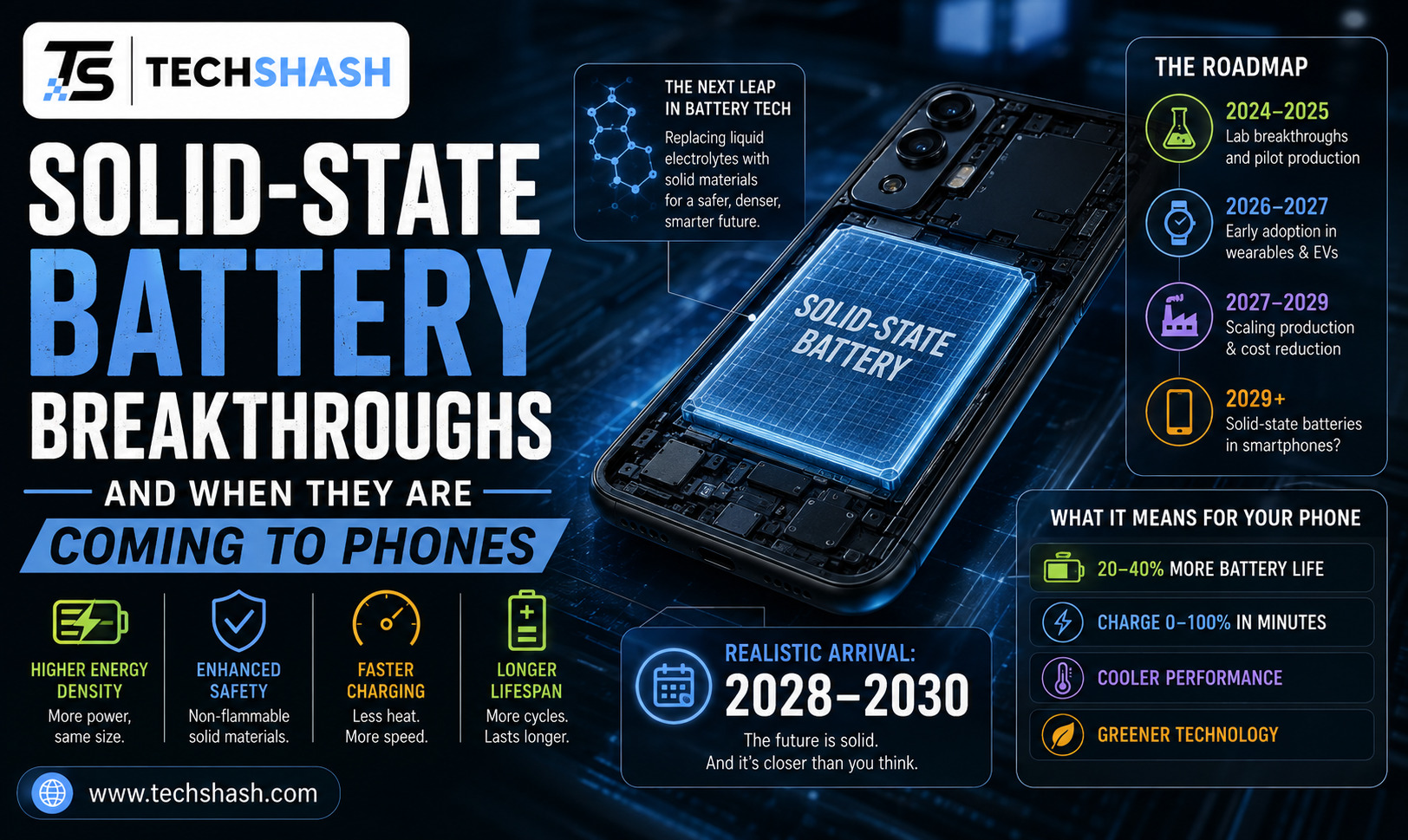
Based on where the industry stands today, the most reasonable expectation looks something like this: solid-state batteries in wearables by late 2026, cautious testing and pilot programs in flagship phones sometime around 2027, and broader smartphone adoption stretching into the 2028 to 2030 window.
If you are shopping for a phone right now, it makes more sense to focus on current-generation improvements, like larger silicon-carbon battery cells, rather than holding out for solid-state technology that remains a couple of product cycles away.
Whichever manufacturer gets there first, the shift from liquid to solid electrolyte chemistry looks like one of the more significant hardware changes coming to phones this decade, even if it arrives more gradually than the most optimistic headlines suggest.
Key Takeaways
- What it is: A solid-state battery replaces the liquid electrolyte in today’s batteries with a solid material, improving safety and energy density.
- Samsung’s target: Mass production of all-solid-state batteries for EVs, robotics, and mobile devices is targeted for late 2027.
- First stop: Wearables like the Galaxy Watch and Galaxy Ring are expected to get solid-state batteries before phones, potentially by late 2026.
- Phone timeline: Widespread smartphone adoption is more realistically expected between 2028 and 2030.
- First-gen benefits: Expect faster charging and improved safety before a dramatic jump in overall battery life.
FAQs
What makes a solid-state battery different from a regular phone battery? A solid-state battery replaces the liquid electrolyte used in current lithium-ion cells with a solid material, improving safety and allowing higher energy density.
When will solid-state batteries reach smartphones? Most realistic estimates point to limited smartphone adoption starting around 2027, with broader mainstream availability more likely between 2028 and 2030.
Will wearables get solid-state batteries before phones? Yes, Samsung has said wearables like the Galaxy Watch and Galaxy Ring are expected to receive solid-state batteries first, potentially by late 2026.
Will solid-state batteries make phones charge faster? Yes, faster charging is one of the more likely early benefits, with some prototypes already charging to 80 percent capacity in around nine minutes.
Are other companies besides Samsung working on solid-state batteries? Yes, companies including Toyota, QuantumScape, and Solid Power are all pursuing solid-state battery technology, though most are currently focused on electric vehicles rather than phones.
Conclusion
Solid-state batteries promise real improvements in safety, charging speed, and long-term durability, and the technology is genuinely closer than it has ever been. Even so, the path to your next phone runs first through wearables and years of careful manufacturing scale-up, with realistic smartphone adoption more likely toward the end of the decade than next year. Solid-state batteries are coming, just not as quickly as some of the more excited headlines suggest.