Millions of people struggle every single day to remember dozens of complex passwords. Writing login details on sticky notes or reusing simple words leaves personal accounts wide open to online theft.
Modern technology now provides a simpler and far more reliable option. The rapid rollout of digital ID and passkeys is changing how everyday users sign into online services. This comprehensive guide covers how digital ID and passkeys function, why they protect your data better than old logins, and what the future of passwordless authentication looks like for everyone.
1. The Growing Failure of Traditional Passwords
Traditional passwords have become a major security bottleneck for modern internet users. People naturally pick short words or obvious number patterns that automated scripts can guess in seconds.
Data breaches occur constantly across global computer networks. When malicious hackers breach a single corporate database, they steal millions of confidential user records in one quick event.
Reusing the same phrase across multiple websites makes this security problem much worse. If a single shopping site suffers a data leak, criminals attempt those stolen credentials on online banks, email accounts, and social media apps.
Phishing scams also trick millions of individuals every year. Fake login pages trick users into typing their secret phrases directly into forms controlled by online scammers.
Why Manual Password Management Fails
Human memory has natural limits when managing dozens of separate online profiles. Password management applications help, but users still must remember a complex master key to unlock their saved credentials.
Security researchers agree that password fatigue causes everyday users to lower their safety habits over time. Relying on typed text strings to protect sensitive private information is no longer practical for modern internet safety.
Choosing long phrases with numbers and symbols creates frustration without offering full protection. Automated guessing tools continue to grow faster and smarter every year.
2. How Digital ID and Passkeys Work Together
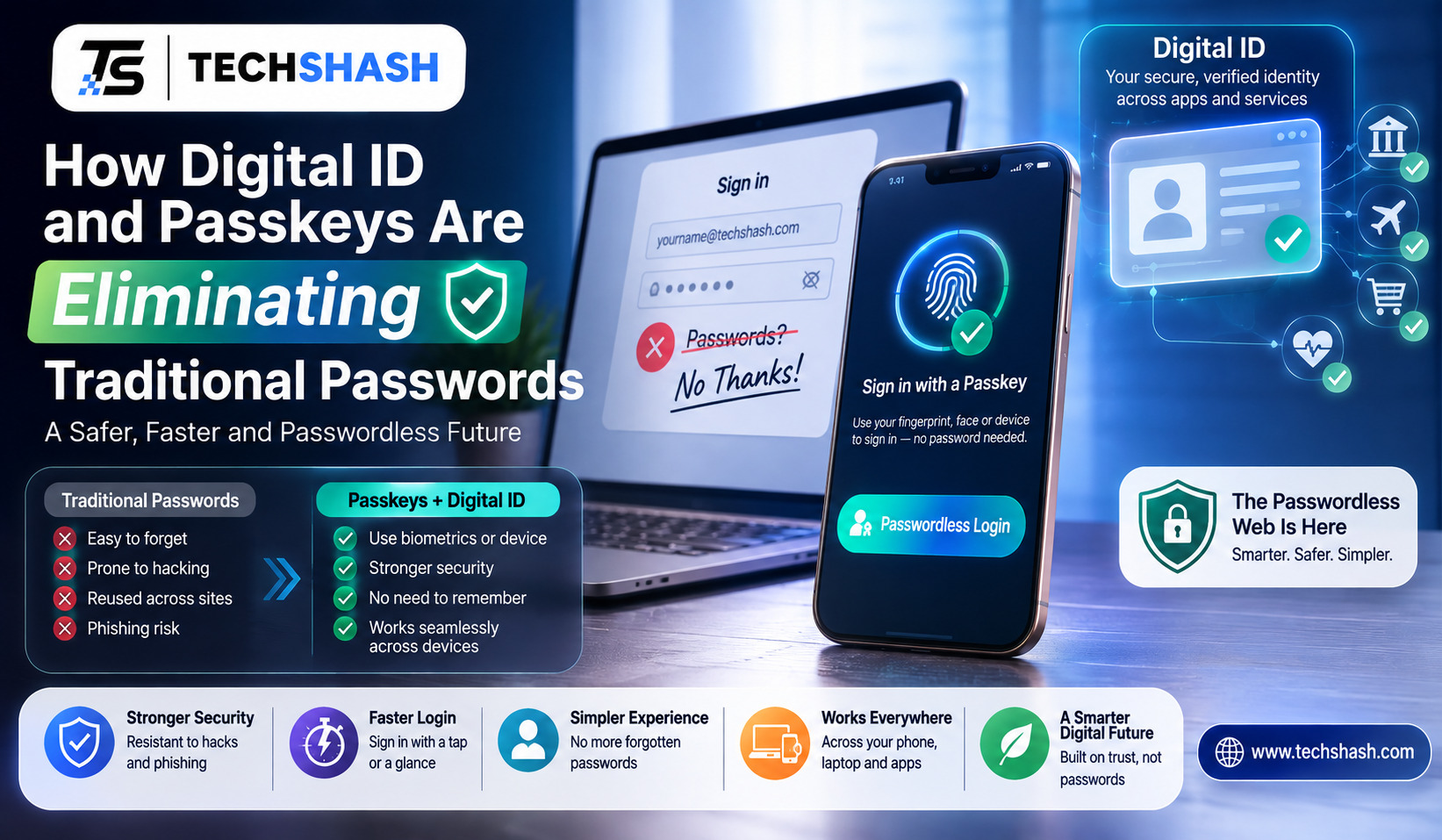
Passkeys replace traditional passwords with unique mathematical key pairs that stay directly on your personal hardware. One key is public and rests on the website server, while the matching private key remains locked inside your device.
When you sign into a service, your phone or computer uses built-in biometrics like a fingerprint scanner or facial recognition to verify your physical presence. You never need to type or memorize a secret string of text again.
Combining digital ID and passkeys creates an end-to-end identity platform for secure digital actions. A verified digital identity proves who you are, while a passkey grants access without sending secret keys across the public internet.
The Role of Open Standards
The FIDO Alliance and the World Wide Web Consortium built the underlying technology standards for passkeys. These open specifications ensure that different brands of mobile phones, computers, and web browsers talk to each other safely.
Public key cryptography makes it impossible for attackers to guess or intercept your private login details. Even if a target server suffers a total security breach, your private key stays safe on your personal hardware.
Using digital ID and passkeys removes the need for master passwords or secondary text message confirmation codes. The identity check finishes in just two seconds with a simple scan of your thumb or face.
3. The Rise of Government-Backed Digital ID Verification
Governments around the world are developing official digital credentials for their citizens. Mobile driver’s licenses and official identification cards can now sit inside protected wallet applications on standard smartphones.
These official identity systems use cryptographic verification to prove identity without revealing unnecessary personal information. For instance, a clerk can confirm your legal age without seeing your home address or exact birth date.
Integrating digital ID and passkeys allows citizens to access official public services without visiting physical government offices. People can renew vehicle permits, file annual tax documents, or check public benefits securely from home.
International Standards for Digital Identity
The ISO 18013-5 standard defines how mobile driver’s licenses communicate safely with official reader devices. This standard ensures that mobile identity credentials function across state lines and national boundaries.
Government agencies require high levels of trust before granting access to sensitive public records. Utilizing verifiable digital credentials ensures that online identity theft becomes much harder for criminals to execute.
As more state and national institutions adopt these tools, carrying physical plastic cards will become optional for daily errands. Official digital identity tools will soon replace paper forms and physical plastic cards entirely.
4. Tech Industry Adoption and Device Compatibility
Major technology companies have built passkey support directly into their operating systems. Apple, Google, and Microsoft worked together to ensure passkeys work across mobile phones, tablets, and desktop computers.
Cloud synchronization services allow your passkeys to back up automatically across all your personal devices. If you create a passkey on your tablet, you can use it immediately on your desktop computer without extra steps.
Cross-device authentication lets you sign into a laptop by using a smartphone resting nearby. The two hardware units communicate using local Bluetooth signals to confirm physical proximity before unlocking access.
Web Browsers and Application Support
Leading web browsers now support modern authentication standards natively. Popular online shopping sites, messaging tools, and financial platforms are converting millions of accounts to passwordless sign-ins.
Widespread implementation of cross-platform authentication means consumers are not locked into a single product brand. You can use an Android phone to log into a Windows laptop or a Mac desktop without buying extra accessories.
Software developers continue to add passkey options to popular mobile applications every single month. Millions of active accounts switch away from traditional login forms every week.
5. Key Security and Privacy Advantages
The biggest advantage of passkeys is total resistance to online phishing attempts. A passkey only functions on the exact website domain name where it was originally created.
If a criminal creates a fake bank website to trick you, your personal phone will refuse to share the passkey. The underlying browser software detects automatically that the web address does not match the stored key.
Credential stuffing attacks also become completely useless against digital ID and passkeys setups. Criminals cannot use leaked database credentials because no shared passwords exist inside the corporate database.
Minimal Data Sharing and Zero Knowledge
Privacy protection increases because digital ID systems operate on zero-knowledge design principles. Online services verify your true identity without ever receiving sensitive biometric images like fingerprints or face scans.
Your biometric data never leaves your personal phone or computer chip. The local device checks your fingerprint and only sends a signed mathematical confirmation back to the website server.
Achieving phishing-resistant security protects everyday internet users from standard online scams without requiring complex technical training. Users stay safe even if they click on suspicious email links by accident.
6. Current Challenges in Moving Away From Passwords
Changing global technical habits takes time, and moving away from standard passwords presents real operational challenges. Millions of older websites still rely on standard forms and have not upgraded their software servers yet.
Losing a primary smartphone or personal computer creates worry for users who do not understand cloud backup tools. People fear getting locked out of their primary bank accounts or personal communication channels.
Hardware recovery mechanisms must stay simple so non-technical users can regain account access safely. Cloud backup services help, but users must configure backup contact details or secondary devices in advance.
Educating the Public on Passwordless Logins
Many everyday consumers do not yet understand how digital ID and passkeys function during daily online tasks. Clear instructions and friendly setup screens are necessary to build public confidence in new systems.
Account sharing within families or small office teams also requires fresh technology solutions. Standard teams used to share typed passwords, but passkeys require encrypted sharing paths between trusted accounts.
Resolving these implementation hurdles will ensure a smooth transition toward total password elimination over the coming years. Technical organizations are actively building better tools to simplify hardware replacement and account sharing.
Key Takeaways
- Enhanced Safety: Digital ID and passkeys eliminate weak credentials and protect accounts from automated phishing attacks.
- Simple Experience: Users sign in using local device biometrics like fingerprints or face scans without typing text.
- Government Support: Mobile driver’s licenses and verifiable digital credentials enable secure access to official public services.
- Cross-Platform Access: Major operating systems and web browsers allow passkeys to sync safely across personal devices.
- Privacy Defense: Personal biometric data remains locked inside local device hardware and never uploads to website servers.
Frequently Asked Questions
What happens if I lose my phone containing my passkeys?
Your passkeys are backed up securely to your encrypted cloud account, allowing you to restore them easily when you set up a new replacement device.
Can website owners see my fingerprint or face scan when I use a passkey?
No, your biometric data stays entirely on your local hardware device and is never sent to external servers or website operators.
Are digital ID and passkeys completely immune to internet scams?
Passkeys prevent online phishing attacks because they only work on authentic domain addresses, but users must still protect their physical devices from unauthorized access.
Do I need an active internet connection to generate and use a passkey?
You need an internet connection to communicate with the website server, but the cryptographic key check takes place locally on your device.
Will standard passwords disappear completely in the near future?
Standard passwords will gradually vanish over the coming years as more websites and government platforms adopt passwordless login standards.
Conclusion
Moving away from typed secret phrases is one of the most important security upgrades in internet history. The widespread adoption of digital ID and passkeys delivers unmatched daily convenience while shielding individuals from persistent cyber threats. As major tech companies and government institutions continue to expand support, passwordless identity verification will become the standard for safe digital living.