
Introduction
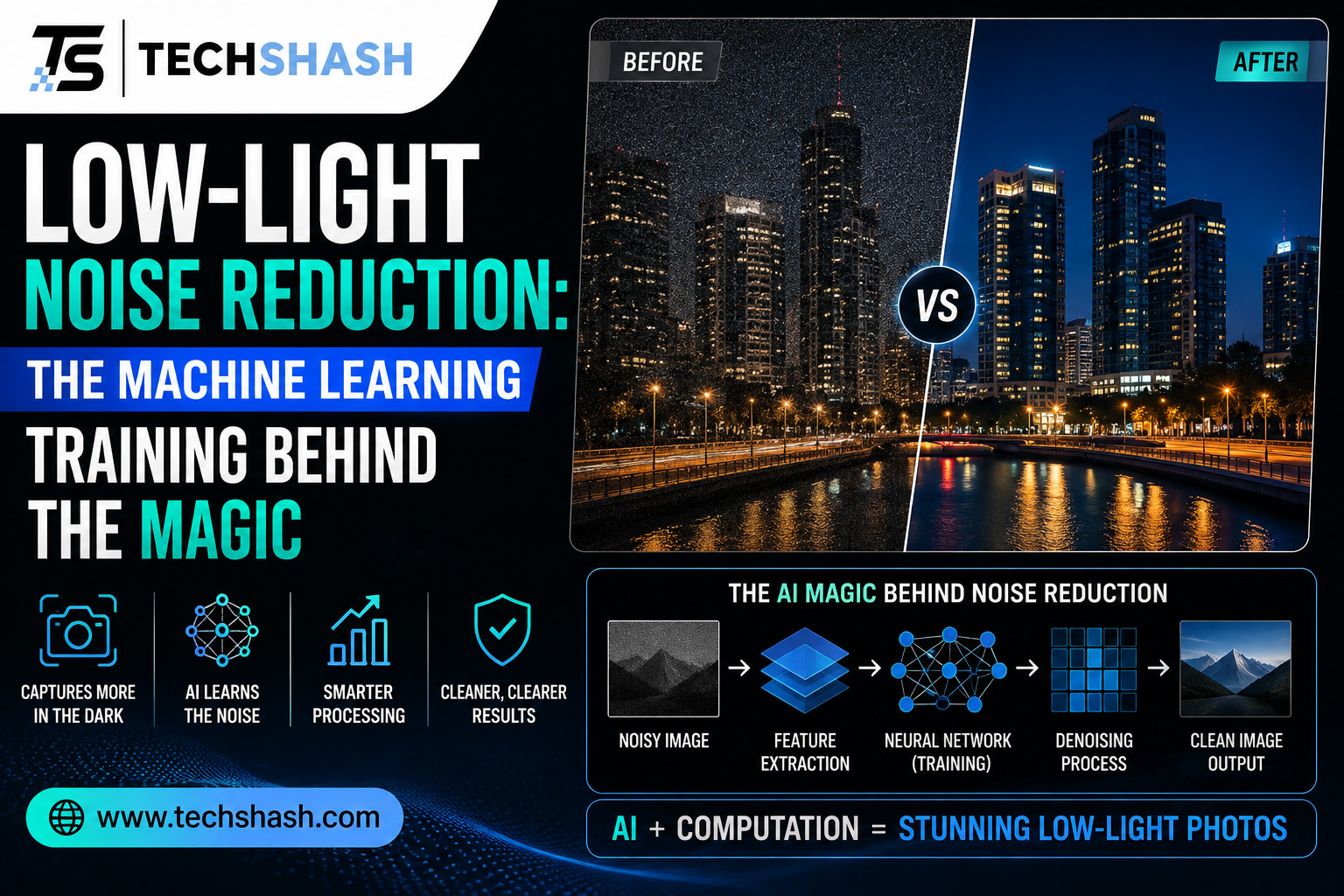
A dim restaurant photo that looks clean and bright on a modern phone did not come from a better lens. It came from a trained model quietly rebuilding the image behind the scenes. Low-light noise reduction on phones today relies on machine learning systems trained on massive paired datasets, not simple brightness adjustments. This article looks at how that training actually works, what kind of noise the models are fighting, and why some of the hardest problems in this field are still not fully solved.
1. Why Low Light Is So Hard for a Camera Sensor
A camera sensor captures an image by counting photons of light hitting each pixel. In bright conditions, there are plenty of photons to count, and the resulting signal is strong and stable. In dim conditions, far fewer photons arrive, and the signal gets weak enough that random fluctuations start to dominate the picture.
Raising ISO amplifies that weak signal so the image looks brighter, but amplification does not discriminate between real image detail and random noise. It boosts both at once, which is why a photo taken in a dark room at high ISO often looks grainy and speckled rather than simply well-lit.
2. The Different Kinds of Noise a Sensor Produces
Not all sensor noise behaves the same way, and understanding the different types is the starting point for building a model that can remove them.
- Photon shot noise comes from the random nature of light itself, and it follows a Poisson distribution, meaning brighter areas of a scene actually show more shot noise in absolute terms than darker areas.
- Readout noise is introduced by the sensor’s electronics as it converts captured light into a digital signal.
- Row noise appears as faint horizontal banding, caused by inconsistencies in how a sensor reads out each row of pixels.
- Quantization noise comes from rounding continuous light values into discrete digital numbers.
Researchers building noise-reduction models increasingly simulate these noise types individually, using physical models like a Poisson distribution for shot noise, rather than treating all sensor noise as one generic blur to smooth away.
3. How Multi-Frame Noise Reduction Works
Before diving into pure machine learning approaches, it helps to understand the technique they usually work alongside: multi-frame noise reduction. Instead of relying on a single exposure, the phone captures a rapid burst of frames and combines them into one image.
Because random noise varies from frame to frame while the real scene detail stays consistent, averaging several frames together cancels out much of the noise while reinforcing the actual image content. This is the same principle behind long-exposure photography, just achieved through computation rather than a single long shutter opening. Machine learning models are then layered on top of this combined frame to clean up whatever noise remains and recover detail the averaging process could not fully resolve.
4. Training a Noise Reduction Model
Modern low-light enhancement models are trained using paired datasets, where each noisy, dark image is matched with a clean, well-lit version of the same scene. The model learns to predict the clean version from the noisy one by comparing its output against the real clean image during training and adjusting itself to reduce the difference.
That difference is measured with a loss function, often combining more than one type of comparison. A common setup uses an L1 loss, which measures the average pixel-by-pixel difference, alongside a perceptual loss calculated using a pretrained network such as VGG-19, which compares how similar two images look in terms of texture and structure rather than exact pixel values. Combining both helps the model produce results that are not just numerically close to the clean image but also look natural to a human eye.
More advanced approaches use generative adversarial networks, where a generator model produces a denoised image and a separate discriminator model tries to tell the generated image apart from a real one. Training the two networks against each other pushes the generator toward outputs realistic enough to fool the discriminator, which tends to produce more convincing fine detail than a straightforward pixel-comparison approach alone.
5. The Data Problem Nobody Solved Easily
Training data is the biggest bottleneck in this entire field. Popular datasets used for years, including LOL, LOL-V2, and LSRW, provide a limited number of image pairs, often captured under tightly controlled conditions using low ISO settings or artificially dimmed bright scenes rather than genuinely difficult real-world low-light situations.
Models trained heavily on this kind of constrained data tend to struggle when faced with the messier, more varied lighting conditions found in real photos. That gap between lab-controlled training data and unpredictable real-world scenes is a major reason why some phones still produce inconsistent results in genuinely challenging lighting, even after years of research progress. Newer efforts, including datasets built specifically for recent NTIRE research challenges, aim to close that gap with larger and more varied real-world image collections rather than relying only on older, narrower benchmarks.
6. How Phone Makers Apply This in 2026
Every major phone maker now runs some version of machine learning-based noise reduction as a core part of its camera pipeline.
- Apple’s iPhone 17 Pro Max applies its Photonic Engine across more stages of the image pipeline, using machine learning to preserve detail, manage noise, and adjust color specifically in low-light conditions.
- Samsung’s Galaxy S26 Ultra runs a ProVisual Engine that processes image data in real time, paired with sensor-specific noise reduction applied directly during low-light video recording.
- Google’s Pixel 10, powered by the Tensor G5 chip, applies Gemini-based camera intelligence across its imaging pipeline, including tools that analyze a scene before capture to guide settings and framing.
Each of these systems reflects the same underlying idea, a trained model doing the heavy lifting that used to depend entirely on sensor hardware and optics alone.
7. Getting a Trained Model to Run on a Phone
A model trained on a powerful GPU in a research lab cannot simply be dropped onto a phone as-is. It has to be converted into a lightweight format capable of running quickly on limited mobile hardware, often using frameworks like TensorFlow Lite that support running trained models directly on a phone’s GPU.
Real-world benchmarks show what that constraint looks like in practice. One published low-light enhancement approach, designed for efficient smartphone deployment, requires roughly 400MB of memory and processes a large image in around 100 milliseconds on a Qualcomm Adreno GPU. Some methods reduce this load further by downscaling the image first, applying a lightweight model to enhance the smaller version, and then using a guided upsampling step to apply that same correction back onto the full-resolution photo.
8. Where the Technology Still Falls Short
Despite genuine progress, low-light noise reduction is not a solved problem. Recent research challenges dedicated specifically to this task, drawing well over a hundred participating research teams in a single year, are proof that the field is still actively searching for better solutions rather than polishing a finished one.
The core tension remains the same one researchers have wrestled with for years: a model needs enough real, varied training data to generalize well, but collecting large volumes of genuinely difficult low-light images paired with clean references is expensive and slow. Until that gap closes further, even the best phone cameras will occasionally stumble on scenes that look nothing like the conditions their models were trained on.
Key Takeaways
- The core problem: Weak light signals mean amplifying brightness also amplifies noise.
- Noise types: Photon shot noise, readout noise, row noise, and quantization noise each behave differently and increasingly get modeled separately.
- Training method: Models learn from paired noisy and clean images, often using combined pixel-level and perceptual loss functions.
- Data bottleneck: Older datasets like LOL and LOL-V2 are limited and often do not reflect real-world low-light conditions well.
- On-device deployment: Trained models get converted into lightweight formats like TensorFlow Lite to run quickly within a phone’s memory and processing limits.
FAQs
Why do low-light phone photos look grainy at high ISO? Raising ISO amplifies the sensor’s weak signal in dim conditions, and that amplification boosts random noise along with real image detail.
What is multi-frame noise reduction? It is a technique that combines several rapidly captured frames into one image, since averaging cancels out random noise while reinforcing consistent scene detail.
How are low-light enhancement models trained? They are trained on paired datasets of noisy and clean images, learning to predict the clean version from the noisy one using pixel-level and perceptual loss functions.
Why do some low-light models struggle on new photos? Many training datasets are limited and captured under controlled conditions, so models can struggle to generalize to the messier variety of real-world low-light scenes.
How does a trained model run on a phone without a powerful GPU? Models are converted into lightweight formats such as TensorFlow Lite, often after being simplified, so they can run efficiently on a phone’s built-in GPU.
Conclusion
The clean, bright low-light photo a modern phone produces is the end result of a machine learning model trained to separate real detail from random noise, built on paired datasets, refined with combined loss functions, and squeezed down to run in a fraction of a second on limited mobile hardware. Low-light noise reduction has come a long way from simple brightness boosts, but the data challenges behind training these models mean the technology is still improving year over year rather than sitting still.