Introduction
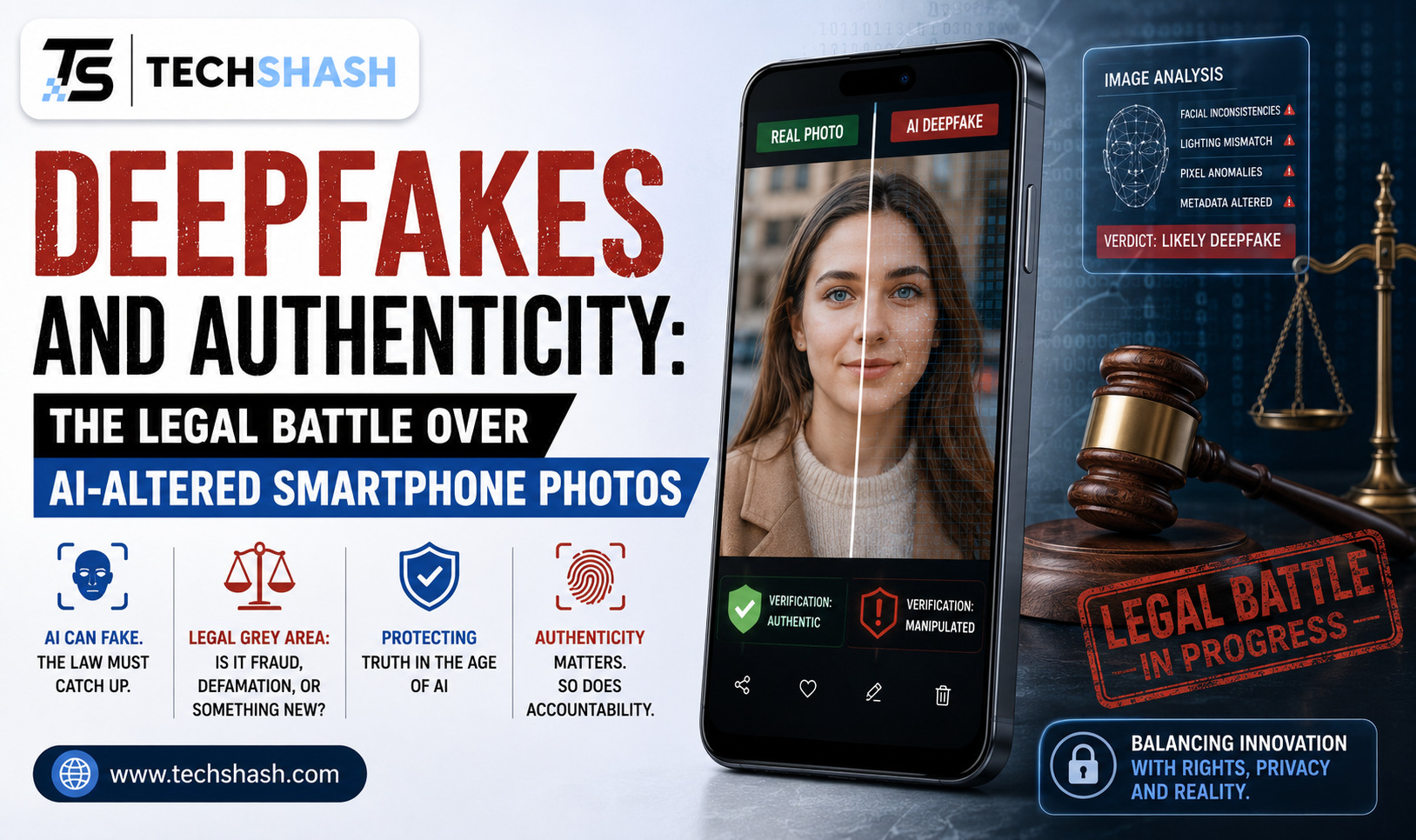
A photo used to be treated as proof, the kind of evidence nobody bothered to question. That assumption is falling apart fast. Modern phone cameras now apply AI processing before an image is ever saved, and that shift has opened a genuine legal battle over photo authenticity that courts, lawmakers, and tech companies are all scrambling to address. This article looks at the technology built to prove a photo is real, why that technology has real gaps, and how the law is trying to catch up.
1. Why Smartphone Photos Are No Longer Simple Evidence
Today’s flagship phones do far more than capture light through a lens. AI pipelines built into the camera app can smooth skin, swap in a better facial expression from a different frame, or blend several exposures into one image, all before the photo lands in your gallery.
That processing happens quietly. Most people tapping the shutter button have no idea how much of the final image was generated rather than captured. When one of those photos later gets used as evidence, a family record, or proof of a moment, the line between what the camera saw and what the software constructed gets blurry fast.
2. What Content Credentials Actually Do
The main technical answer to this problem is a standard called C2PA, short for the Coalition for Content Provenance and Authenticity. C2PA attaches a signed manifest to a photo or video, recording details like the capturing device, the time and location, and any edits applied afterward.
The system relies on cryptographic hashing. The content is hashed using SHA-256, and that hash gets locked into the signed manifest. Change even a single pixel, and the hash no longer matches, which reveals that tampering occurred. This is genuinely useful, but it is worth being precise about what it proves. C2PA does not scan an image and declare it real or fake. It only confirms whether the signed history attached to a file still matches the file itself.
3. Which Phones Support This Technology
Google made the first major move into mainstream hardware. The Pixel 10 shipped with Content Credentials enabled by default, signing every photo captured through the Pixel Camera app, including images altered by AI tools like Magic Eraser or Best Take. The device became the first to reach Assurance Level 2 in the C2PA Conformance Programme, currently the highest security tier the standard defines.
Samsung has followed a similar path, adopting C2PA starting with the Galaxy S25 and expanding support with the Galaxy S26. Apple has not yet shipped native Content Credentials, leaving iPhone owners and users of other Android phones to rely on third-party apps for comparable provenance signing. Even where support exists, it is currently limited mostly to flagship devices, with mid-range and budget phones from the same manufacturers left out.
4. The Limits Nobody Likes to Mention
C2PA credentials get sold as a fix for the authenticity problem, but the standard has real boundaries that matter a great deal in practice.
- It asserts, it does not verify. A missing credential says nothing about whether an image is fake, and a present credential only confirms what the signer claims, not that the claim is true.
- The chain breaks easily. Most social media platforms, including Instagram, X, TikTok, and Facebook, strip C2PA metadata during the re-encoding process when a photo is uploaded.
- Many editing tools drop it too. Popular applications such as Affinity Photo, GIMP, and Capture One do not preserve C2PA manifests when a file is saved through them.
- It can be forged. Researchers have demonstrated the ability to create a valid forged manifest attributed to a named person, and separately showed that an AI-generated image could still be signed by a C2PA-enabled camera.
Put simply, a Content Credential tells you what a file claims about its own history. It cannot tell you what the scene actually looked like in front of the lens.
5. The Consent Problem Hiding Inside Your Camera App
There is a subtler issue sitting underneath all of this. When a phone’s AI pipeline alters a photo before saving it, and the Content Credential is generated only after that alteration, the credential ends up certifying an AI-modified composite rather than the original capture. The metadata is accurate about what happened technically, but it can still mislead anyone who assumes a signed photo means an unedited one.
Samsung’s own executives have struggled to give a clear answer on this tension. At a recent Q&A session, the company’s SVP of Mobile Product Management suggested public concern over AI-generated content would eventually fade, comparing it to early skepticism toward user-generated content. Critics have pushed back hard on that comparison, since user-generated content changed who could publish an image, while AI processing changes what the image actually shows.
This becomes a real forensic issue whenever a photo taken on a phone gets treated as ordinary evidence, whether that is a witness statement, an insurance claim, or a piece of courtroom testimony, without anyone realizing how much of the image was shaped by software rather than the sensor.
6. How the Law Is Responding in the United States
American lawmakers have moved fastest on the narrower problem of non-consensual and deceptive deepfakes, even while broader AI regulation has stalled. The TAKE IT DOWN Act, signed into federal law in May 2025 after near-unanimous congressional support, makes it a federal crime to publish or threaten to publish non-consensual intimate imagery, whether authentic or AI-generated, and requires platforms to remove flagged content within 48 hours.
State legislatures have been even more active. California’s AI Transparency Act (AB853), signed in October 2025, requires developers of generative AI tools to embed provenance data into the content they produce, with effective dates staggered through 2028. Washington state enacted its own law, Substitute Senate Bill 5886, updating personality rights to cover forged digital likenesses, which took effect in June 2026.
More than 40 states now carry some form of deepfake-related legislation, much of it aimed at election-related deception and non-consensual imagery rather than photo authenticity broadly. On the evidentiary side, a proposed amendment to Federal Rule of Evidence 901(c) would specifically let a party challenge digital content by presenting evidence that it was AI-fabricated, a direct response to how hard authenticity has become to establish in court.
7. The European Approach Under the AI Act
The European Union has taken a more direct route through the EU AI Act. Starting August 2, 2026, providers and users of AI-generated content must comply with transparency obligations specifically covering deepfakes, under Article 50 of the Act.
The European definition is fairly broad. To qualify as a deepfake under the Act, content must resemble an existing person, object, place, entity, or event closely enough that it could be mistaken for authentic. A fabricated photo of a real restaurant or a synthetic voice imitating a real public figure can fall under this rule, even when no real person’s likeness was captured directly. A minor technical retouch generally will not trigger the obligation, but a substantial modification capable of misleading viewers can.
Providers of image, audio, or video generation systems must ensure their output can be identified as AI-generated or AI-manipulated, and any disclosure must be clear enough that an ordinary user recognizes it without needing technical expertise. Noncompliance risks administrative fines under the AI Act itself, along with potential claims under unfair competition, trademark, and personality rights law.
8. What This Means in a Courtroom
Provenance metadata alone generally is not enough to make a photo admissible as reliable evidence. Courts still expect a recognized acquisition methodology that can demonstrate integrity from the moment of capture through to the case file, not just the presence of a signed manifest sitting inside the image.
That gap is pushing forensic and legal technology providers toward layered verification, combining camera-level C2PA signing with independent checks such as sensor authenticity analysis, metadata consistency review, and comparison against any original RAW file. For photojournalism, insurance claims, and legal proceedings, this combined approach currently offers the strongest available assurance, though even that falls short of a guarantee.
Key Takeaways
- The core problem: AI processing inside modern camera apps can alter a photo before it is ever saved, without most users realizing it.
- The main technical fix: C2PA Content Credentials cryptographically sign a photo’s origin and edit history.
- Adoption so far: Google’s Pixel 10 and Samsung’s Galaxy S25 and S26 support C2PA; Apple does not yet offer it natively.
- The catch: Social media platforms and many editing tools strip C2PA metadata, and forged manifests have already been demonstrated.
- US law: The TAKE IT DOWN Act, California’s AB853, and dozens of state deepfake laws now address parts of this problem.
- EU law: The AI Act’s Article 50 deepfake disclosure requirements take effect August 2, 2026.
FAQs
What is a C2PA Content Credential? It is a cryptographically signed record attached to a photo or video that documents its origin, capturing device, and edit history.
Does a Content Credential prove a photo is real? No, it only confirms whether the signed history attached to a file matches the file, not whether the depicted scene is authentic.
Which phones currently support Content Credentials? Google’s Pixel 10 and Samsung’s Galaxy S25 and S26 support C2PA signing, while Apple has not yet added native support.
When do EU deepfake disclosure rules take effect? The EU AI Act’s transparency requirements for deepfakes take effect on August 2, 2026.
Can Content Credentials be stripped or forged? Yes, many social media platforms and editing tools strip the metadata, and researchers have demonstrated that forged manifests are possible.
Conclusion
The legal battle over AI-altered smartphone photos is really two problems layered on top of each other: a technical one, where provenance tools like C2PA can confirm a file’s signed history but not the truth of what it depicts, and a legal one, where lawmakers in the United States and the European Union are racing to define what counts as a deceptive deepfake in the first place. Content Credentials are a genuine step forward, but they were never built to be the final word on authenticity. Until camera makers, platforms, and courts settle on a shared standard for what a signed photo actually proves, the burden of figuring out what is real will keep falling on the people viewing the image.