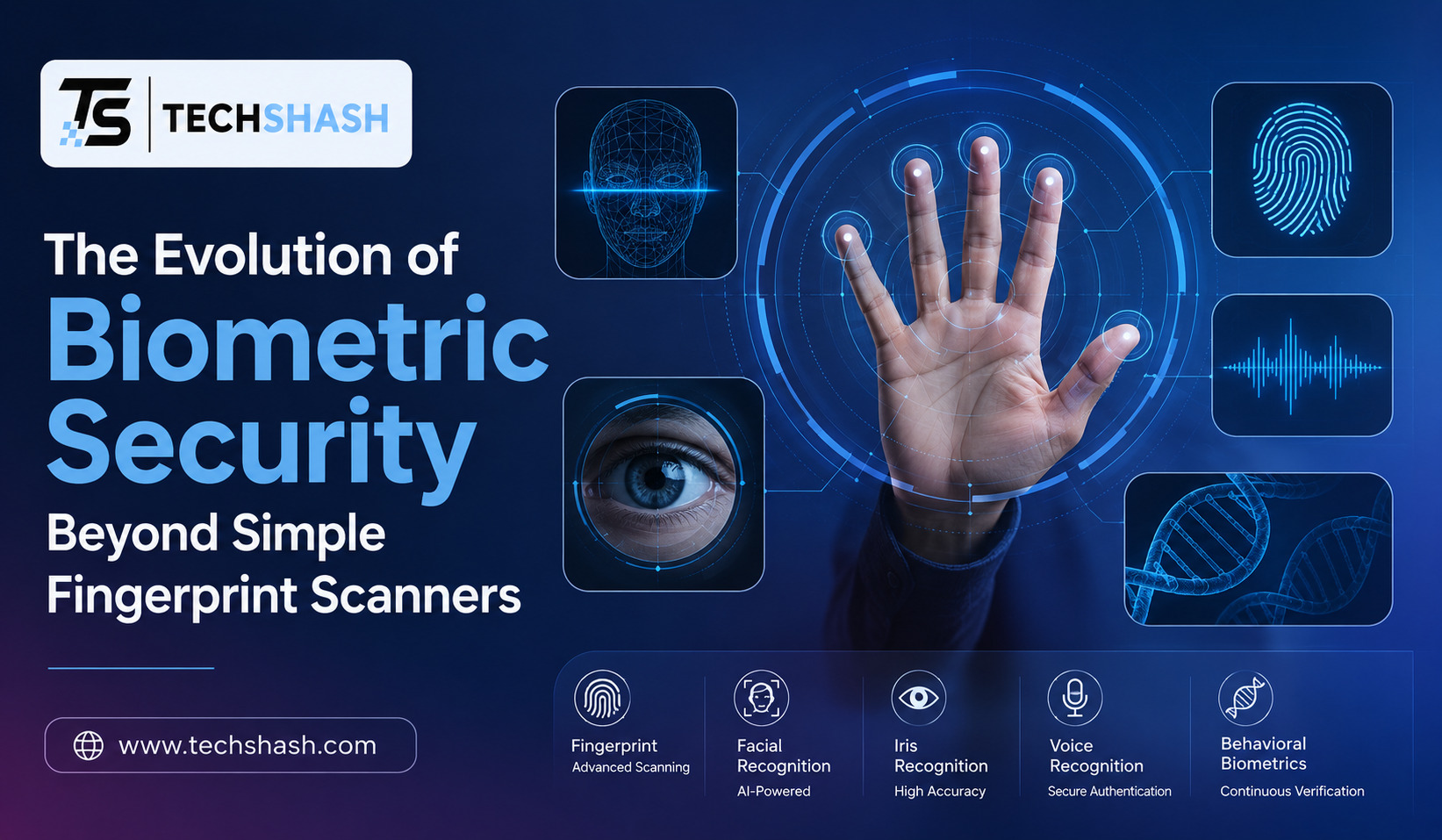
Passwords and plastic cards are no longer enough to keep digital spaces safe. People need authentication methods that are quick, unique, and hard to steal. This necessity sparked the evolution of biometric security from basic ink pads to systems that recognize human traits instantly.
Every person carries physical features that remain distinct throughout life. Technology can now read these traits to prove who you are in seconds. Understanding this progression shows how modern devices keep your personal data protected.
1. The Early Days of Fingerprint Scanning Technology
Fingerprint identification was the first physical trait used on a large scale. Early commercial systems relied on optical sensors to capture digital images of ridge patterns. Light reflected off the skin to create a visual map of the finger.
Over time, these optical sensors showed clear limits. Dirty fingers, wet skin, or surface scratches often caused system errors. Simple paper photos or rubber molds could also fool basic optical readers.
Manufacturers then developed capacitive sensors to fix these security gaps. Capacitive chips use tiny electrical circuits to measure the electrical signals in your skin. Because dead skin or photos do not carry electrical charge, these sensors raised the safety standard.
Later, ultrasonic technology entered mobile phones. Ultrasonic sensors send sound waves against the glass to map every tiny valley on a surface. This advancement made fingerprint recognition faster and far more accurate than older models.
- Optical Readers: Capture flat images using visible light and camera sensors.
- Capacitive Chips: Measure small electrical charges across skin ridges.
- Ultrasonic Sensors: Map physical ridges using high-frequency sound waves.
2. How Facial Recognition Changed Digital Identity
Facial identification moved security from touching a surface to looking at a screen. Early facial tools measured the distance between eyes, nose width, and jaw lines using flat two-dimensional images.
Two-dimensional systems had massive weaknesses. A high-resolution photo held up to a camera could unlock a locked system easily. Security engineers needed a method that captured actual depth.
Modern smartphones use three-dimensional structured light technology to fix this vulnerability. Infrared dots project onto a face to calculate thousands of depth points instantly. Infrared cameras read this invisible pattern to construct an exact mathematical model of your face.
[Infrared Emitter] —> Projects 30,000 Invisible Dots
|
[User’s Face]
|
[Infrared Camera] —> Captures Depth Map & Matches Template
Artificial intelligence helps these systems adapt as human faces age. Changes like growing a beard, wearing glasses, or applying makeup do not block access. Today, facial scanners operate in pitch darkness while maintaining strict accuracy.
3. Iris and Retina Scanning for High Security
Eye scanning technology provides higher precision than standard physical measurements. While fingerprints can wear down from physical work, internal eye structures stay unchanged for decades.
Iris scanning examines the colored ring inside your eye. Specialized camera filters capture hundreds of unique detail markers within the muscle fibers. This process works from a distance of several inches without touching the user.
Retina scanning looks deeper into the eye structure. Infrared light shines through the pupil to highlight the unique pattern of blood vessels at the back of the eye. Because the retina lies deep inside, it is nearly impossible to fake or alter.
Iris Scanning Features
- Captures over two hundred unique data points within the iris structure.
- Works well through normal clear reading glasses or contact lenses.
- Operates rapidly without requiring physical contact with equipment.
Retina Scanning Features
- Scans internal blood vessel layouts behind the pupil.
- Provides extremely low error rates for maximum facility safety.
- Requires the user to stand still close to a specialized sensor.
High-security sites like government vaults and research laboratories prefer eye scans. The mathematical uniqueness of eye patterns makes false positive matches virtually impossible.
4. Vein Pattern Recognition and Vascular Biometrics
Vascular identification looks beneath the surface of human skin to verify identity. Every human body has a distinct network of veins carrying blood to the heart. Infrared light passes through skin tissue and gets absorbed by hemoglobin in the blood.
Because veins absorb infrared rays, they show up as dark lines on sensor cameras. This creates an internal map that no outside individual can view or copy. Vascular scanning works on hands, palms, or single fingers.
[Near-Infrared Light] —> Absorbed by Hemoglobin in Veins
|
[Vascular Sensor] —> Creates Map of Dark Internal Vein Lines
|
[Matching Module] —> Grants Access Based on Unique Vein Pattern
Spoofing a vascular system requires active blood flow within living tissue. Dead tissue or fake rubber hands cannot pass a vascular scan. This makes vein recognition exceptionally secure for financial centers and bank ATMs.
Contactless palm scanners offer high sanitary value in public places. Users hover their hand above a scanner without touching shared hardware. Sanitization concerns disappear while identification remains fast and reliable.
5. Behavioral Biometrics and How You Interact With Devices
Physical traits are not the only way to confirm who you are. Behavioral metrics analyze human habits and micro-movements during normal device usage. Modern software builds a profile based on your physical interactions.
Keystroke dynamics measure how fast you press keys on a keyboard. The system calculates the exact milliseconds you hold down each letter and the delays between words. Everyone has a distinct typing cadence that is difficult for an intruder to copy.
Touchscreen gestures offer another layer of behavioral proof. Software tracks finger pressure, swiping speed, and angle of contact across screens. Even the subtle angle at which you hold your mobile device acts as an identification factor.
Key Behavioral Attributes
- Typing Rhythm: Microsecond delays between keystrokes on standard keyboards.
- Swipe Dynamics: Angle, speed, and surface area of finger movement on touch screens.
- Gait Analysis: Walking pace and movement bounce recorded by smartphone sensors.
Behavioral verification runs continuously in the background while you work. If an unauthorized person grabs your unlocked phone, the system notices strange handling habits. The device can lock itself automatically within seconds of unusual activity.
6. The Rise of Multi-Modal Biometric Systems
Single verification methods sometimes fail under harsh real-world conditions. Wet fingers confuse touch sensors, bright sunlight blinds cameras, and loud background noise blocks voice detectors. Multi-modal systems solve this problem by combining two or more identification traits.
A multi-modal setup might check a fingerprint while simultaneously analyzing a face. Some high-security doors require a voice print alongside a quick iris scan. Requiring multiple valid inputs reduces security errors down to near zero.
+——————-+ +——————-+
| Fingerprint Scan | + | Facial Depth Map |
+——————-+ +——————-+
| |
+————+————-+
|
[Multi-Modal Security Engine]
|
[Access Granted or Denied]
Multi-modal architectures also improve convenience for diverse user bases. If a user has a damaged fingerprint ridge, the system automatically falls back on facial traits. Flexibility increases while system protection remains exceptionally strong.
Large enterprises use these combined checks to safeguard valuable infrastructure. Banking apps often use multi-factor checks before permitting massive wire transfers. Combining physical traits creates a complex defense that bad actors cannot bypass.
7. Security Challenges and Privacy in the Evolution of Biometric Security
As verification technology expands, privacy concerns grow larger every year. Unlike stolen passwords, you cannot change your facial features or eye patterns after a data leak. Protecting raw biological files must remain the top priority for developers.
Hackers use advanced artificial intelligence to create deepfake videos and synthetic voice samples. Security teams counter this threat by building active liveness detection tools. Liveness checks ensure that the scanned subject is a real, breathing human present at the scene.
Modern hardware stores biological data inside encrypted system chips rather than central servers. Apple uses the Secure Enclave, while Android relies on Trusted Execution Environments. Your biological files never leave the local processor during standard verification steps.
[Raw Biometric Input] —> [On-Device Secure Chip] —> [Encrypted Hash Match]
|
[No Data Leaves Device]
Governments across the globe are passing stricter regulatory laws for biological data protection. Companies must ask for explicit permission before collecting any personal identifiers. Strict data minimization rules ensure that businesses store mathematical values rather than actual photos or recordings.
The evolution of biometric security continues as software models become smarter. Future iterations will focus on subtle biological signals like heartbeat rhythms. Protecting user rights while building strong identity tools will determine the future of personal defense.
Key Takeaways
- Fingerprint Progression: Technology moved from flat optical pictures to deep ultrasonic sound waves.
- Facial Mapping: Modern systems project invisible depth grids to prevent photo spoofing.
- Internal Scanning: Iris and vein patterns offer near-perfect security because internal traits cannot be copied.
- Behavioral Protection: Continuous background tracking checks typing speed and screen swipe habits.
- Data Privacy: On-device security chips keep raw biological data isolated from remote servers.
Frequently Asked Questions
Can a picture fool modern facial identification systems?
Flat photos cannot fool modern three-dimensional depth sensors and liveness detection algorithms.
What makes vein pattern scanning so secure?
Vein scanning requires active blood flow inside living human tissue to create a valid scan.
Is biometric identity data stored on central corporate servers?
Most modern consumer devices isolate and encrypt your biological files locally inside specialized hardware chips.
What happens if a physical biometric scanner fails to read a user?
Multi-modal systems automatically fall back on alternative traits such as facial recognition or personal PIN codes.
Can an individual change their biological data if a leak occurs?
Physical traits cannot be changed, which is why system architectures store encrypted mathematical hashes instead of raw biological images.
Conclusion
Biological identity verification has changed dramatically over recent decades. Simple surface scanners have transformed into intelligent networks capable of reading internal veins, eye structures, and subtle motion habits. This ongoing evolution of biometric security ensures that personal accounts stay safe against modern digital threats. Moving toward multi-layered systems promises higher convenience without sacrificing individual user privacy.