Introduction
Google has spent several years trying to talk people out of typing passwords, and by 2026 that effort has a name most people have at least heard of: passkeys. Android has quietly rebuilt sign-in around this technology, treating passkeys as the new default rather than an optional extra.
This article breaks down what passkeys actually are, how deep Android’s integration goes, and what the current adoption data says about whether passwords are actually on their way out.
What a Passkey Actually Is
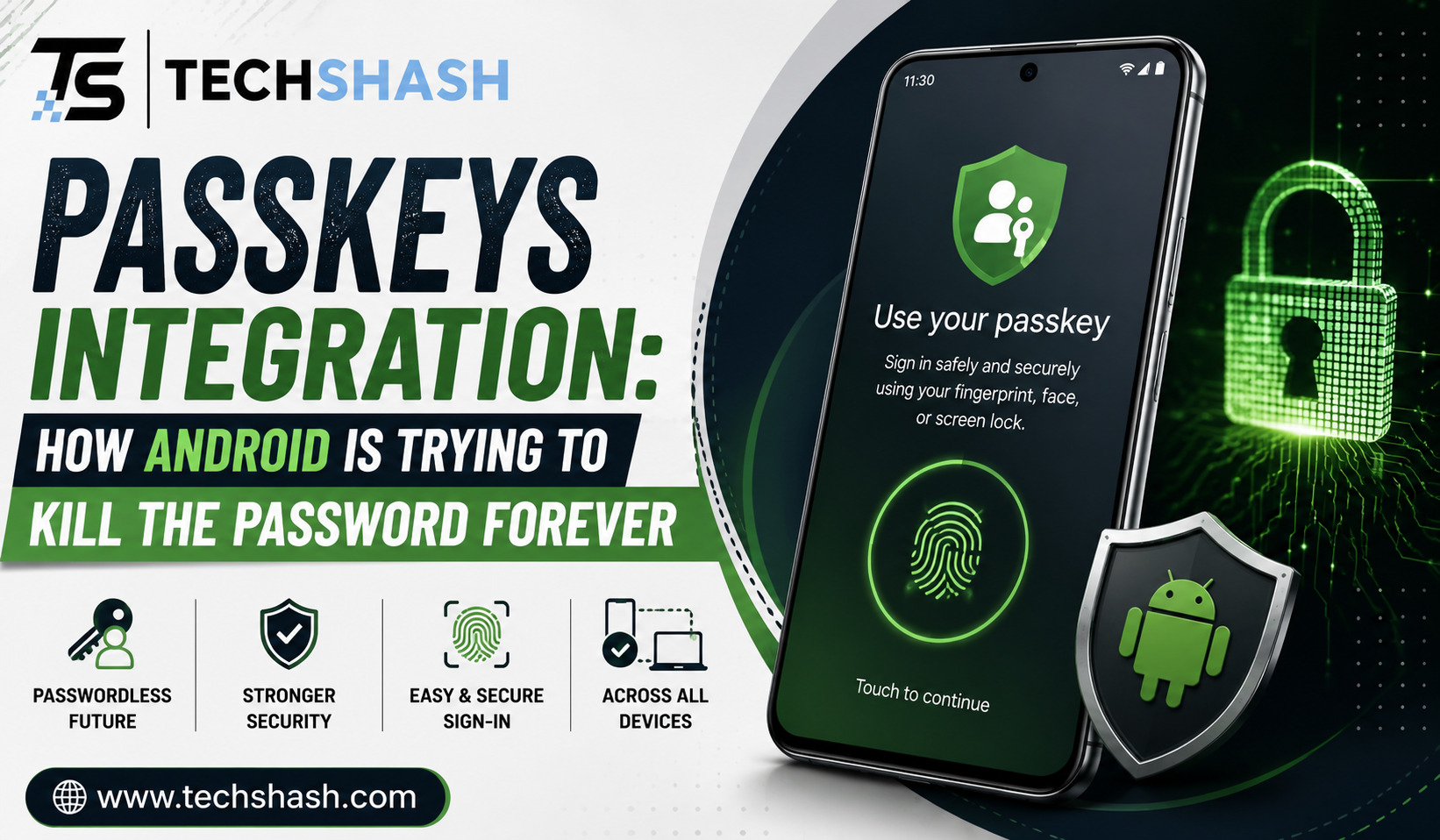
A passkey is not a password stored somewhere safer. It is a cryptographic key pair created specifically for one account on one service. A public key gets stored with that service, while a matching private key stays locked to your device and never travels across the network during sign-in.
Logging in works differently as a result. The service sends a one-time challenge, your device signs it using the private key, and the site checks that signature against the public key it already has on file. Nothing resembling a shared secret is ever typed, sent, or stored the way a password is.
Confirming that this is really you happens locally, through a biometric sensor, PIN, or pattern rather than through the credential itself. This is the detail that makes passkeys feel similar to unlocking your phone, because in a real sense, that is exactly what is happening.
How Android Builds Passkeys Into the Phone
Google has not treated passkeys as a bolt-on feature. Android’s Credential Manager, opened up publicly for app developers in November 2023, gives apps a standard way to offer passkey sign-in and lets users pick their preferred password manager for handling those credentials, even if the app itself was not built with passkeys in mind.
Passkeys created on an Android device are, by default, stored and encrypted through Google Password Manager, which then synchronizes them across a person’s other Android devices and any Chrome browser signed into the same Google account. That syncing is central to the pitch: create a passkey once, and it should be usable everywhere you are already signed into your account.
Google has pushed this further at the account level too. Passkeys became the default sign-in option for Google accounts, meaning users who had not already set one up would be prompted to create one, rather than needing to seek the feature out themselves.
Why Phishing Resistance Is the Real Selling Point
Convenience gets most of the marketing attention, but security researchers consistently point to a different reason passkeys matter: they are structurally resistant to phishing in a way passwords can never be. According to the FIDO Alliance’s 2026 State of Passkeys report, phishing resistance remains the leading reason organizations deploy the technology, ahead of login speed and user experience.
The mechanism behind that resistance is domain binding. A passkey is cryptographically tied to the real website or app it was created for, so a convincing fake login page cannot trick a device into releasing a valid signature, even if a person is completely fooled by the page itself. A password, by contrast, can always be typed into the wrong place.
The scale of that protection shows up in enterprise data. Microsoft’s Digital Defense Report found that phishing-resistant multi-factor authentication blocks more than 99 percent of identity-based attacks, even when an attacker already has a valid username and password in hand. That is a meaningfully different security posture than adding a second password-adjacent step on top of a first one.
The Adoption Numbers So Far
By most available measures, 2026 is the year passkeys actually became mainstream rather than a feature only security-conscious users bothered with. The FIDO Alliance estimated 5 billion passkeys in active use worldwide as of its May 2026 State of Passkeys report, and consumer awareness of passkeys reached 90 percent, up from 75 percent the year before.
Awareness has translated into real use, not just recognition. The same report found 75 percent of consumers enable passkeys on at least some accounts, 40 percent enable them across most of their apps, and nearly half say they enable a passkey whenever the option is offered.
Performance data backs up why people stick with them once they try them. FIDO’s figures put passkey sign-in success at 93 percent, compared with 63 percent for traditional password-based methods, and average sign-in time at roughly 8.5 seconds versus 31.2 seconds for passwords. Google has separately reported that passkey sign-ins succeed about four times more often than password sign-ins on its own platforms.
Where the Passwordless Promise Still Breaks Down
None of this means passwords are actually gone, and the same reports celebrating passkey growth are candid about how far the transition still has to go. FIDO’s own research found that 57 percent of organizations that have already deployed passkeys still rely on phishable authentication methods for everyday primary sign-in, meaning deployment and full replacement are two very different milestones.
Website-level support tells a similar story. Academic scans of top-ranked domains have found only a few hundred confirmed passkey-enabled websites, even as the number of passkeys in circulation runs into the billions. Most of that gap comes down to major platforms, banks, and large services enabling passkeys quickly, while smaller sites, older enterprise tools, and many government portals lag behind.
Real-world friction shows up at the individual level too. One Android Authority writer who tried living passwordless in 2026, pairing passkeys with Google’s newer Verified Email feature, described the experience as fragmented rather than seamless, despite each individual piece working roughly as intended. Passkey recovery adds its own wrinkle: switching devices, losing a phone, or signing out on a non-Android device can all trigger different rules about how long a passkey stays valid before you need a fallback method.
What This Looks Like for a Regular Android User
In practice, the fastest way to see this shift is to look at what happens the next time you sign into a Google account on Android. If a passkey has not already been created, the device now proactively offers to set one up rather than waiting for the option to be found in settings.
Once created, that passkey is not limited to the phone that generated it. Because it syncs through Google Password Manager, the same credential can confirm a sign-in on a computer by scanning a QR code with the phone, effectively turning the handset into a physical authentication key for other devices.
Third-party apps have followed a similar path. Developers who adopt Android’s Credential Manager API get passkey support without having to build biometric authentication or key management themselves, which is a large part of why passkey-enabled apps have expanded well beyond Google’s own products, including services like eBay, PayPal, and various password managers.
Is the Password Actually Dying
The honest answer, based on where the data sits in 2026, is that passwords are losing ground quickly at the platform level while remaining deeply embedded everywhere else. Google, Apple, Microsoft, most major password managers, and an increasing share of banks now support passkeys as either the default or a prominently offered option, and the adoption numbers behind that shift are genuinely large rather than aspirational marketing figures.
At the same time, industry benchmarks describe passkey adoption as uneven rather than complete: strong in fintech, where the cost of account takeover makes aggressive rollout an easy business case, and much slower in general SaaS, government services, and smaller websites that have not prioritized the engineering work involved. Full password elimination, even among organizations that have already deployed passkeys, remains the exception rather than the rule.
So Android is not exaggerating when it frames passkeys as the future of sign-in. It is, however, still a future in progress. The password has not been killed yet. It has been demoted, on an increasing share of the internet, from the only option to one of several, with passkeys steadily becoming the one most people are pushed toward first.
Key Takeaways
- What a passkey is: A cryptographic key pair confirmed locally by biometrics, not a stored password.
- Android’s role: Credential Manager and Google Password Manager build passkey creation and syncing directly into the platform, with passkeys now the default prompt for Google accounts.
- Core security benefit: Domain binding makes passkeys resistant to phishing in a way passwords structurally cannot be.
- Scale reached in 2026: 5 billion passkeys in active use worldwide and 90 percent consumer awareness, per the FIDO Alliance.
- The gap that remains: 57 percent of organizations using passkeys still rely on phishable methods for everyday sign-in, and website-level support still trails consumer demand.
- Bottom line: Passwords are shrinking in importance quickly, but coexistence, not elimination, describes 2026 accurately.
Frequently Asked Questions
What is the main difference between a passkey and a password?
A passkey is a cryptographic key pair confirmed with biometrics or a PIN, while a password is a shared secret typed and transmitted at every sign-in.
How many passkeys are currently in use worldwide?
The FIDO Alliance estimated 5 billion active passkeys worldwide as of its May 2026 report.
Does Android make passkeys the default sign-in method?
Yes, Google has made passkeys the default prompt for Google accounts, encouraging users to create one if they have not already.
Are passkeys actually more resistant to phishing than passwords?
Yes, because a passkey is cryptographically bound to the real website or app, a fake login page cannot obtain a valid signature even if a user is fooled by it.
Have passwords been fully replaced by passkeys in 2026?
No, even among organizations that have deployed passkeys, a majority still rely on phishable methods for everyday sign-in.
Conclusion
Android’s push toward passkeys is not a minor feature update. It is a genuine structural shift in how sign-in works, backed by adoption numbers that have moved from early enthusiast territory into mainstream, billions-of-credentials scale. What the current data does not support is the idea that the password is already gone. Coexistence remains the reality for 2026, with passkeys steadily becoming the preferred front door while the password waits in reserve as the fallback almost everyone still needs somewhere.