Introduction
Apple likes to put a small green leaf on the box of certain products and call them carbon neutral. It sounds simple. The reality behind that label is not.
Between lawsuits, a court ruling in Germany, tightening regulations in Europe, and ongoing questions about where old phones actually end up, the carbon neutral claim has become one of the most argued-about parts of Apple’s marketing. This article looks at what the claim means, where it holds up, where it does not, and what it has to do with e-waste.
What “Carbon Neutral” Actually Means for Apple
Apple defines a carbon neutral product as one where it has cut emissions by roughly 75 percent compared with a standard version of that product, then balanced the remaining emissions using carbon offset credits. The company began stamping this label on certain devices, including select Apple Watch models, starting in 2023.
That definition matters, because it does not mean zero emissions were produced. It means most emissions were avoided through cleaner manufacturing and shipping, and the leftover portion was offset by paying for projects elsewhere, such as forestry or renewable energy schemes, that claim to remove or avoid an equivalent amount of carbon.
Critics have pointed out that this definition is a company-chosen standard rather than a universal one. One climate journalist compared it to declaring a single body part free of a disease while ignoring the rest of the body.
The Case for Apple’s Progress
It is worth being fair to what Apple has actually done, separate from the marketing label. The company has cut its overall greenhouse gas emissions by more than 60 percent since 2015, and that reduction held steady in 2025 even during a year of business growth.
Much of that progress has come from moving suppliers onto renewable electricity, redesigning packaging, and shifting toward recycled materials rather than newly mined ones. Apple’s own reporting states that 30 percent of the material across all products it shipped in 2025 came from recycled content, up from the year before.
Some materials have reached full recycled sourcing. Apple says all cobalt in batteries it designs and all rare earth elements in its magnets are now 100 percent recycled, and the enclosures on several devices, including the Apple Watch, iPad, and MacBook Air, use fully recycled aluminum.
Where the Carbon-Neutral Label Gets Challenged
The disagreement is not really about whether Apple has reduced emissions. It has. The disagreement is about whether the remaining, unreduced emissions are genuinely canceled out by the offsets Apple buys.
Offset critics raise a concept called additionality: the idea that an offset project should represent carbon reduction that would not have happened anyway. If a forest was never at risk of being cut down, paying to “protect” it does not remove any extra carbon from the atmosphere, even if the paperwork says it does.
A 2023 analysis from the Institute of Public and Environmental Affairs raised a related question. It noted that Apple reported increased emissions for a new iPhone release in the same period the Apple Watch reached its carbon neutral milestone, and asked whether renewable energy allocated to suppliers was being shifted toward the watch specifically. Apple responded that it did not reallocate renewable energy between the two product lines.
The Apple Watch Lawsuits and What Courts Decided
These questions eventually reached courtrooms on two continents, with different results.
In the United States, seven buyers filed a proposed class action in February 2025, arguing Apple exaggerated the environmental benefit of the Apple Watch Series 9, Apple Watch SE, and Apple Watch Ultra 2. They said they would not have purchased the watches, or would have paid less, had they understood the details behind Apple’s carbon accounting. In February 2026, a federal judge dismissed the case, ruling that the plaintiffs had not shown Apple’s claims were plausibly false, though the case has since moved to an appeals court.
In Germany, the outcome went the other way. A Frankfurt court ruled in 2025 that Apple could no longer advertise the Apple Watch as a CO2-neutral product in that country. Part of the case focused on a eucalyptus plantation offset project in Paraguay, where the court questioned whether the land rights behind the project were secure past 2029, and critics separately argued that eucalyptus monocultures offer limited ecological value.
New Rules Are Forcing a Language Change
Regulation is catching up to this debate faster than litigation. The European Union is introducing rules that will bar companies from labeling a product carbon neutral if that claim depends on offsetting rather than direct emissions cuts.
Reporting indicates Apple will need to retire the carbon neutral label under these rules by 2026, regardless of whether its underlying manufacturing practices change at all. In other words, the same phone or watch, built the same way, may simply no longer be allowed to carry the phrase that made headlines when it first appeared on a product box.
This does not undo the emissions cuts Apple has made. It does mean the marketing language that consumers have gotten used to seeing is likely on its way out, at least in European markets, with pressure building elsewhere too.
E-Waste: The Side of the Story Carbon Labels Do Not Cover
A carbon neutral label focuses on emissions produced while making and shipping a device. It says very little about what happens after that device is thrown away, which is where e-waste enters the picture.
Electronic waste is one of the fastest-growing waste categories in the world. Phones, tablets, and laptops contain a mix of valuable and hazardous materials, including gold, cobalt, lithium, and various rare earth elements, alongside components that can leach harmful substances if dumped or burned improperly rather than processed through formal recycling channels.
A device can be manufactured with a relatively low emissions footprint and still contribute to e-waste problems if it is hard to repair, short-lived, or ends up in a landfill or informal recycling operation instead of a certified facility. Carbon accounting and e-waste outcomes are related, but they are not the same measurement, and a strong score on one does not guarantee a strong outcome on the other.
How Apple Is Tackling E-Waste
Apple has invested specifically in the recovery side of this problem, separate from its carbon offset programs. In 2025, the company launched a recycling line called Cora at its Advanced Recovery Center in California, which uses precision shredding and sensor-based sorting to pull more usable material out of returned devices.
Alongside Cora, Apple developed a tool called the Automated Recycling Identification System, or ARIS, which runs on machine learning to help classify e-waste more accurately. The company has encouraged its outside recycling partners to adopt the system as well, with the goal of recovering more material industry-wide rather than only within Apple’s own facilities.
Some questions remain open here too. Apple’s public reporting does not break down recycled content by individual product line or price tier, so it is difficult for outsiders to know whether flagship devices carry meaningfully more recycled material than entry-level ones. Claims about fully recycled components are also generally limited to parts Apple itself designs, which leaves out third-party accessories and older devices still circulating through secondary markets.
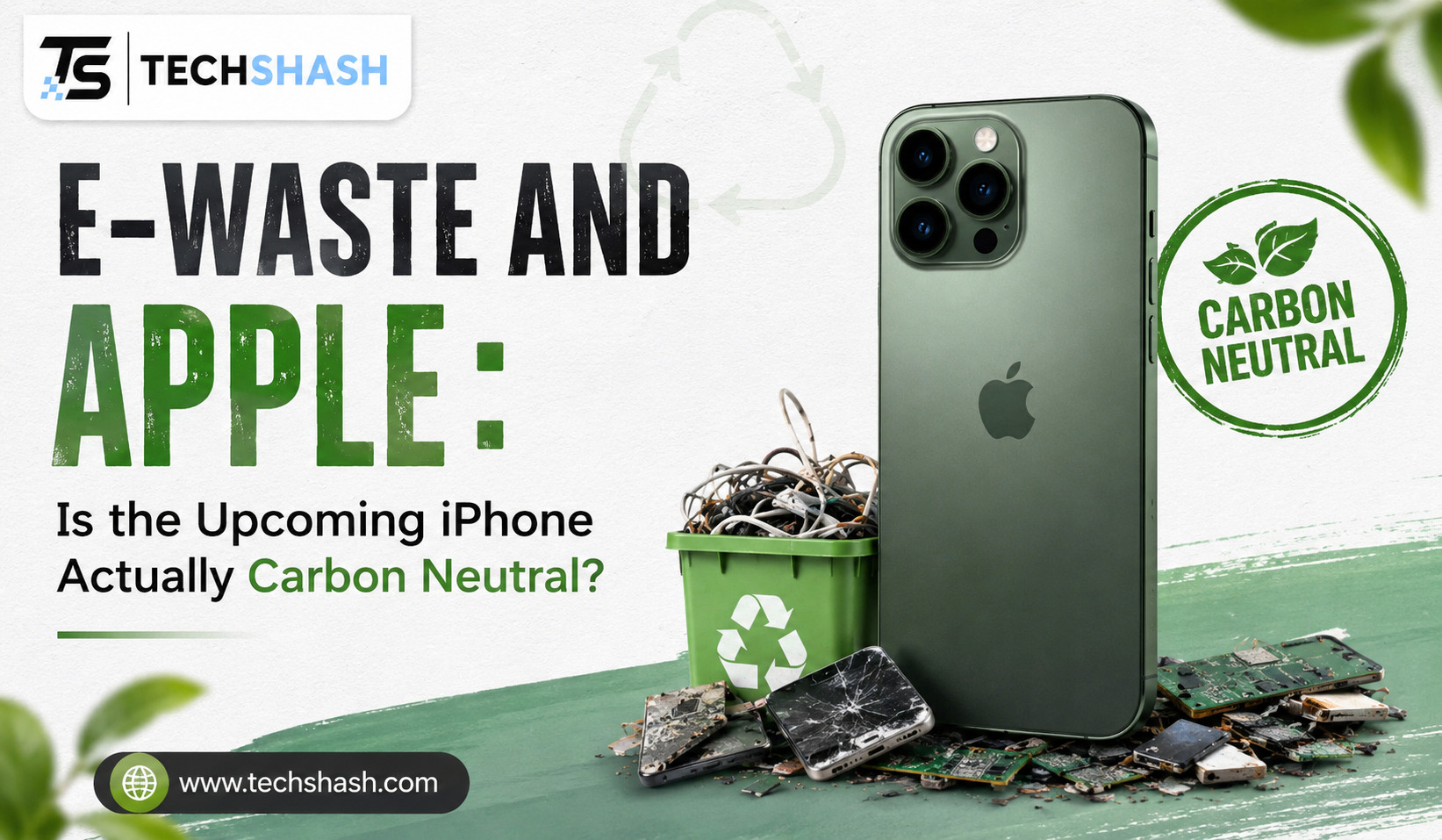
Is the Upcoming iPhone Actually Carbon Neutral
At the time of writing, Apple has not shipped a carbon neutral iPhone in the way it has certain Apple Watch models. iPhone models do publish individual Product Environmental Reports listing recycled content percentages and the share of manufacturing electricity sourced from supplier renewable energy projects, but they generally stop short of the full carbon neutral badge.
So the honest answer for any upcoming iPhone is layered. Genuine progress is happening: recycled materials are climbing, supplier renewable energy use is expanding, and total emissions remain well below 2015 levels. At the same time, “carbon neutral” as a specific marketing claim rests on offset accounting that courts, regulators, and researchers have not fully agreed is reliable, and the label itself is being phased out under new rules regardless of what happens inside the factory.
Calling a device carbon neutral implies its climate impact has effectively reached zero. A more accurate description, based on what has actually been reported, is that Apple has meaningfully reduced its emissions and is investing in better material recovery, while still leaning on offset purchases and imperfect data to close the remaining gap.
Key Takeaways
- Definition: Apple’s carbon neutral claim means roughly 75 percent emissions reduction plus offsets for the rest, not zero emissions.
- Real progress: Apple has cut overall emissions more than 60 percent since 2015 and reached 30 percent recycled material across shipped products in 2025.
- Legal record is mixed: A US lawsuit over Apple Watch claims was dismissed, while a German court blocked the CO2-neutral label outright.
- Regulation is changing the language: New EU rules will likely force Apple to drop the carbon neutral label by 2026 regardless of manufacturing practices.
- E-waste is a separate issue: Emissions accounting does not fully capture what happens to a device after it is discarded.
- Apple’s recycling investment: New tools like Cora and ARIS aim to recover more material from returned electronics.
- Bottom line: Meaningful progress exists, but the specific carbon neutral claim rests on contested offset accounting.
Frequently Asked Questions
Does Apple currently sell a carbon neutral iPhone?
As of this writing, Apple has applied the carbon neutral label mainly to select Apple Watch models rather than the iPhone lineup.
Why did a German court block Apple’s carbon neutral claim?
The Frankfurt court questioned the long-term reliability of a forestry offset project Apple used and ruled the CO2-neutral label could mislead consumers.
Did Apple lose the US lawsuit over its carbon neutral claims?
No, a federal judge dismissed the case in February 2026 after ruling the plaintiffs had not plausibly shown Apple’s claims were false, though the case has since been appealed.
Will Apple stop using the term carbon neutral?
Reports indicate new EU rules will require Apple to retire the carbon neutral label by 2026 because it relies on offsets rather than direct emissions elimination.
How is e-waste different from carbon emissions?
Carbon emissions measure greenhouse gases released during production and shipping, while e-waste refers to what happens to a device physically after it is discarded.
Conclusion
The debate over carbon neutral iPhones and Apple Watches is really two separate conversations tangled into one label. Apple has made real, measurable cuts to its manufacturing emissions and is investing seriously in material recovery and e-waste handling through tools like Cora and ARIS. At the same time, the specific claim that a product’s climate impact reaches zero depends on offset accounting that courts, regulators, and independent researchers continue to question, and that label is now being phased out under new rules regardless of what changes on the factory floor.