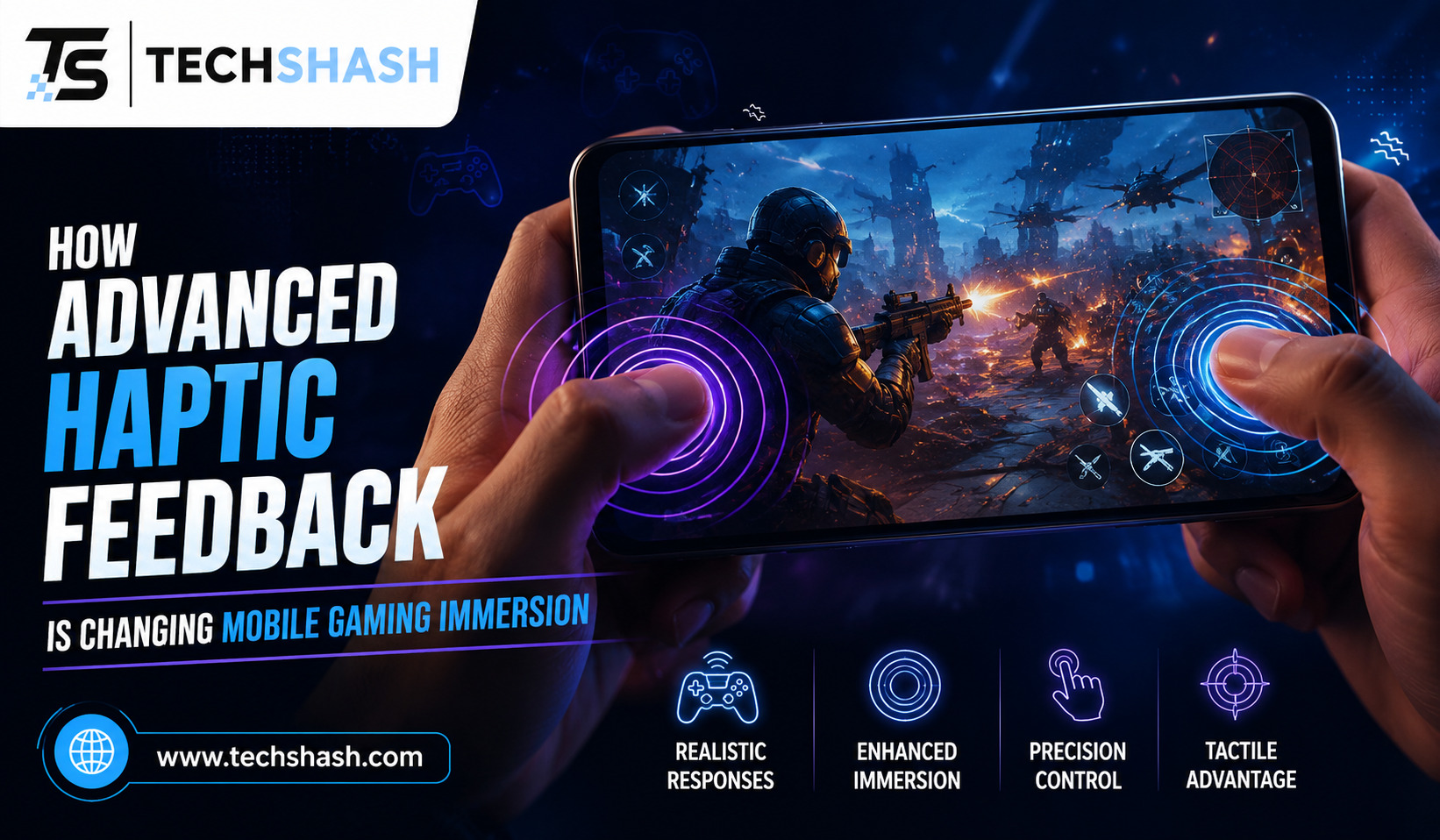
Imagine holding a smartphone and feeling the distinct drop of rain, the mechanical click of a reload, or the sudden thump of an explosion directly in your palms. Advanced haptic feedback makes these sensations possible by converting digital events into realistic physical touch sensations. Mobile gaming used to rely only on sharp graphics and clear sound to pull players into a virtual world. Today, touch sensation has become the third major pillar of digital immersion. This article will explain how touch feedback technology works, why it matters for modern phones, and how developers use it to improve player experiences.
1. What Is Advanced Haptic Feedback in Mobile Devices?
Simple phone vibration has existed for decades to alert users about incoming calls. Modern touch feedback goes far beyond basic buzzes by creating targeted physical sensations that feel like real surfaces or actions.
When you play a video game, advanced haptic feedback delivers precise physical sensations that match what happens on the screen. The goal is to simulate physical forces so your hands react to the game world naturally.
Understanding the Role of Touch Sensation
Human touch is deeply tied to how we perceive physical reality. When a game provides tactile response alongside sound and visuals, your brain processes the experience as a physical event.
This sensory alignment helps players feel more present in virtual environments. It transforms a flat glass screen into an interactive control surface.
Moving Beyond Basic Buzzes
Older mobile phones used basic motors that created loud, low-frequency buzzes. These old systems had slow start and stop times, which meant every effect felt roughly the same.
Modern devices use precise actuators that can start and stop in milliseconds. This precision allows hardware to recreate light taps, sharp clicks, and steady rumbles with extreme accuracy.
2. The Evolution of Mobile Vibration Motors
Mobile vibration hardware has changed dramatically over the last twenty years. Early mobile phones relied on simple mechanical designs that lacked nuance and control.
Understanding this history helps clarify why current vibration motors offer such high precision. Hardware makers spent years refining tiny internal components to maximize physical output
Eccentric Rotating Mass Motors
The earliest vibration system was the Eccentric Rotating Mass motor, often called an ERM motor. This system uses a tiny electric motor that spins an off-center weight.
Because the weight is unbalanced, spinning it causes the entire phone to shake. These motors take time to reach full speed, which makes quick physical effects impossible to produce.
Linear Resonant Actuators
To solve the speed problem, phone manufacturers introduced linear resonant actuators, or LRAs. Instead of spinning a weight, an LRA moves a tiny magnetic mass back and forth along a single straight axis.
Because a magnetic spring controls the weight, an LRA can start and stop almost instantly. This allowed phone makers to create realistic button presses and sharp UI feedback.
Wide-Band Haptic Systems
The newest mobile devices feature wide-band linear actuators. These advanced components can operate across a wide range of frequencies and force levels at the same time.
By mixing different frequencies, wide-band motors can recreate complex textures like wood grain, running water, or sand. This capability brings unprecedented physical realism to handheld devices.
3. How Game Developers Utilize Tactile Response for Immersion
Hardware is only half of the equation when creating realistic touch effects. Game developers must write code that connects digital actions to specific physical forces.
When done correctly, tactile feedback gives players instant physical information without cluttering the screen. It builds a direct connection between player actions and in-game outcomes.
Weapons and Combat Mechanics
In first-person shooting games, different weapons should feel unique in the hand. Developers assign distinct haptic profiles to each firearm in a game.
- Pistols create a quick, sharp recoil tap in the palm.
- Heavy machine guns generate a strong, repeating pulse with sustained force.
- Energy weapons produce a smooth, rising hum that ends in a sudden discharge burst.
- Bow and arrow mechanics simulate growing tension as the player pulls back the string.
Environmental Feedback and Textures
Immersion improves when the environment itself responds to player movement. Modern game engines send physical cues when characters walk over different ground surfaces.
Running across concrete feels firm and brief under your fingers. Walking through deep mud produces a slow, heavy drag sensation that signals reduced movement speed.
Driving and Racing Simulations
Racing games benefit greatly from real-time physical feedback. Drivers rely on physical sensations to judge vehicle speed, traction, and road stability.
When a car drifts off the track, the phone vibrates on the specific side that hits the gravel. Tactile response lets players feel engine revolutions shifting through the virtual steering controls.
4. The Hardware Technology Powering Modern Mobile Haptics
Creating believable physical sensations inside a thin smartphone requires sophisticated engineering. Hardware designers must balance motor strength, space constraints, and power usage carefully.
Modern mobile phones use specialized hardware modules devoted entirely to tactile processing. These systems work alongside main processors to deliver instant physical responses.
Linear Resonant Actuator Axes
Phone makers install linear actuators in two main configurations based on space and desired force. The alignment of the motor changes how force moves through the phone body.
| Actuator Type | Axis Movement | Primary Use Case | Sensation Profile |
| Z-Axis LRA | Up and down (perpendicular to screen) | Crisp UI clicks and home button taps | Concentrated, sharp tap on the glass surface |
| X-Axis LRA | Side to side (parallel to phone edges) | Complex gaming effects and direction | Broad, immersive rumble across the hands |
X-axis actuators are larger and produce stronger physical forces across the entire device body. Most modern high-end gaming phones use X-axis motors or dual motor setups for maximum effect.
High-Voltage Dedicated Drivers
Vibration motors require rapid changes in voltage to produce distinct physical effects. Dedicated haptic driver chips control these electrical signals with extreme precision.
These specialized driver chips store pre-rendered wave files for common physical effects. When a game requests an effect, the driver chip plays the waveform instantly to prevent delay.
Pressure-Sensitive Touchscreens
Some modern gaming phones combine vibration motors with pressure-sensitive screen layers. These screens measure how hard a user presses down on the glass.
Pressing harder can trigger deeper physical clicks or activate secondary game controls. This hardware combination makes flat glass screens feel like physical buttons.
5. Key Benefits of Touch Feedback for Competitive Mobile Gamers
Tactile sensations are not just decorative features for casual fun. For competitive mobile players, tactile feedback provides functional advantages during matches.
Receiving information through touch frees up visual and auditory attention. Players can process critical game events faster when multiple senses work together.
Faster Reaction Times
Human visual processing is slightly slower than tactile physical processing. When a player feels a physical hit marker before seeing health bars drop, they react quicker.
This tiny speed advantage helps competitive players dodge incoming attacks or return fire faster. Physical cues lower cognitive load during intense gameplay situations.
Reducing Visual Clutter
On small mobile screens, user interface elements often block the game action. Traditional games use large icons, directional arrows, and flash overlays to show damage.
Using physical feedback allows developers to clean up the user interface. Mobile gaming experience improves when players feel damage direction through their hands instead of reading screen indicators.
Improved Control Accuracy
Virtual touch buttons offer no physical resistance, which leads to misclicks during fast play. Haptic engine response creates a simulated click whenever a virtual button is pressed.
This immediate physical confirmation tells the player their input was registered successfully. As a result, players make fewer mistakes during high-stakes competitive moments.
6. Challenges in Implementing Haptics Across the Mobile Ecosystem
Despite the benefits, adding high-end touch feedback to mobile titles comes with technical difficulties. Developers must solve several hardware and software issues to ensure consistent quality.
Not every mobile phone contains the same high-end components. Creating effects that work well across thousands of different phone models requires extra effort.
Hardware Fragmentation
The Android market features thousands of different phone models from dozens of brands. Some budget phones still use cheap ERM motors, while flagship devices use advanced wide-band actuators.
A physical effect designed for a flagship phone might sound like a loud rattle on a low-cost device. Developers must adjust effect strength to ensure good performance across all hardware levels.
Battery Drain and Thermal Limits
Vibration motors require electric current to move internal magnetic weights rapidly. Continuous physical feedback during long gaming sessions can drain the battery faster than normal play.
Motors also produce small amounts of internal heat when active for long periods. System software must limit motor usage to keep devices cool and protect battery life.
Software API Differences
Operating systems handle tactile signals differently depending on the software version. Translating game engine commands into native hardware signals can create small performance delays.
To fix this, industry groups are working to standardize touch feedback APIs. Common standards make it easier for developers to build physical effects across different platforms.
7. What the Future Holds for Mobile Tactile Touch Technology
Mobile hardware continues to evolve rapidly each year. Next-generation touch technology will offer even higher precision and entirely new ways to feel digital worlds.
Emerging engineering methods aim to change how we interact with mobile glass screens entirely. The line between real textures and virtual graphics will continue to blur.
Microfluidic Screen Surfaces
Engineers are developing screens that physically change shape using microfluidic technology. Tiny channels of liquid beneath the display can push up to form temporary physical buttons.
When you launch a mobile game, real plastic-like ridges pop up over virtual control sticks. Once you close the game, the fluid drains away and leaves a smooth glass surface.
Artificial Intelligence-Driven Effect Generation
Creating custom physical waveforms for thousands of game actions takes a lot of manual work. Future game engines will use machine learning to convert game audio directly into tactile signals.
An AI algorithm can analyze sound effects in real time and generate matching physical vibrations automatically. This automation will bring high-quality touch feedback to smaller indie game studios.
Wearable Accessory Integration
Future mobile platforms will expand tactile feedback beyond the smartphone body itself. Bluetooth gaming gloves and wearable wristbands will provide localized physical feedback across both hands.
Feeling recoil in your fingers or impacts along your arms creates a deeper sense of physical presence. Mobile devices will act as central hubs for complex wearable sensory systems.
Key Takeaways
- Technology Foundation: Modern mobile touch systems use linear resonant actuators instead of old spinning motors to create fast, accurate physical sensations.
- Developer Implementation: Games use precise physical profiles to simulate weapon recoil, ground terrain textures, and vehicle engine vibrations directly through the hands.
- Competitive Advantage: Physical tactile cues help players react faster to damage, confirm virtual button presses, and clear visual clutter from small phone screens.
- Ecosystem Challenges: Device fragmentation, battery consumption, and non-standard software APIs remain the biggest obstacles for widespread adoption across all mobile devices.
- Future Innovations: Emerging technologies like microfluidic surface buttons, AI waveform generation, and gaming wearables will expand touch sensations beyond traditional glass screens.
Frequently Asked Questions
Does continuous tactile feedback drain your phone battery quickly?
Continuous physical feedback uses additional electrical power from the battery, but modern linear actuators are designed to minimize power draw during standard gaming sessions.
Can old smartphones support advanced physical touch effects?
Older smartphones containing eccentric rotating mass motors cannot play precise physical effects properly because their internal hardware reacts too slowly to quick electrical signals.
What is the main difference between ERM and LRA vibration motors?
ERM motors spin an off-center weight to shake the entire phone slowly, while LRA motors move a mass back and forth quickly along a straight axis for crisp physical clicks.
How do physical touch cues help competitive mobile gamers?
Physical cues allow players to feel damage hits and input confirmations faster than visual indicators alone, which improves reaction speed during intense matches.
Do all mobile games support custom touch feedback automatically?
Game developers must explicitly code custom physical profiles into their software, though newer tools are making it easier to convert game sounds into touch sensations automatically.
Conclusion
Mobile gaming has evolved from simple tap-and-swipe controls into a rich multisensory medium. The steady rise of advanced haptic feedback allows players to feel digital actions directly in their hands, creating deeper immersion and improved competitive control. As hardware makers build sharper actuators and developers refine tactile game design, physical touch will remain an essential feature of handheld entertainment.