Introduction
L&T Semiconductor Technologies keeps showing up in headlines about India’s chip ambitions, yet many people still ask what the company builds and whether it runs its own factory. It does not, at least not yet. This article lays out what the company has confirmed publicly, how it plans to make money, and what would need to happen before it ever builds a fabrication plant of its own. Along the way, it also covers who backs the company financially, what it has acquired, and where its revenue stands right now.
What L&T Semiconductor Technologies Actually Does
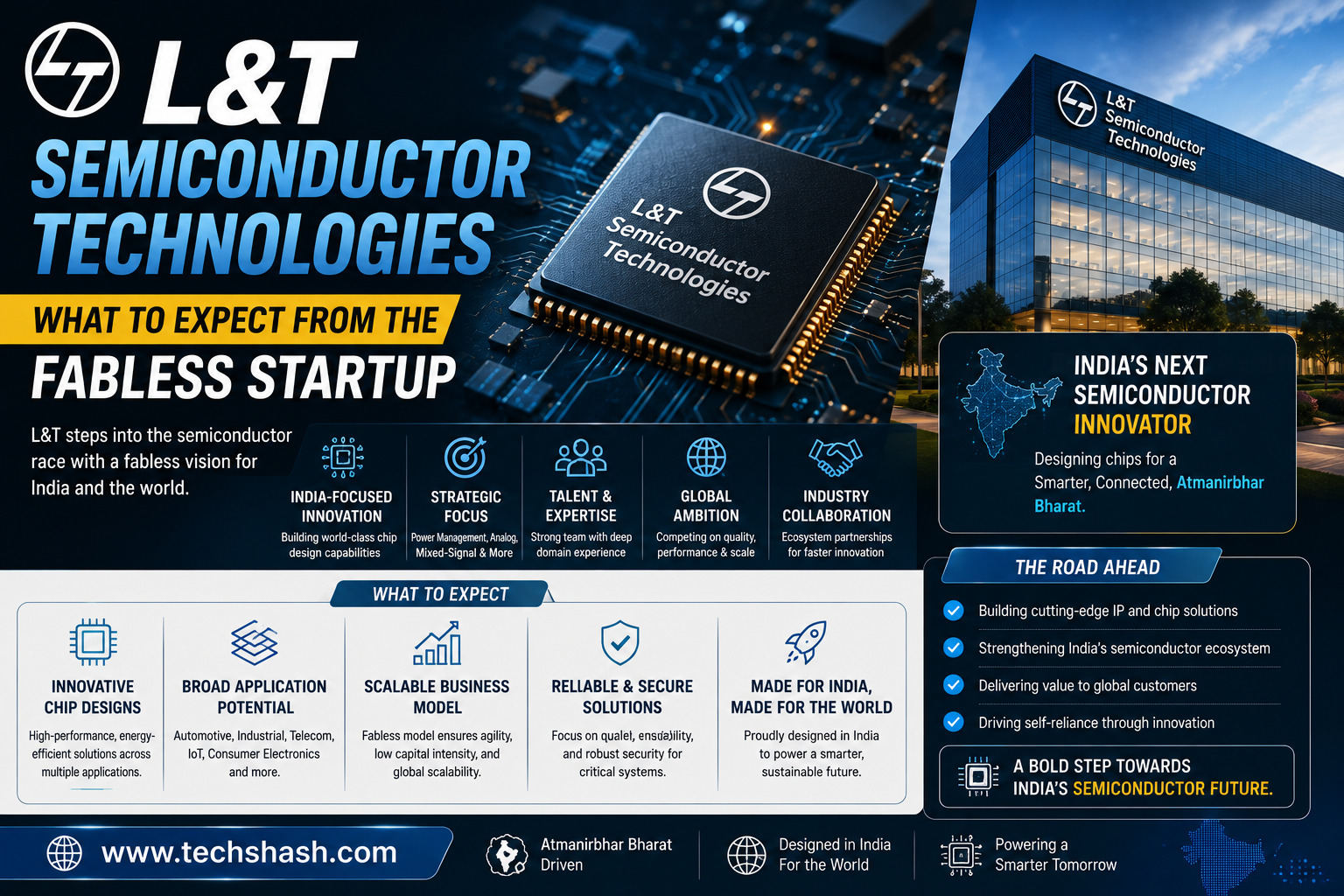
L&T Semiconductor Technologies, often shortened to LTSCT, is a wholly owned subsidiary of Larsen & Toubro. The company was founded in 2023 and is based in Mumbai. It follows a fabless model, meaning it designs chips but hands off the actual manufacturing to outside factories.
The company’s CEO, Sandeep Kumar, has described the focus areas clearly. LTSCT designs power chips, radio-frequency semiconductors, and mixed-signal integrated circuits. It targets automotive, industrial, and energy applications rather than chasing the AI graphics processor market that companies like Nvidia dominate.
Funding, Ownership, and Financial Backing
Larsen & Toubro announced plans in September 2024 to invest more than $300 million over three years to build out this chip design business. That commitment has grown since then. In the fiscal year ending March 2026, L&T funded the subsidiary with ₹541.97 crore, pushing its total capital commitment to the venture to ₹859 crore.
For a company still finding its commercial footing, the numbers on the revenue side remain modest. LTSCT recorded operating revenue of ₹13.52 crore for the fiscal year ended March 31, 2026. That gap between capital poured in and revenue generated tells you where the company sits right now: still building, not yet scaling.
Products, Focus Areas, and the SiliConch Acquisition
LTSCT’s product roadmap spans MEMS sensors, analog and mixed-signal chips, RF products, and smart power devices. Early plans called for designing 15 different semiconductor products, with commercial sales originally expected to start around 2027.
The company also grew through acquisition. It bought Bangalore-based SiliConch Systems for ₹183 crore, split into ₹133 crore paid upfront and ₹50 crore deferred. SiliConch was legally amalgamated into LTSCT effective March 24, 2026, consolidating chip-design intellectual property into a single entity rather than running it as a separate unit.
Revenue Targets and Business Strategy
LTSCT has set a public target of $500 million in annual revenue by fiscal year 2030-31. To hit that number, the company expects 70 to 80 percent of future revenue to come from international exports rather than domestic sales alone.
The strategy behind this is straightforward. By sticking to chip design instead of building a factory, LTSCT avoids the multi-billion-dollar upfront cost of fabrication. Kumar has pointed to automotive, industrial, and energy sectors as spaces going through heavy transformation, arguing there is room for a new entrant to compete without needing AI-scale chip volumes to survive.
Why India’s Design Talent Matters Here
LTSCT is not building its design teams in a vacuum. India is home to roughly 20 percent of the world’s chip design engineers, a talent pool that has drawn global chip companies to open research and design centers in the country well before any large-scale fabrication plants came online. That existing base of engineering talent gives a company like LTSCT a practical reason to headquarter its design work in India rather than abroad, even while it depends on outside factories for actual production.
This talent advantage also explains why fabless companies tend to appear earlier in a country’s semiconductor buildout than fabrication plants do. Design work needs skilled engineers and software tools. Fabrication needs a factory costing billions of dollars. India already had the former in growing supply; the latter is what programs like the India Semiconductor Mission are trying to attract.
The $10 Billion Fab Question
Here is where the fabless label gets interesting. LTSCT has floated plans to eventually build its own wafer fabrication plant, at an estimated cost of over $10 billion. But this is not a near-term project. Kumar has said the company needs clear revenue visibility, specifically a $1 billion annual revenue run rate, before committing to construction.
His own words on timing were direct: the company expects that visibility by 2026-27, then would decide whether to build the plant by 2031. The Indian government is expected to cover up to 90 percent of the cost under its semiconductor incentive programs, a support level Kumar has called unusually high compared to other countries. That incentive backdrop traces back to the India Semiconductor Mission, a program worth about $10 billion when it launched in 2021 to draw fabrication investment into the country.
LTSCT has also looked at a smaller, alternative path: a compound fab built around gallium nitride, or GaN, technology. Kumar has put the cost of such a plant at around $1.5 billion, requiring annual revenue visibility of roughly $150 million before moving ahead. Neither the silicon fab nor the GaN fab has a confirmed construction start date as of mid-2026.
Timeline: Key Milestones So Far
- 2023: L&T Semiconductor Technologies is founded as a wholly owned subsidiary of Larsen & Toubro.
- September 2024: L&T announces plans to invest over $300 million over three years in the chip design business.
- 2025 (planned): Commercial chip production originally expected to begin, per early company statements.
- March 24, 2026: SiliConch Systems is legally amalgamated into LTSCT following its acquisition.
- FY26 (ended March 31, 2026): LTSCT posts ₹13.52 crore in operating revenue; L&T contributes ₹541.97 crore in funding for the year.
- 2026-27 (targeted): Company aims for clarity on whether it can hit a $1 billion revenue run rate.
- By 2031: Decision point on whether to proceed with a $10 billion wafer fab.
Key Takeaways
- Fabless by design: LTSCT designs chips and outsources manufacturing rather than owning a factory today.
- Backed by a large parent: Larsen & Toubro has committed ₹859 crore in cumulative funding as of FY26.
- Revenue still early stage: FY26 operating revenue stood at ₹13.52 crore against a long-term target of $500 million by FY31.
- Fab plans are conditional: A $10 billion silicon fab depends on hitting a $1 billion revenue run rate, with a decision expected around 2031.
- Smaller alternative exists: A $1.5 billion GaN compound fab is also under consideration, needing lower revenue visibility.
- Export focused: The company expects 70 to 80 percent of future revenue from international markets.
- Talent advantage: India’s large pool of chip design engineers, roughly 20 percent of the global total, supports LTSCT’s design-first strategy.
Frequently Asked Questions
Does L&T Semiconductor Technologies own a chip fabrication plant?
No, the company currently operates on a fabless model and outsources manufacturing to third-party facilities.
When might L&T build its own semiconductor fab?
The company has said it would decide on building a $10 billion fab by 2031, contingent on reaching a $1 billion annual revenue run rate.
What products does L&T Semiconductor Technologies design?
The company designs MEMS sensors, analog and mixed-signal integrated circuits, RF chips, and power semiconductors for automotive, industrial, and energy applications.
How much has Larsen & Toubro invested in this venture?
L&T’s cumulative capital commitment to the semiconductor subsidiary reached ₹859 crore as of fiscal year 2026.
What was L&T Semiconductor Technologies’ revenue in FY26? The company reported operating revenue of ₹13.52 crore for the fiscal year ended March 31, 2026.
Why does LTSCT base its design work in India?
India holds roughly 20 percent of the world’s chip design engineers, giving the company access to a large pool of skilled talent close to home.
Conclusion
L&T Semiconductor Technologies is playing a long game. The company has chosen a fabless path to avoid the enormous upfront cost of chip manufacturing, while quietly building design capability, acquiring talent through deals like the SiliConch purchase, and setting revenue milestones that would eventually justify a factory of its own. Whether that $10 billion fab ever gets built depends entirely on whether LTSCT can turn its design portfolio into the kind of revenue scale its own leadership has laid out as the trigger point. For now, the company remains one to watch rather than one already competing at global chip-design scale.