
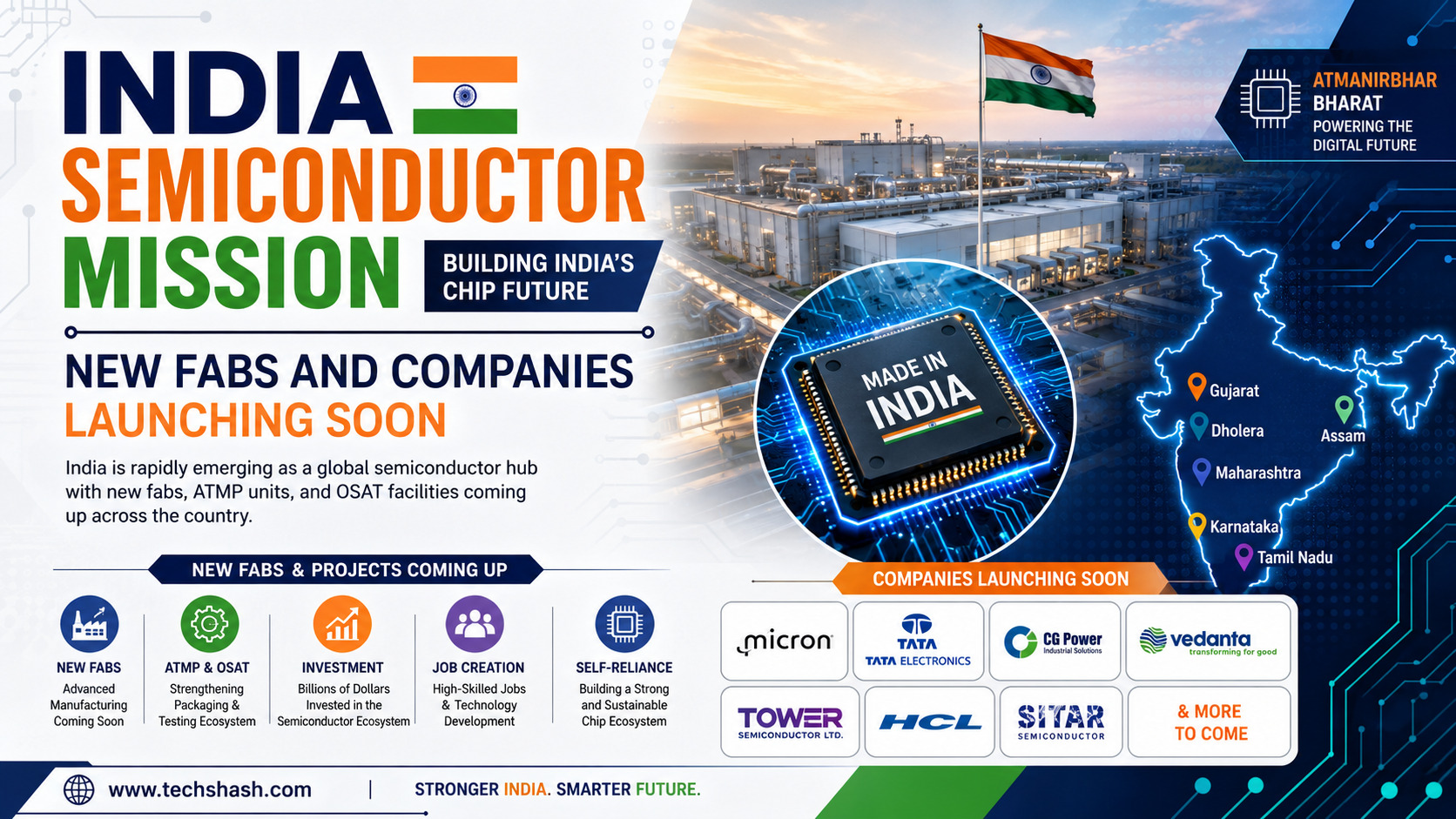
India’s semiconductor mission has quietly shifted from a policy document into an industrial reality. Plants are opening, chips are shipping, and new approvals keep arriving. Here is where the mission actually stands as its fabs and companies move from paper to production.
What the India Semiconductor Mission Actually Is
The India Semiconductor Mission, formally the Programme for Development of Semiconductors and Display Manufacturing Ecosystem in India, was notified in December 2021 with a total outlay of ₹76,000 crore. Its goal is to build a full domestic chip ecosystem, spanning design, fabrication, assembly, testing, and packaging, rather than relying entirely on imports.
The Union Budget for 2026-27 added a further ₹1,000 crore for the mission’s next phase, often referred to as ISM 2.0, focused on semiconductor equipment and materials, full-stack Indian chip intellectual property, and stronger domestic and global supply chains.
How Many Projects Have Been Approved So Far
By mid-2026, the government had approved between 12 and 13 semiconductor projects, depending on the exact reporting date, spread across seven states. These include one large logic and power wafer fab, multiple assembly and testing units, and newer silicon carbide and substrate-focused projects.
As of December 2025, an earlier snapshot put the combined investment across approved projects at roughly ₹1.60 lakh crore across six states, a figure that has grown since with newer approvals.
The Three Plants Already in Production
By July 2026, three of the approved projects had moved into commercial production. Micron’s Sanand assembly and test facility opened on February 28, 2026, shipping its first made-in-India memory modules to Dell Technologies the same day. Kaynes Semicon’s OSAT plant, also in Sanand, followed on March 31, 2026, with a production capacity of around 6 million chips per day. CG Semi, the joint venture between CG Power, Renesas, and Stars Microelectronics, began shipments in June 2026 and was formally inaugurated on July 4, 2026.
Together, these three plants mark the first wave of India’s semiconductor mission actually delivering finished products rather than construction updates.
The Fab Still Under Construction
India’s first full wafer fabrication plant, being built by Tata Electronics with Taiwan’s PSMC in Dholera, Gujarat, remains under construction. Reports from mid-2026 suggest the fab will now open at the 90-nanometer process node rather than the 28-nanometer node originally promised, with commercial production pushed toward mid-2028 instead of the earlier December 2026 target.
Elsewhere, the HCL-Foxconn joint venture broke ground near Jewar, Uttar Pradesh on February 21, 2026, targeting 2027 commercial production for display driver chips used in phones, laptops, and automobiles.
New Approvals: Crystal Matrix and Suchi Semicon
The mission continues to add new projects. The Union Cabinet has approved two further semiconductor projects: Crystal Matrix, an integrated compound semiconductor fab and assembly, test, mark, and packaging facility in Dholera, Gujarat, and Suchi Semicon, an OSAT facility in Surat, Gujarat.
Additional projects approved in August 2025 covered SiCSem, CDIL, 3D Glass Solutions, and ASIP Technologies, spread across Odisha, Punjab, and Andhra Pradesh, broadening the mission’s footprint beyond Gujarat.
What the Government Has Promised for 2026 and 2027
Union Electronics and IT Minister Ashwini Vaishnaw has stated that four semiconductor plants would be operational by the end of 2026, with two more following in 2027, and India’s first full fabrication unit ready in Dholera by 2028. That 2028 fab timeline reflects the more cautious revised schedule rather than the original 2026 target.
Why This Matters for India’s Economy
India’s semiconductor market was valued at roughly $38 billion in 2023 and had grown to an estimated $45 to $50 billion by 2024-25. Projections point to a market of $100 to $110 billion by 2030. The government has stated that by 2029, India is expected to develop the capability to design and manufacture chips covering nearly 70 to 75 percent of its domestic demand.
Whether that goal is met depends heavily on projects like the Dholera fab staying close to their revised timelines, since a full wafer fab remains the most technically demanding piece of the entire mission.
Key Takeaways
- Total mission outlay: ₹76,000 crore under the original programme, plus a further ₹1,000 crore for ISM 2.0.
- Approved projects: Between 12 and 13 as of mid-2026, spread across seven states.
- Already in production: Micron, Kaynes Semicon, and CG Semi, all in Gujarat.
- Still under construction: Tata’s Dholera wafer fab, now expected in mid-2028, and HCL-Foxconn’s Jewar plant, targeting 2027.
- Newest approvals: Crystal Matrix and Suchi Semicon, both in Gujarat.
- Market outlook: India’s semiconductor market is projected to reach $100 to $110 billion by 2030.
Frequently Asked Questions
How many semiconductor projects has India approved?
Between 12 and 13 projects had been approved as of mid-2026, spread across seven states.
Which semiconductor plants are already producing chips in India?
Micron, Kaynes Semicon, and CG Semi had all begun commercial production by July 2026.
When will India’s first full wafer fab open?
The Tata-PSMC fab in Dholera was originally targeted for late 2026, but recent reports suggest commercial production may not begin until mid-2028.
What is ISM 2.0?
It is the next phase of the India Semiconductor Mission, funded with an additional ₹1,000 crore in the 2026-27 Union Budget, focused on equipment, materials, and domestic chip intellectual property.
How big is India’s semiconductor market expected to become?
Projections point to a market size of $100 to $110 billion by 2030, up from roughly $45 to $50 billion in 2024-25.
Conclusion
The India Semiconductor Mission has moved well past its planning stage, with three plants already shipping chips and several more under construction across Gujarat, Uttar Pradesh, and beyond. The mission’s flagship project, the Dholera wafer fab, faces a slower and more modest path than originally promised, but the broader push, backed by ISM 2.0 funding and a growing list of approved projects, still points toward a meaningfully larger domestic chip industry by the end of the decade.