Introduction
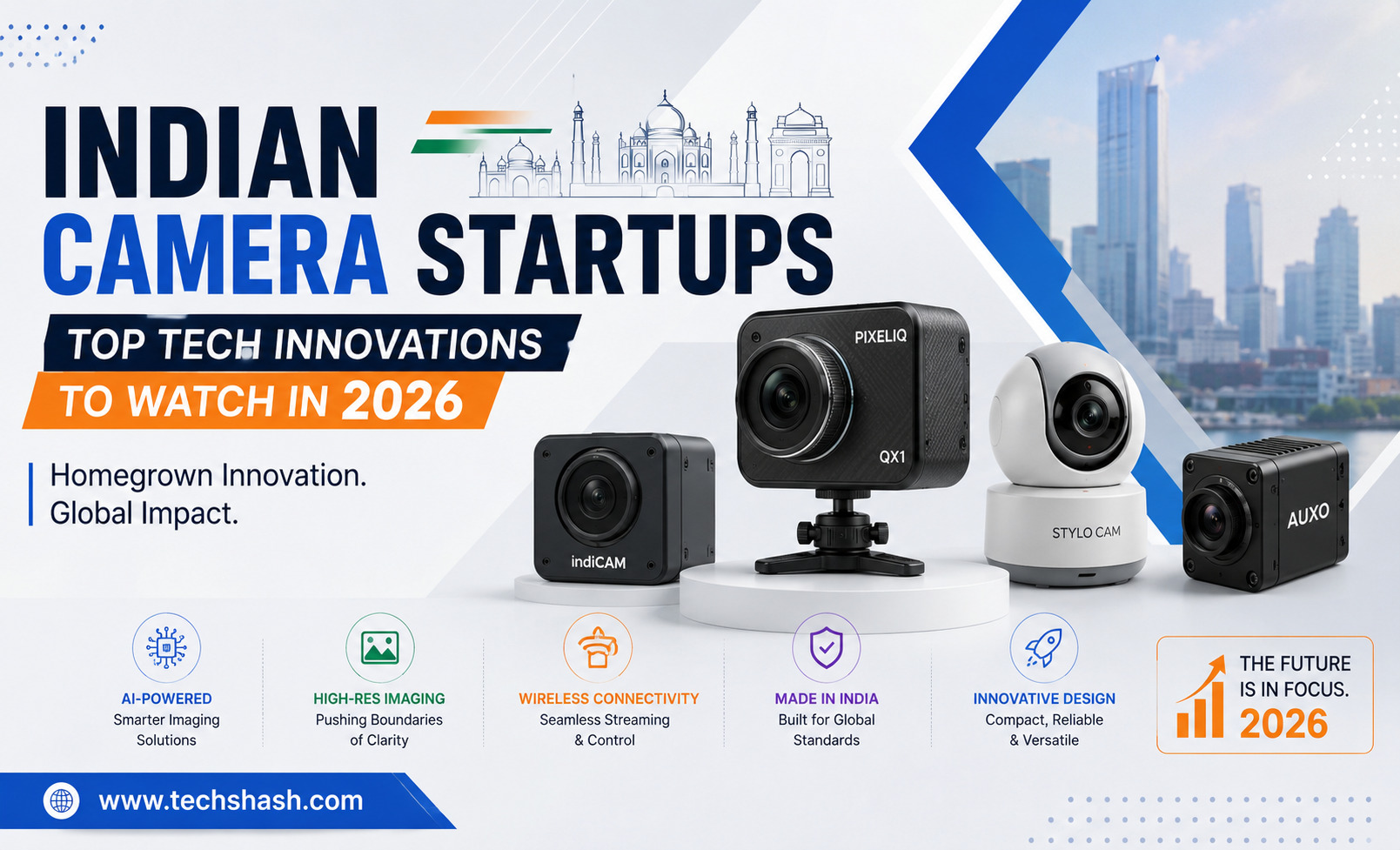
Indian camera startups are having an unusually active year in 2026, driven by both new technology and a major policy shift in surveillance hardware. From satellites that see in hundreds of spectral bands to software that makes a basic CCTV camera think for itself, here are the Indian companies actually shaping camera and imaging technology this year.
Why 2026 Is a Turning Point for Indian Camera Tech
Two separate forces are pushing Indian camera innovation forward this year. On the space and AI side, homegrown startups are winning contracts with governments and global agencies on the strength of genuinely novel imaging technology. On the ground, a new government certification rule has reshaped who gets to sell surveillance cameras in India at all, opening real market share to domestic manufacturers for the first time in years.
Pixxel: Hyperspectral Imaging From Orbit
Bengaluru-based Pixxel builds satellites that capture hyperspectral imagery, meaning they see in far more detail than a standard optical camera by capturing data across more than 150 spectral bands. Founded by Awais Ahmed and Kshitij Khandelwal, the company has raised close to $98 million in funding to date.
In 2026, Pixxel expanded its commercial satellite constellation and signed agreements with the US National Reconnaissance Office and India’s IN-SPACe agency for the country’s National Earth Observation Constellation. It also announced its next-generation Honeybee satellites and a partnership with Sarvam AI to build India’s first orbital data centre.
Why It Matters for Camera Technology
Pixxel’s satellites carry proprietary hyperspectral cameras built largely in-house, each containing thousands of individual parts and requiring sub-micron precision optics. That level of custom camera engineering, done domestically, is relatively rare for an Indian hardware startup and has drawn comparisons to specialized imaging companies abroad.
Staqu: Turning Ordinary CCTV Into Smart Cameras
Gurugram-based Staqu Technologies takes a different approach to camera innovation, focusing on software rather than new hardware. Its platform, JARVIS, connects to a business or government’s existing CCTV feeds using their IP addresses and adds AI-powered analysis on top, without requiring new cameras.
Staqu, founded in 2015 by Atul Rai, Anurag Saini, Pankaj Sharma, and colleagues, describes JARVIS as giving traditional CCTV a brain. The platform performs facial recognition, crowd monitoring, footfall counting, and anomaly detection, and has been deployed for police departments across multiple Indian states as well as retail and manufacturing clients.
Recent Recognition
JARVIS was recognized in MIT Sloan Management’s AI20 and AI50 lists in 2026 and has been used for crowd monitoring at IPL matches at Bengaluru’s Chinnaswamy Stadium, alongside earlier recognition from NASSCOM and FICCI for its work in smart policing.
The CCTV Hardware Boom: CP Plus, Qubo, and Prama
The single biggest shift in Indian camera hardware this year has nothing to do with a single startup and everything to do with policy. On April 1, 2026, India’s Ministry of Electronics and Information Technology enforced mandatory STQC certification for all internet-connected CCTV cameras, effectively barring Chinese brands like Hikvision, Dahua, and TP-Link from selling uncertified products in the country.
Chinese manufacturers previously controlled close to a third of India’s surveillance camera market. Domestic manufacturers, including CP Plus, Qubo, Prama, Matrix, and Sparsh, used the two-year transition window to rebuild their hardware around Taiwanese and Singaporean chipsets instead of Chinese components. By early 2026, Indian brands had captured over 80 percent of the domestic surveillance camera market.
What This Means for Buyers
Industry sources point to a modest 15 to 20 percent price increase across mid-range and high-end camera segments as manufacturers absorbed the cost of switching suppliers, though most expect prices to stabilize or fall as domestic competition increases. Existing Hikvision and Dahua cameras already installed continue to work, but replacement units must now carry STQC certification to be sold legally.
Orbo: AI That Makes Any Camera Smarter
Mumbai-based Orbo takes a software-first approach similar to Staqu, but aimed at image and video enhancement rather than surveillance. Founded in 2016 by Manoj Shinde, Danish Jamil, and Abhit Sinha, the company builds AI algorithms that improve image quality, remove unwanted objects from photos, enhance low-light footage, and power virtual makeup try-on tools for beauty and retail brands.
Orbo gained wider public attention after appearing on Shark Tank India, where it secured investment from Shark Vineeta Singh. Its underlying pitch is straightforward: rather than building new camera hardware, Orbo’s computer vision layer can be added to any existing device to make its camera output look meaningfully better.
What Ties These Companies Together
Despite working in very different segments, from orbit to storefront CCTV, these companies share a common thread: none of them are trying to out-manufacture established global camera brands on hardware alone. Pixxel differentiates through spectral range rather than resolution. Staqu and Orbo add intelligence to cameras that already exist. Even the domestic CCTV manufacturers benefiting from the STQC rules are competing primarily on trust, certification, and supply chain transparency rather than raw specs.
What to Watch for Next
Pixxel’s next funding round, aimed at scaling its National Earth Observation Constellation work, is one of the bigger stories to watch through the rest of 2026. On the surveillance side, keep an eye on how quickly domestic manufacturers can close remaining gaps in semiconductor and sensor supply, since India still depends on imported components for several critical parts even as finished camera assembly shifts local.
Key Takeaways
- Pixxel: Bengaluru satellite startup building hyperspectral imaging constellations, now working with India’s IN-SPACe and the US National Reconnaissance Office.
- Staqu: Gurugram AI startup that adds smart analytics to existing CCTV cameras through its JARVIS platform.
- CCTV hardware shift: India’s April 2026 STQC certification rules pushed Indian brands like CP Plus, Qubo, and Prama to over 80 percent domestic market share.
- Orbo: Mumbai-based computer vision startup that enhances image and video quality through AI rather than new hardware.
- Common theme: Indian camera innovation in 2026 is largely software and policy driven, not a hardware arms race.
Frequently Asked Questions
What is Pixxel known for?
Pixxel is an Indian startup that builds hyperspectral imaging satellites, capturing data across more than 150 spectral bands for agriculture, environmental, and defense applications.
What does Staqu’s JARVIS platform do?
JARVIS adds AI-powered analytics like facial recognition, crowd monitoring, and anomaly detection to existing CCTV camera feeds without new hardware.
Why were Hikvision and Dahua cameras restricted in India?
India introduced mandatory STQC certification in April 2026 over national security concerns tied to Chinese-made components, effectively blocking uncertified Chinese CCTV brands from new sales.
Which Indian CCTV brands have benefited most from the certification rules?
CP Plus, Qubo, Prama, Matrix, and Sparsh have captured over 80 percent of the domestic market since the rules took effect.
What does Orbo’s technology do?
Orbo builds AI software that enhances photo and video quality, removes unwanted objects, and powers virtual makeup try-on tools for existing cameras and devices.
Conclusion
Indian camera startups to watch in 2026 span a wide range, from Pixxel’s orbital hyperspectral imaging to Staqu and Orbo’s AI layered onto everyday cameras, alongside a genuine hardware shakeup in the CCTV market following India’s new STQC certification rules. The common pattern across all of them is intelligence and trust winning out over raw specs, a shift worth watching as domestic manufacturers close the remaining gaps in components like sensors and semiconductors.