Introduction
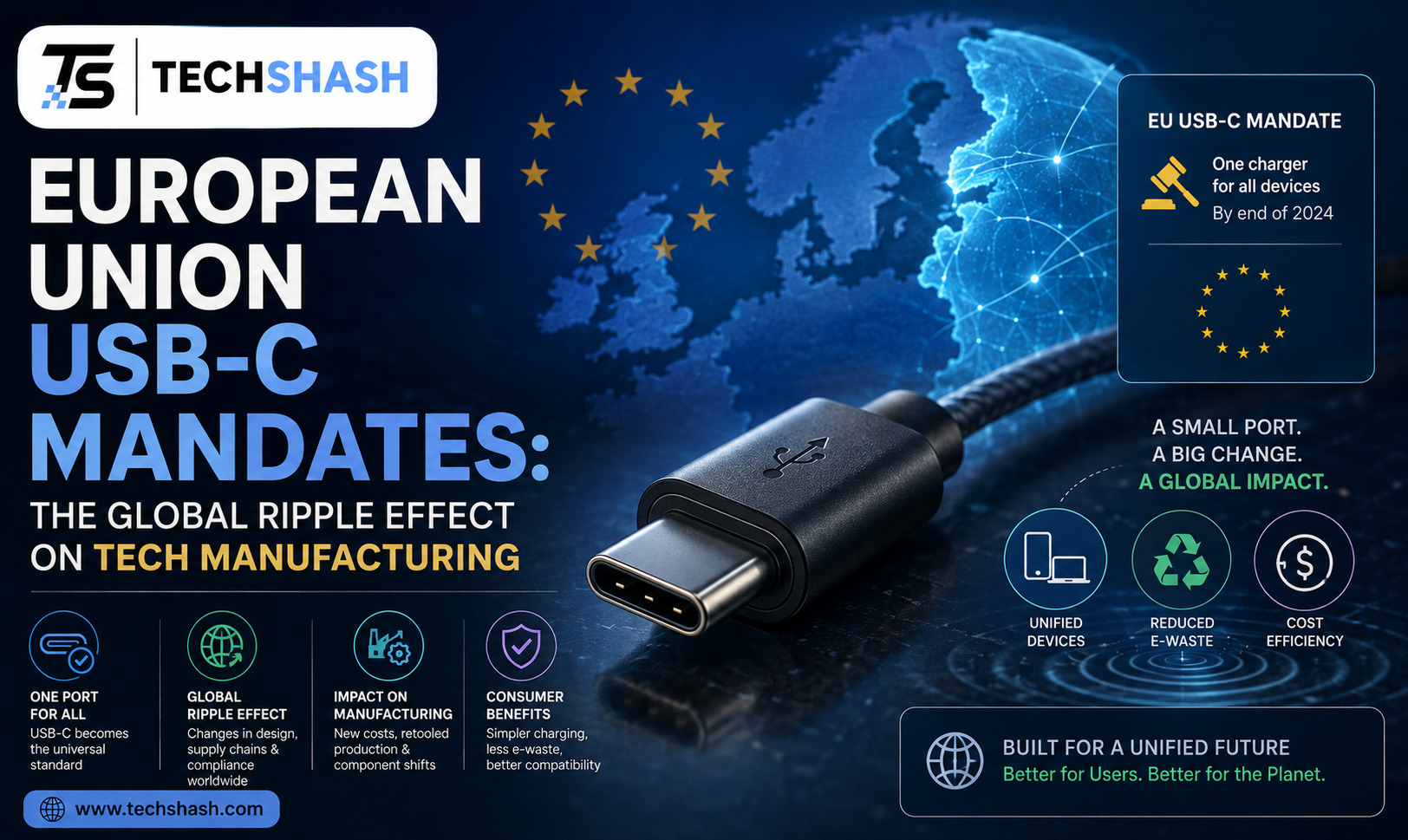
A single law passed in Brussels changed the bottom of gadget drawers across the entire planet, not just in Europe. The EU USB-C mandate forced phone, tablet, and now laptop makers to abandon proprietary charging ports in favor of one shared connector. This article looks at what the rule actually says, why manufacturers everywhere had to respond even outside EU borders, and what the mandate has set in motion for the global tech industry.
1. What the EU USB-C Mandate Actually Requires
The rule is formally known as Directive (EU) 2022/2380, often called the Common Charger Directive. It requires USB-C to be the standard charging port on a long list of electronics sold within the EU.
Covered devices include:
- Mobile phones and tablets
- Digital cameras
- Headphones and portable speakers
- Handheld video game consoles
- E-readers
- Keyboards and mice
- Portable navigation systems
Small devices that cannot physically fit a USB-C port, such as certain health trackers and sports equipment, are exempt for now.
2. The Timeline From Vote to Law
The European Parliament approved the directive with a lopsided vote, 602 in favor, 13 against, and 8 abstentions, back in October 2022. That overwhelming margin signaled just how little resistance the idea faced once it reached a formal vote.
Two separate deadlines followed:
- Phones, tablets, cameras, and the other covered small electronics had to comply starting December 28, 2024.
- Laptops received a longer runway, with their compliance deadline landing on April 28, 2026.
Laptops needed extra time mainly because their power delivery requirements are far higher than a phone or a pair of headphones, and the USB Power Delivery specification needed to mature enough to handle that load reliably.
3. Why the EU Chose USB-C
USB-C was not a random pick. The connector already dominated the data and power landscape before the mandate existed, which made it the least disruptive option to standardize around.
The technical case is strong too. The USB PD 3.1 protocol can scale power delivery anywhere from a few watts up to 240 watts, adjusting automatically based on what the connected device asks for. That range covers everything from a pair of wireless earbuds to a power-hungry gaming laptop, all through the same physical connector.
4. The Real Benefits Behind the Rule
The EU built its case around two main outcomes: less waste and lower costs for consumers.
By the EU’s own estimates, standardizing on one charger type is projected to cut 11,000 tonnes of charger-related e-waste every year. Consumers are expected to save around €250 million annually by no longer needing a new charger every time they buy a new device.
The directive also requires charger unbundling, meaning manufacturers must offer consumers the option to buy a device without a charger included in the box. That single requirement pushes people toward reusing chargers they already own instead of collecting a fresh one with every purchase.
5. What It Means for Manufacturers
Compliance is not as simple as swapping one port for another. Companies selling covered devices in the EU must prove their USB-C implementation is genuinely interoperable, which means testing against mismatched chargers, broken cables, sudden disconnects, and unpredictable power negotiation scenarios.
Packaging rules add another layer. Labels must clearly state a device’s charging performance and whether a charger ships in the box. For companies used to bundling a proprietary charger as part of the unboxing experience, that is a real shift in both design and marketing.
The legislation has also nudged manufacturers toward standardizing fast-charging behavior, since proprietary charging speeds that only worked with a matching brand of charger run against the spirit of the rule.
6. The Global Ripple Effect
Here is the part that reaches far past EU borders. Most manufacturers design one hardware line for global sale rather than building separate versions of a phone or laptop for each region. That means a compliance change made for European shelves usually ends up shipping everywhere else too.
Other governments have taken notice and started drafting their own versions of the rule:
- India made USB-C mandatory for electronic devices sold in the country starting in March 2025.
- Brazil has proposed legislation that mirrors the EU’s requirements.
- The United States Senate has held discussions about similar charger mandates, though nothing has passed into law yet.
- International standards bodies have updated their own technical specifications in response to the EU’s move.
None of these efforts required direct coordination with Brussels. The EU mandate simply made USB-C the default answer everywhere, since building one global product is cheaper and simpler than maintaining region-specific charging hardware.
7. The Certification Burden Nobody Talks About
Meeting the mandate is not free for manufacturers, and the compliance costs extend well beyond redesigning a charging port. Selling power adapters and chargers into the US and EU markets requires navigating UL 62368-1 certification, FCC approval, and CE marking, which itself covers low voltage, electromagnetic compatibility, and hazardous substance rules.
Recent changes have made this more expensive. A 2026 shift affecting roughly 75 percent of global device certifications has pushed testing costs up by an estimated 15 to 30 percent, with typical certification budgets now running $3,000 to $8,000 per product and taking six to ten weeks to complete. Smaller manufacturers without in-house compliance teams are likely to feel that cost increase the hardest.
8. The Loophole That Still Exists
The mandate covers wired charging specifically, which leaves an opening for devices that rely entirely on wireless charging. A phone that ships without any wired charging port at all could, in theory, sidestep the requirement altogether.
In practice, most manufacturers have not gone that route yet. Recent flagship phones have kept a USB-C port alongside wireless charging options rather than dropping the wired connection completely, likely because a phone with no wired port at all would create its own compatibility headaches for consumers used to plugging in a cable.
Key Takeaways
- The law: Directive (EU) 2022/2380 makes USB-C the required charging port across a wide range of electronics sold in the EU.
- Deadlines: Phones, tablets, and small electronics complied by December 28, 2024, with laptops following by April 28, 2026.
- Reach: The directive applies to all 27 EU member states plus Iceland, Liechtenstein, and Norway.
- Impact: An estimated 11,000 tonnes of e-waste and €250 million in consumer savings each year.
- Global effect: India, Brazil, and discussions in the US Senate show the mandate’s influence reaching well beyond Europe.
- Hidden cost: Certification requirements have grown more expensive for manufacturers heading into 2026.
FAQs
What is the EU USB-C mandate? It is Directive (EU) 2022/2380, a law requiring USB-C as the standard charging port on a wide range of electronics sold in the EU.
When did the mandate take effect for phones and tablets? Phones, tablets, and similar small electronics had to comply starting December 28, 2024.
When do laptops need to comply? Laptops must support USB-C charging by April 28, 2026.
Does the mandate apply outside the European Union? The law itself only applies within the EU and EEA, but it has influenced similar rules in countries like India and Brazil.
Can a manufacturer avoid the mandate with wireless charging? Yes, the rule currently covers wired charging only, leaving a technical opening for wireless-only devices.
Conclusion
The EU USB-C mandate started as a regional rule aimed at cutting e-waste and simplifying life for European consumers, but its effects have spread across the entire tech industry. Because manufacturers build one product line for the whole world rather than one per region, a law written in Brussels has reshaped charging ports on devices sold everywhere. With India already following suit and other countries drafting similar rules, the mandate looks less like a European regulation and more like the moment the world finally agreed on one charger.