Introduction
Phone batteries have barely changed in shape for two decades, even as everything else about phones changed completely. The solid-state battery is the technology many engineers point to as the next real leap, not just another small bump in capacity. This article breaks down what a solid-state battery is, why so many companies are chasing it, and how close it really is to showing up in a phone you can buy.
1. What a Solid-State Battery Actually Is
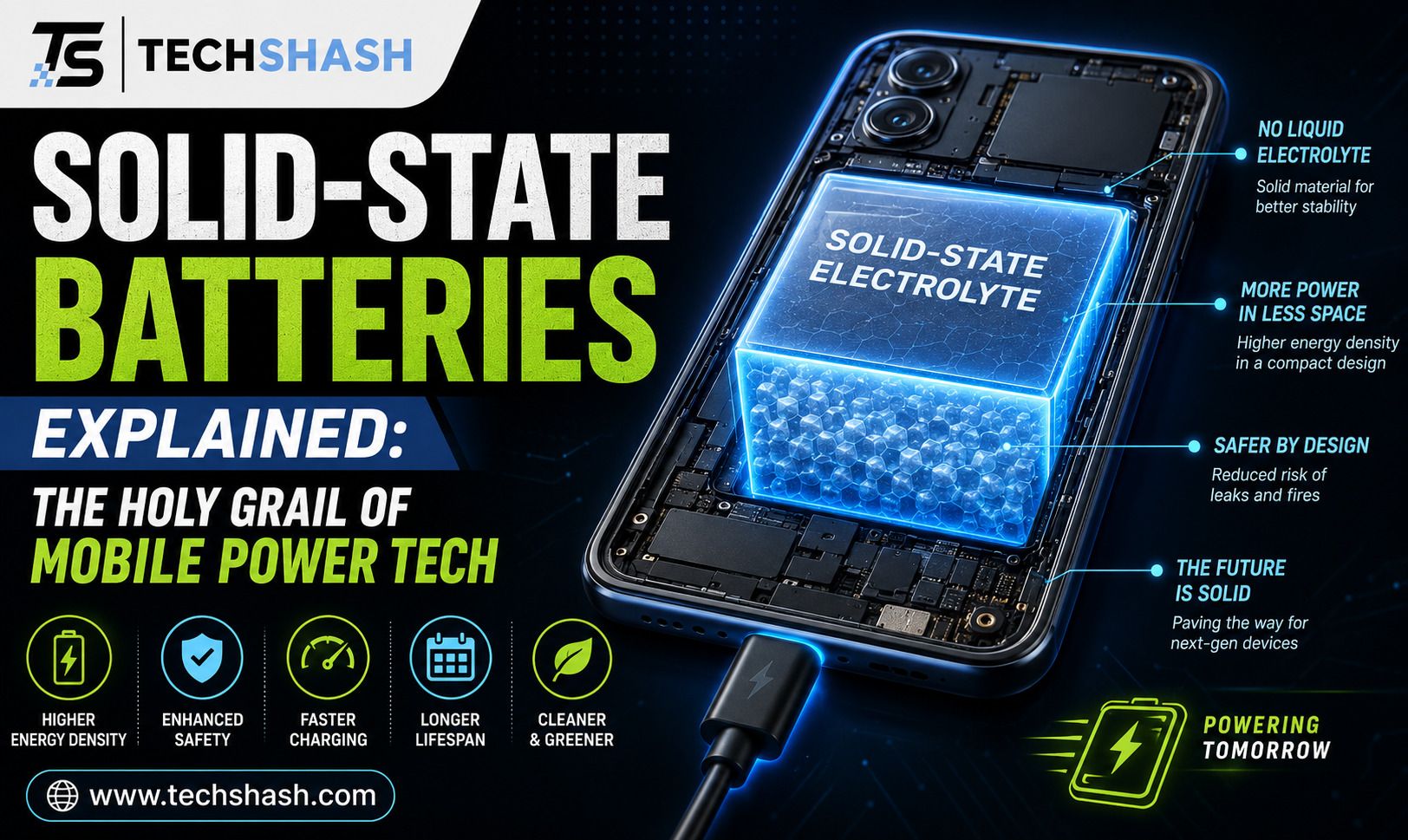
A normal lithium-ion battery moves ions between two electrodes through a liquid or gel electrolyte. That liquid is flammable, and it is part of the reason a damaged battery can swell, leak, or catch fire.
A solid-state battery swaps that liquid for a solid electrolyte instead, built from materials like ceramic, sulfide, or polymer compounds. Ions still travel between the anode and cathode, just through a solid layer rather than a liquid one. That single change is small on paper but touches almost everything about how the battery performs.
2. Why the Industry Wants This Technology So Badly
The appeal comes down to a handful of clear advantages over today’s batteries.
- Higher energy density. Solid-state designs can pack roughly double the capacity of a lithium-ion cell into the same physical space.
- Faster charging. Some prototypes have reached an 80 percent charge in under nine minutes.
- Longer lifespan. Cells rated for tens of thousands of charge cycles would outlast the typical 500 to 1,000 cycles a phone battery handles before it drops to 80 percent capacity.
- Better safety. Removing the liquid electrolyte greatly lowers the risk of thermal runaway, the chain reaction behind most battery fires.
- Wider temperature tolerance. Solid-state cells can operate across a broader range of conditions than liquid-based batteries.
Put those together and you get a battery that lasts longer per charge, survives more charge cycles over its life, and is safer to carry around every day.
3. The Real Barriers Holding It Back
None of this comes easily. Manufacturing a defect-free solid electrolyte at scale is difficult and expensive, and that difficulty is the main reason solid-state batteries keep missing their announced timelines.
A few specific problems stand out:
- The interface between the solid electrolyte and the electrodes can crack or degrade over repeated charge cycles.
- Production costs remain higher than standard lithium-ion manufacturing.
- Scaling a lab-proven process up to smartphone-level manufacturing volume takes major investment and new infrastructure.
Analysts have described this technology as being five years away for well over a decade now, and mid-2026 brought another round of delays across the industry. That pattern is worth keeping in mind whenever a new solid-state announcement makes headlines.
4. Where the Progress Is Actually Happening
Electric vehicles, not phones, are getting the first real-world solid-state deployments. Chinese automaker Changan has targeted a rollout of solid-state-equipped EVs, and companies including Factorial and Stellantis have already begun real-world road testing of solid-state cells. Geely has also announced plans to begin production of solid-state battery packs later in 2026.
BYD expects to start demonstration use of its own solid-state battery around 2027, though the company’s battery executive has said widespread availability may not arrive until after 2030. That kind of staggered timeline, demos first and mass adoption years later, shows up again and again across the industry.
5. Samsung and the Mobile Device Angle
Samsung has been one of the most visible names pushing solid-state technology toward consumer electronics. Samsung Electro-Mechanics developed a small all-solid-state battery aimed at wearable devices, with mass production planned for 2026 and an early market debut targeted for late that year. Samsung SDI, the branch responsible for the batteries inside Galaxy phones, has set its own target of late 2027 for mass-producing all-solid-state cells aimed at both EVs and mobile devices.
Samsung SDI has also reported a breakthrough reaching 500 Wh/kg using solid electrolytes in testing, with cells charging to 80 percent within nine minutes. The company has filed more than 40 patent applications related to oxide-based all-solid-state batteries, which signals a serious long-term investment even if the products are not ready yet.
Wearables are expected to get this technology first, likely showing up in devices like the Galaxy Watch, Galaxy Buds, or Galaxy Ring before it ever reaches a flagship phone. Industry watchers generally expect true solid-state batteries in Galaxy smartphones no earlier than the S28 or S29 generation, well beyond the current S26 lineup.
6. Other Players Racing Toward the Same Goal
Samsung is not working alone in this space. Samsung has partnered with Colorado-based Solid Power and BMW to fit solid-state cells into a test electric vehicle, an effort aimed at proving out real-world performance rather than lab results alone. That EV-focused testing tends to run ahead of anything planned for phones, since automotive batteries can absorb higher costs and larger form factors more easily than a smartphone can.
Chinese manufacturers, including Changan and Geely, are pursuing parallel timelines aimed at getting solid-state EVs onto the road within the same window Samsung is targeting for its own devices.
7. When Could This Reach Your Phone
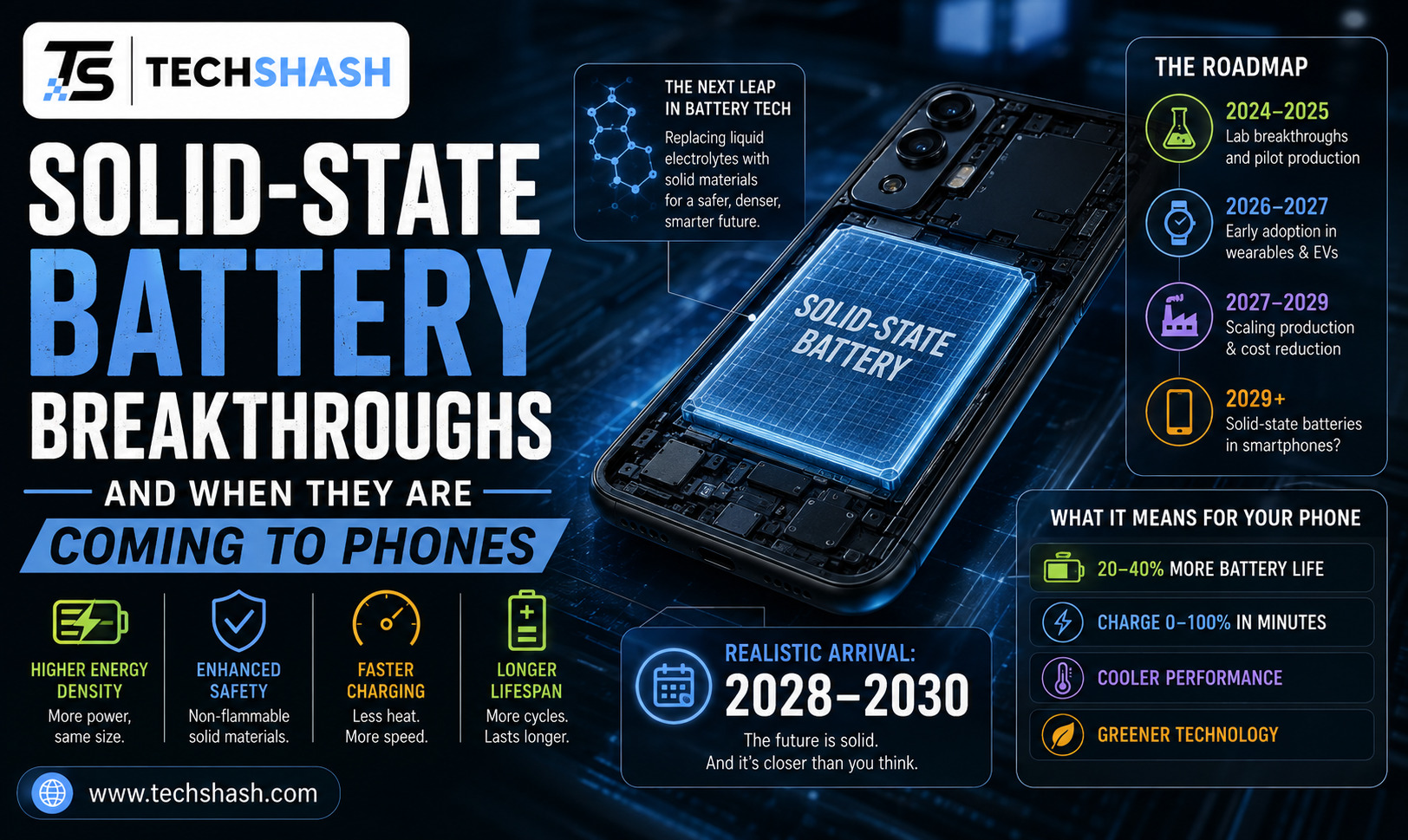
As of 2026, no mainstream smartphone ships with a solid-state battery, and the technology has not reached commercial scalability for consumer electronics. Most current development is aimed at electric vehicles first, with phones expected to follow years later.
Realistic estimates put wearables ahead of phones by a wide margin, possibly by several years. Mainstream smartphone adoption is generally expected sometime after Samsung SDI’s late 2027 manufacturing target, and some estimates push full smartphone adoption into the 2030s. Anyone holding onto an old phone in anticipation of a solid-state upgrade should plan for a long wait.
8. What You Can Get Today Instead
While solid-state batteries remain out of reach, phone makers have not stood still. Current flagship devices, including the Galaxy S26 Ultra, use silicon-carbon batteries, which swap a silicon anode in for the traditional graphite one. This approach trades some longevity for a meaningful boost in capacity, giving today’s phones more battery life without waiting on a fully new battery chemistry.
Software-side improvements matter too. AI-driven power management, smarter charging curves, and better thermal handling have all pushed real-world battery life higher, even though the underlying lithium-ion architecture has stayed mostly the same.
Key Takeaways
- Core idea: A solid-state battery replaces the liquid electrolyte in a normal battery with a solid material.
- Main benefits: Higher energy density, faster charging, longer lifespan, and improved safety.
- Biggest obstacle: Manufacturing a defect-free solid electrolyte at a scale that is affordable.
- Current focus: Electric vehicles are getting solid-state batteries well before phones do.
- Samsung’s timeline: Wearables around late 2026, broader mass production targeted for late 2027.
- Phone reality: No mainstream phone uses a solid-state battery as of 2026, and mainstream adoption may not arrive until the 2030s.
FAQs
What is a solid-state battery?
It is a battery that uses a solid electrolyte instead of the liquid or gel electrolyte found in standard lithium-ion cells.
Are solid-state batteries safer than lithium-ion batteries?
Yes, removing the flammable liquid electrolyte significantly lowers the risk of fire or thermal runaway.
Does any smartphone currently use a solid-state battery?
No, as of 2026 no mainstream smartphone ships with a solid-state battery.
Which devices will get solid-state batteries first?
Wearables and electric vehicles are expected to receive solid-state batteries well before smartphones do.
When will solid-state batteries reach smartphones?
Estimates vary, but many analysts expect mainstream smartphone adoption sometime after 2027, with some predictions extending into the 2030s.
Conclusion
The solid-state battery promises a real jump forward for mobile power, offering more capacity, faster charging, and a much safer design than the lithium-ion cells inside phones today. The catch is timing. Manufacturing challenges have pushed this technology’s arrival back for years, and the current roadmap points to wearables and electric vehicles reaching solid-state power long before smartphones do. Until that changes, silicon-carbon batteries and smarter software remain the practical way phone makers are stretching battery life in the meantime.