Households across the globe are quietly rethinking traditional entertainment setups. Ultra-short-throw projectors have emerged as powerful contenders that challenge the dominance of standard flat-screen televisions in modern living spaces. People want bigger cinematic views without ugly black glass panels dominating their interior design when turned off. This article will examine why these innovative display systems are quickly becoming the preferred choice for home entertainment.
1. Understanding Ultra-Short-Throw Technology
Traditional projection systems required massive rooms with distance between the lens and the wall. Ultra-short-throw technology changes this dynamic completely by using advanced laser light engines and specialized optics.
How Laser Optics Work
Engineers designed these machines to sit mere inches away from a blank wall or a specialized ambient light-rejecting screen. Light fires upward at a steep angle instead of shooting straight across the room. Advanced optical lenses bend the beam sharply to project a giant image without distortion.
Eliminating Shadow Interference
Older projectors suffered whenever someone walked across the beam and cast annoying shadows on the wall. Placing the hardware right beneath the display surface prevents anyone from interrupting the path of light. Shadow interference ceases to exist in your daily viewing experience.
2. Space Saving and Aesthetic Appeal
Living room design trends favor clean lines, minimalist furniture, and open floor layouts. Bulky entertainment centers and massive television stands often clash with contemporary interior styles.
Minimalist Media Consoles
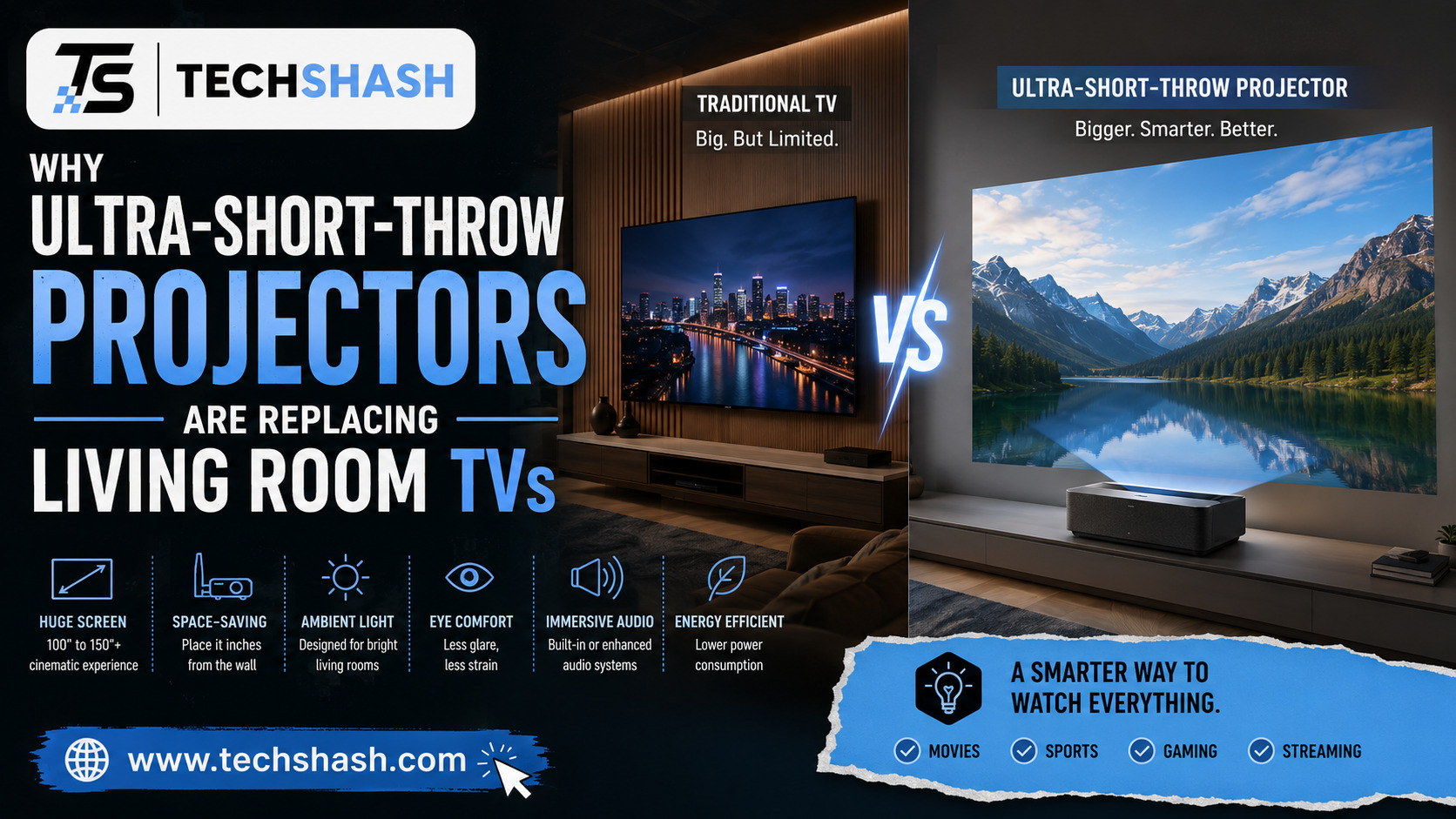
An ultra-short-throw unit rests on a low media console just like a standard soundbar or cable box. You do not need to mount heavy brackets into drywall or sacrifice precious floor space for bulky furniture. Interior design flexibility improves dramatically when heavy black boxes disappear from your walls.
Blending Into Room Decor
Modern manufacturers build these chassis in neutral colors, fabric wraps, and sleek metallic finishes that complement modern furniture. When powered down, the device looks like an ordinary piece of high-end home decor rather than a massive piece of technology. Discreet visual integration keeps your living room looking peaceful and uncluttered.
3. Massive Screen Sizes at Home
Consumers crave cinematic immersion that matches what they experience inside commercial movie theaters. Standard television panels become exponentially more expensive once you cross the eighty-inch threshold.
Scaling Up to One Hundred Inches
Projectors deliver massive diagonal measurements ranging from eighty to one hundred and fifty inches with absolute ease. You get breathtaking scale without paying exorbitant prices for oversized glass panels that are nearly impossible to move through doorways. Immersive visual scale transforms ordinary movie nights into theatrical events.
Flexible Aspect Ratios
Adjusting the projected boundary takes seconds using digital keystone correction and manual focus rings. You can scale content down for casual news viewing or expand it fully for epic fantasy films. Customizable display sizing adapts effortlessly to whatever media you choose to consume.
4. Eye Comfort and Viewing Safety
Staring at backlit LED or OLED panels for hours can cause noticeable eye strain and fatigue during long viewing sessions. Projection technology offers a fundamentally different visual experience for human eyes.
Reflected Light vs Direct Light
Televisions shine bright light directly into your pupils from microscopic sub-pixels. Projectors bounce light off a surface before it reaches your eyes, creating a softer and more natural viewing sensation. Reflected light distribution reduces harsh glare and lowers eye strain during evening relaxation.
Reduced Blue Light Exposure
Viewing bounced illumination feels much closer to reading a physical book under a desk lamp. Families with young children often prefer this gentler method of consuming visual media in the evenings. Softer illumination methods help protect visual comfort over extended hours.
5. Sound Integration and Audio Quality
Audio performance used to be an afterthought in projector design, forcing buyers to purchase complicated external speaker setups. Modern units solve this problem through built-in high-fidelity sound systems.
Premium Internal Speakers
Manufacturers partner with legendary audio brands to embed powerful drivers directly into the projector chassis. You receive clear dialogue, rich mid-tones, and decent bass response without running speaker wires across your living room floor. Integrated sound delivery simplifies home theater wiring completely.
Dolby Atmos Support
Advanced firmware decodes spatial audio formats to create an expansive soundstage that matches the massive picture size. Viewers hear helicopters flying overhead and rain falling around them using only the single tabletop console. Spatial audio processing delivers true surround sound experiences from a single device.
6. Cost Comparison and Long-Term Value
Evaluating the financial aspect of purchasing a display device requires looking beyond the initial retail price tag. Screen durability and maintenance costs play a vital role in long-term ownership satisfaction.
Laser Lifespan Advantages
Traditional projector lamps burned out quickly and required expensive replacements every few thousand hours. Modern solid-state laser diodes last for tens of thousands of hours before experiencing any noticeable degradation in brightness. Extended laser lifespan ensures years of maintenance-free daily operation.
Value per Inch of Screen
Calculating cost relative to screen surface area reveals surprising economic benefits for ultra-short-throw systems. Buying an eighty-inch television requires a massive financial investment, whereas projection technology delivers one hundred inches for a fraction of that per-inch cost. Superior value per inch makes giant screen entertainment accessible to more households.
Key Takeaways
- Space efficiency: Ultra-short-throw projectors sit inches from the wall, saving floor space and eliminating heavy wall mounts.
- Aesthetic design: Units blend seamlessly into living room decor without a massive black glass panel dominating the room.
- Massive scale: Viewers enjoy immersive visual scale between eighty and one hundred and fifty inches easily.
- Eye comfort: Reflected light technology reduces harsh glare and lowers eye strain compared to direct-lit televisions.
- Audio integration: Premium internal speakers and spatial audio decoding eliminate the need for complex external sound systems.
FAQs
Do ultra-short-throw projectors require a special screen?
You can project onto a smooth white wall, but an ambient light-rejecting screen greatly improves contrast and daytime viewing clarity.
Can these projectors replace a normal television for daytime news viewing?
Modern high-lumen laser engines produce enough brightness to combat normal ambient daylight when paired with a proper rejection screen.
How loud are the cooling fans on these devices during quiet movie scenes?
Engineers utilize advanced liquid cooling and quiet fan designs to keep operating noise below standard conversational levels.
Is it difficult to align the image perfectly with the wall boundary?
Automatic geometry correction software aligns and squares the projected picture within seconds using your smartphone camera.
Do these units support high refresh rates for modern video game consoles?
Current models feature low input lag and high refresh rates that accommodate fast-paced competitive gaming smoothly.
Conclusion
The shift toward ultra-short-throw projectors highlights a growing desire for flexible, space-saving, and deeply immersive home entertainment solutions. By combining giant screen sizes with minimalist design and advanced laser optics, these systems successfully redefine what a modern living room can achieve.