Introduction
Glasses that answer questions about what you are looking at sound like a gadget from a movie. They are now something you can buy off the shelf.
Ray-Ban Meta glasses have grown from a simple camera accessory into a full lineup built around AI, audio, and, in some models, a private display. This article explains how the technology works, what each model offers, and whether it genuinely reduces how often you reach for your phone.
1. What Ray-Ban Meta Glasses Actually Are
At the core, these are ordinary-looking glasses built by Meta in partnership with EssilorLuxottica, the company behind the Ray-Ban brand. They pack in cameras, microphones, speakers, and a chip that connects to Meta’s AI assistant.
Most versions in the lineup are screenless, meaning all interaction happens through voice and audio, not through anything you see projected in your vision. That audio-first design was a deliberate choice, aimed at making the glasses useful without turning them into a distraction.
You control them mainly by speaking, using the wake phrase “Hey Meta,” followed by a question, command, or request.
2. The Lineup Explained
The Ray-Ban Meta family has expanded quickly, and it now spans several price points and feature sets.
Ray-Ban Meta (Gen 2)
Starting around 379 dollars, this is the core product: camera, audio, and Meta AI, without any built-in display. It supports 3K video recording and offers up to eight hours of battery life on a single charge.
Ray-Ban Meta Display
At 799 dollars, this model adds Meta’s first true built-in screen, a private 600 by 600 pixel monocular display in the right lens. It pairs with the Meta Neural Band, a wrist-worn controller that reads hand gestures through muscle signals instead of a touchpad or camera.
Meta Glasses (Budget Line)
Launched in mid-2026 at 299 dollars, this line drops the Ray-Ban and Oakley branding entirely, offering 26 styles at a lower price point while still running the same Meta AI software as the rest of the lineup.
3. Multimodal AI: Seeing and Hearing at the Same Time
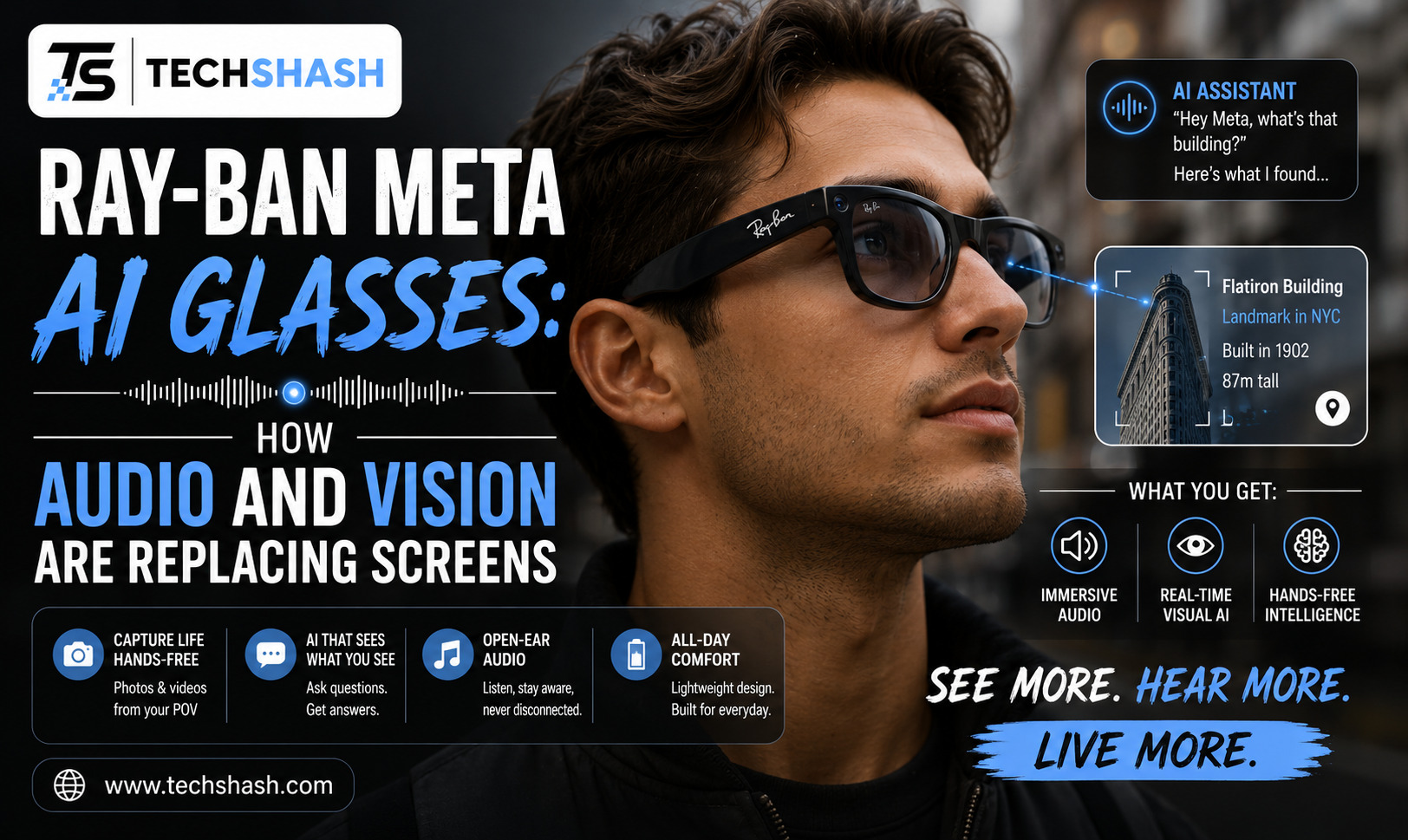
The standout capability across the lineup is what Meta calls multimodal AI. The glasses can process what the camera sees alongside what the microphone hears, then respond out loud in real time.
A common example: walking past a landmark and asking the glasses about its history, or holding up a menu in another language and asking for a translation. The assistant answers through the speakers built into the arms of the glasses, without ever pulling out a phone.
A recent software update made these conversations feel more natural. Users can now interrupt the assistant mid-response or ask a follow-up question without repeating the wake phrase every single time.
4. Where the Display Fits In
Not every model has a screen, and that is intentional. Meta’s screenless releases came first, giving the company a chance to refine the audio experience before adding anything visual.
The Ray-Ban Meta Display changes that with its in-lens screen, which supports a 90Hz refresh rate and up to 5,000 nits of brightness, bright enough to read outdoors. The display can currently show text messages and video calls through WhatsApp and Messenger, turn-by-turn navigation, live captions, real-time translations, and whatever song is playing on Spotify.
Recent updates have expanded what the display can do beyond messaging and navigation. Users can now watch, like, and share Instagram Reels directly through the lens, and two simple games have been added for idle moments.
5. Real-World Features People Actually Use
A few features have become genuine daily habits for owners rather than novelty demos.
- Voice notes and hands-free capture, useful for anyone who needs to jot down a thought or record a moment without pulling out a phone.
- Autocapture, which listens for a spoken cue and automatically records short highlight videos during activities like a hike or a get-together.
- Conversation Focus, a feature that isolates the voice of the person you are speaking with while reducing background noise, useful in loud environments like restaurants or events.
- Combined display and point-of-view recording, which merges what you see on the display with your outward-facing camera footage into a single shareable video.
These features point toward a pattern: less time staring at a phone screen, more short interactions handled entirely through voice or a quick glance.
6. Battery Life and Everyday Practicality
Battery life has been one of the more noticeable improvements across generations. The Gen 2 glasses offer up to eight hours on a full charge, with a 50 percent top-up possible in about 20 minutes.
The included charging case extends that further, offering up to 48 hours of additional charge on the go, which matters for anyone wearing the glasses through a full day of errands, meetings, or travel.
Upcoming models are expected to push battery life even further. Rumors around a third-generation release point to a version built for extended battery life alongside a lighter, prescription-friendly version aimed at everyday wear.
7. Privacy Questions Worth Asking
Glasses with a built-in camera raise obvious questions, and Meta has tried to address some of them directly. A visible LED lights up whenever the camera is recording, meant to signal to bystanders that they may be on camera.
Real concerns remain around how footage might be used to train AI systems, and how real-time object or location recognition could affect the privacy of people nearby who never agreed to be recorded. Upcoming models are reportedly aiming for brighter recording indicators and more local, on-device processing rather than sending everything to the cloud.
Anyone considering a pair should read through the current privacy settings before wearing them somewhere sensitive, since defaults and data practices continue to shift with each software update.
8. Are These Glasses Really Replacing Your Phone Screen?
The honest answer is: not entirely, but they are chipping away at specific tasks. Quick questions, translations, navigation cues, and short voice notes increasingly happen through the glasses instead of a phone screen.
For anything that requires typing, scrolling through a full app, or extended reading, a phone or a larger display still wins. The display-equipped models narrow that gap somewhat, but the field of view remains small and intentionally limited compared to a phone screen.
What is clear is the direction Meta is pushing toward: fewer moments spent looking down at a screen, and more information delivered through your ears and a quick glance, right where you are already looking.
Key Takeaways
- Core idea: Ray-Ban Meta glasses use cameras, microphones, and AI to answer questions about what you see and hear, mostly through audio.
- Lineup: Options range from the screenless Gen 2 at 379 dollars to the display-equipped model at 799 dollars and a budget line starting at 299 dollars.
- Standout feature: Multimodal AI lets the glasses respond to real-time questions about your surroundings without pulling out a phone.
- Battery life: Up to eight hours per charge, extendable to 48 hours with the included charging case.
- Privacy: A visible recording LED exists today, though concerns remain around data use and bystander privacy.
FAQs
Do all Ray-Ban Meta glasses have a screen? No, most models are screenless and rely entirely on audio, while only the Ray-Ban Meta Display adds a built-in lens screen.
How do you control the glasses without a screen? Most interaction happens through voice commands starting with the phrase “Hey Meta,” alongside physical taps and swipes on the frame.
What is the Meta Neural Band? It is a wrist-worn controller that reads hand gestures through muscle signals, used alongside the Ray-Ban Meta Display model.
Can the glasses replace a phone entirely? Not yet, since tasks like typing, extended reading, and detailed browsing still work better on a phone or larger screen.
Is there a visible sign when the glasses are recording? Yes, a visible LED lights up during recording, and upcoming models are reportedly aiming for brighter, clearer recording indicators.
Conclusion
Ray-Ban Meta glasses represent a genuine shift in how people access information, leaning on multimodal AI and audio-first design to answer questions without a phone screen in sight. The addition of a private in-lens display narrows the gap even further, though phones still handle detailed, screen-heavy tasks better for now. As battery life, privacy safeguards, and display technology keep improving, Ray-Ban Meta glasses look like one of the clearest signs yet that audio and vision are steadily replacing the screens people reach for out of habit.