Introduction
A gaming laptop that fits in your hands sounded like a niche experiment a few years ago. In 2026, it looks a lot more like a real category.
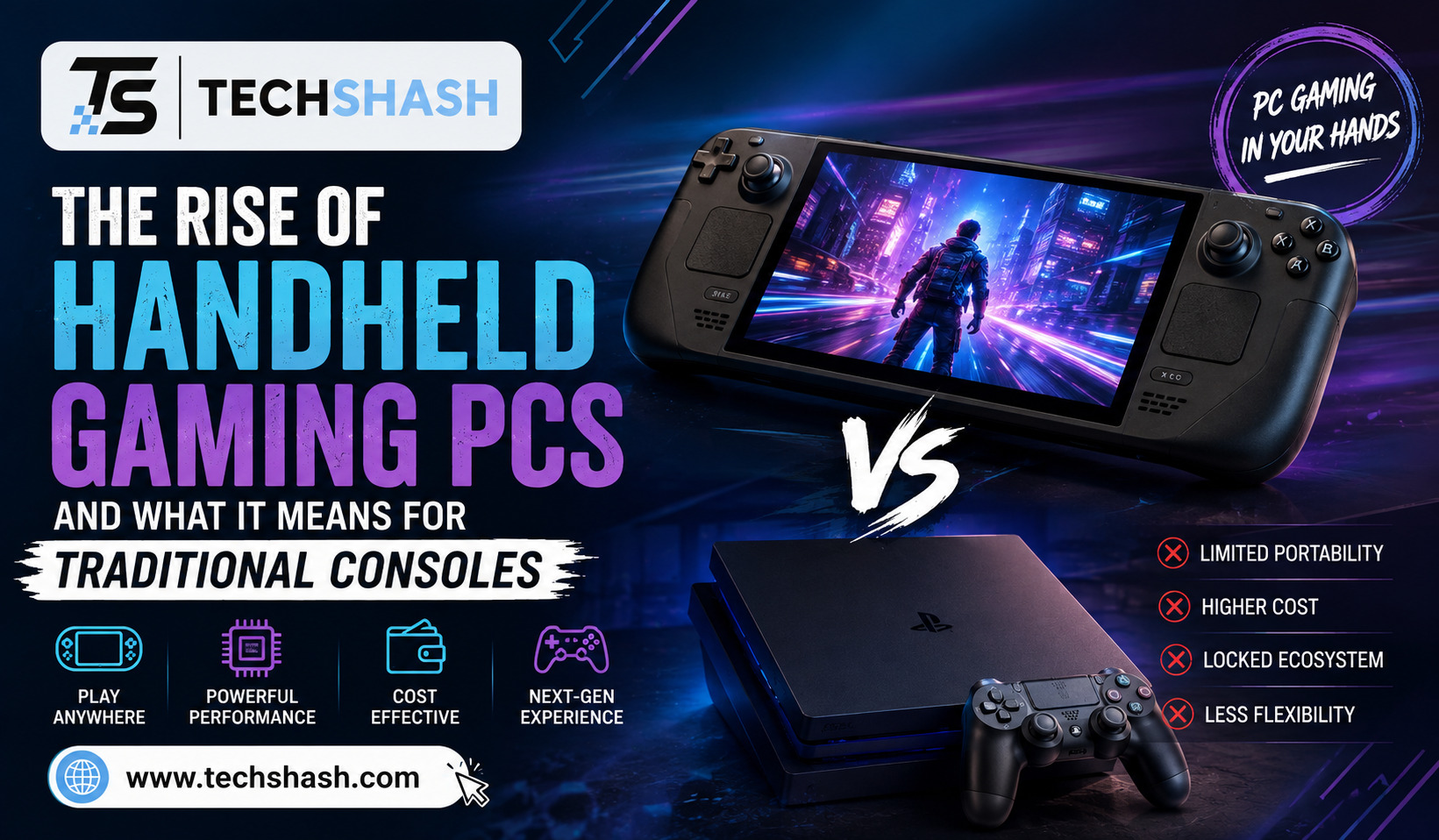
Handheld gaming PCs have moved from a Valve side project into a crowded field with multiple serious competitors. This article looks at how the category has grown, what it costs today, and what it means for the traditional console business built around living room consoles.
1. What Counts as a Handheld Gaming PC
A handheld gaming PC is essentially a full computer squeezed into a controller-shaped body, running either Windows or a dedicated gaming operating system like Valve’s SteamOS. Unlike a locked-down console, it can access your existing PC game library, whether that library lives on Steam, GOG, Epic, or elsewhere.
That flexibility is the entire appeal. You get the versatility of a smartphone or a Nintendo Switch, combined with the raw processing power of a gaming computer, all running on the couch, on a flight, or anywhere in between.
Six devices now compete for shelf space in this category: the Steam Deck OLED, the ROG Xbox Ally X, the MSI Claw 8 EX AI+, the Lenovo Legion Go 2, the Nintendo Switch 2, and the Retroid Pocket 6.
2. The Devices Leading the Category in 2026
Each major handheld targets a slightly different buyer.
Steam Deck OLED
Valve’s device remains the reference point every other handheld gets measured against. It still holds roughly half the handheld gaming PC market, running the entire Steam library along with growing support for GOG and parts of the Epic catalog through community tooling.
ROG Xbox Ally X
Asus and Microsoft’s collaboration boots into a full-screen Xbox-style experience that hides the Windows desktop, aggregating Steam, Game Pass, Epic, and other storefronts into one console-like launcher. It runs AMD’s Ryzen AI Z2 Extreme chip with 24GB of RAM.
Lenovo Legion Go 2
This model leans into premium hardware, with an 8.8-inch 144Hz OLED panel and a larger 74Whr battery that nearly doubles the capacity of the original Legion Go.
MSI Claw 8 EX AI+
Built around Intel’s Arc B390 graphics and a G3 Extreme processor, this device competes directly with the higher-end Windows handhelds on raw horsepower.
3. Steam Deck’s Price Hike and What It Signals
One of the bigger stories in 2026 has been price, not performance. Valve raised Steam Deck OLED prices significantly, pushing the 512GB model from 549 dollars to 789 dollars, a jump of roughly 44 percent that the company attributed to rising component costs. The 1TB model climbed from 649 dollars to 949 dollars over the same period.
Despite the increase, demand held steady. The nearly 1,000-dollar Steam Deck OLED sold out within 24 hours of a recent restock, even at the higher price point.
That combination, higher prices and strong demand, points to a supply issue rather than a lack of buyer interest. A global shortage in NAND and RAM, driven partly by AI-related chip demand, has forced manufacturers across the category to pass higher costs on to consumers.
4. Windows Handhelds Are Getting More Competitive
Windows-based handhelds have closed much of the gap with SteamOS in usability, mainly by hiding the desktop entirely behind a console-style interface.
The ROG Xbox Ally line ships in two tiers:
- ROG Xbox Ally: Priced around 600 dollars, with 16GB of RAM and 512GB of storage, comparable to the Steam Deck OLED at a lower price.
- ROG Xbox Ally X: Priced around 1,000 dollars, with 24GB of RAM and 1TB of storage, aimed at buyers who want the most raw performance available in a 7-inch handheld.
Notably, SteamOS itself has become installable on some Windows hardware, including the Lenovo Legion Go S SteamOS edition, which has outranked the original Steam Deck in several recent comparisons.
5. Why the Category Is Drifting Upmarket
The handheld gaming PC market has a pricing problem, and most analysts trace it back to memory costs. DRAM pricing is not expected to normalize before 2027, which keeps pushing bill-of-materials costs higher across nearly every device in the category.
That has real consequences for adoption. Every dollar added to a handheld’s price moves it further away from an impulse-buy price point, the kind that would let the category break out of its current enthusiast niche and reach a broader audience.
Some manufacturers are responding by doubling down on premium features instead of chasing a lower price. A recent example includes an anniversary-edition bundle pushing even further upmarket with OLED panels and companion AR glasses, a clear signal that margin, not volume, is the current priority for at least part of the market.
6. Where Traditional Consoles Still Win
Handheld PCs have not dethroned traditional consoles, and the sales data makes that clear. Nintendo’s Switch 2 has been the one clear hardware bright spot in 2026, single-handedly offsetting broader declines in console hardware sales elsewhere.
Traditional consoles keep a few advantages that handheld PCs still cannot fully match:
- Simplicity, since a closed system avoids driver issues, storefront fragmentation, and the general complexity of a full operating system.
- Lower starting price, with the Switch 2 currently priced well below most premium Windows handhelds.
- Consistent performance, since games are built and optimized specifically for one fixed hardware target.
Overall US consumer spending on video games is projected to rise about 3 percent to 62.8 billion dollars in 2026, but that growth is coming largely from content and subscriptions, not new hardware purchases.
7. What the Sales Data Actually Shows
Circana data paints a mixed picture for the handheld PC category specifically. ROG Xbox Ally sales stalled after a strong opening month, even as the Steam Deck continues holding around half of the overall handheld gaming PC market.
Some of that Ally momentum may reflect availability rather than genuine preference. When Steam Decks are hard to find, some buyers reportedly settle for an Ally instead, which can temporarily inflate Microsoft’s numbers without reflecting a real shift in what people actually want.
The broader 2026 pattern across gaming hardware overall: software and services are thriving while hardware sales struggle, a trend that stretches beyond just handhelds into the wider console business.
8. Should You Buy One Right Now
If budget matters most, the standard ROG Xbox Ally at around 600 dollars currently undercuts the Steam Deck OLED by roughly 190 dollars while offering comparable specs. If raw performance is the priority, the ROG Xbox Ally X or the Legion Go 2 both push further than the Steam Deck’s aging chipset.
If simplicity and a lower price matter more than raw power, the Nintendo Switch 2 remains the easiest recommendation for casual buyers who do not want to manage a full Windows install or a SteamOS learning curve.
Whatever you choose, it is worth checking current pricing carefully, since the ongoing memory shortage means prices across this entire category have been shifting throughout the year.
Key Takeaways
- Category growth: Six major handheld gaming PCs now compete for the same shelf space, up from a three-way race just a couple years ago.
- Steam Deck’s position: Still holds around half the market despite a 44 percent price increase on the OLED model.
- Windows improvements: The ROG Xbox Ally line now boots into a console-style interface that hides the Windows desktop entirely.
- Pricing pressure: A global RAM and NAND shortage is pushing the entire category upmarket, away from impulse-buy pricing.
- Console impact: Traditional consoles like the Nintendo Switch 2 still lead in simplicity, price, and overall hardware sales strength.
FAQs
What is the main difference between a handheld gaming PC and a console? A handheld gaming PC runs a full operating system and can access your existing PC game library, while a traditional console is a closed system built around one fixed storefront.
Why did the Steam Deck get more expensive in 2026? Valve attributed the price increase to rising component costs tied to a broader global shortage in memory and storage chips.
Is the Nintendo Switch 2 considered a handheld gaming PC? No, the Switch 2 is a traditional closed console, though it competes for the same backpack space and gaming budget as handheld PCs.
Which handheld gaming PC offers the best value in 2026? The standard ROG Xbox Ally currently offers strong value, undercutting the Steam Deck OLED’s price while matching many of its specifications.
Are handheld gaming PCs replacing traditional consoles? Not yet, since traditional consoles still lead in simplicity and overall hardware sales, even as handheld PCs continue growing as a serious alternative.
Conclusion
Handheld gaming PCs have grown from a single Valve experiment into a genuinely competitive category, with Windows-based devices closing the usability gap and Steam Deck still anchoring the market despite a steep price hike. Traditional consoles are not going away, and the Nintendo Switch 2 proves that a simpler, cheaper device still has broad appeal. What is clear is that handheld gaming PCs have carved out a real, lasting place next to traditional consoles rather than replacing them outright.