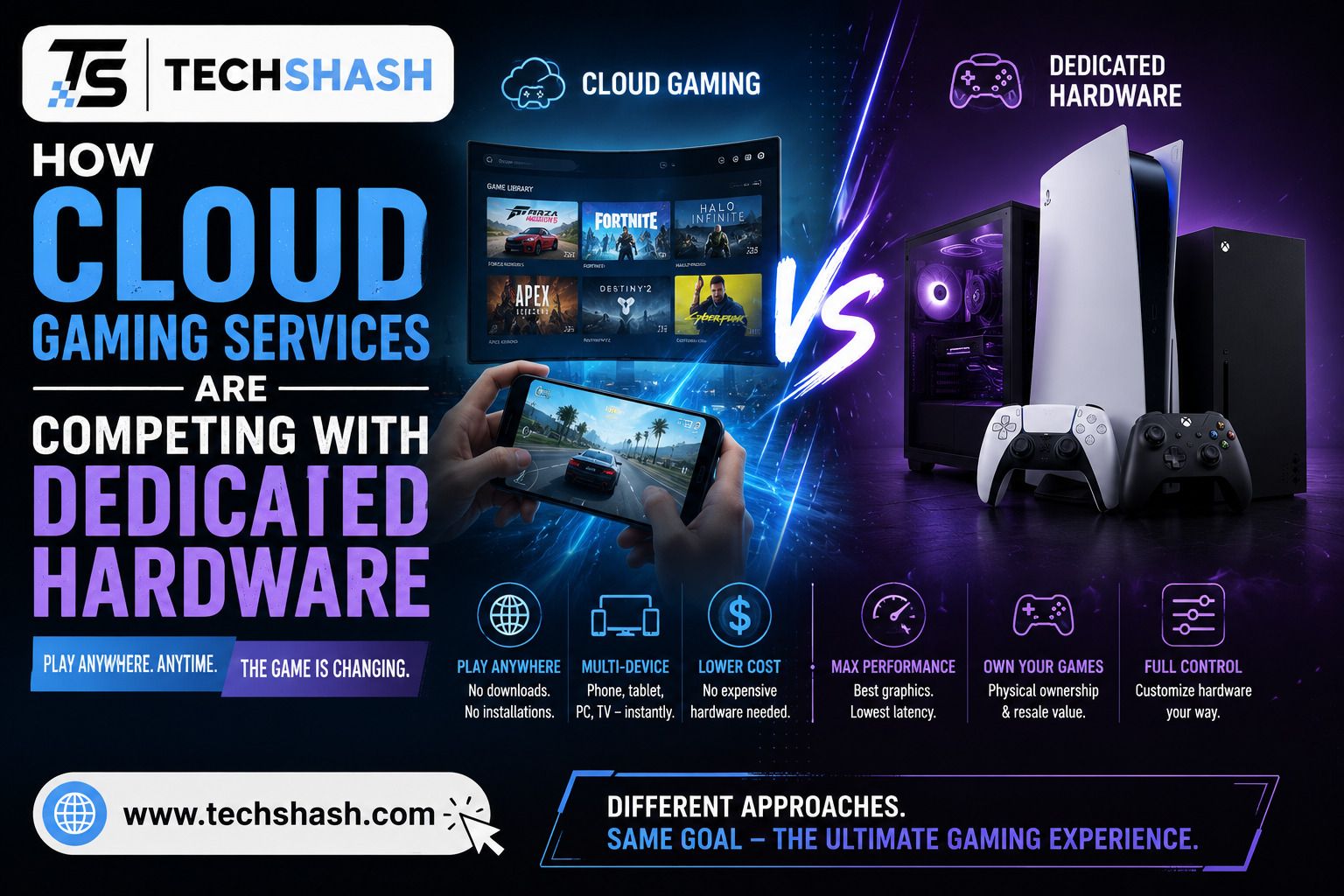
For decades, playing high-end video games required purchasing expensive local machines. Today, platforms streaming interactive entertainment directly over internet lines are altering how players access major releases. Many consumers now ask whether cloud gaming services can fully replace physical consoles and custom computer builds.
This article explores how cloud gaming services compare against traditional local equipment in performance, total cost, and convenience. You will learn about the technology powering remote servers, network demands required for smooth play, and what lies ahead for modern players.
1. How Cloud Gaming Services Process Video Games
Traditional gaming consoles rely on internal graphics processors and memory chips to render visual frames locally. Cloud gaming services move that intense computational work off home devices onto high-powered remote data centers. Distant server racks calculate game physics, render high-definition graphics, and compress visual outputs into live video feeds.
Remote Server Farms
Industrial data centers operate thousands of server blades equipped with high-end processing hardware. Pressing a button on your local game controller sends instant signals across internet lines to a remote server. Distant server racks compute your character movement, generate the next video frame, and transmit that image back to your screen.
Local Device Offloading
Because remote computers handle all visual processing, your home device only needs to decode incoming video signals. Low-cost streaming sticks, older laptops, smart televisions, and mobile phones easily handle simple video decoding. Removing heavy processing demands allows lightweight hardware to run demanding blockbusters cleanly.
- Server Processing: Industrial data centers compute complex game logic remotely.
- Signal Transmission: Commands and video feeds travel over high-speed network lines.
- Client Decoding: Local screens render incoming video streams without generating internal system heat.
2. Financial Cost: Subscriptions vs Hardware Purchases
Buying physical gaming consoles or building personal computers demands a massive initial financial outlay. Modern graphics cards frequently cost over eight hundred dollars, while retail consoles sell for five hundred dollars. Cloud gaming services offer an alternative financial model by replacing large equipment costs with flexible monthly payments.
Upfront Hardware Investment
Purchasing dedicated hardware forces gamers to spend hundreds of dollars before opening a single game title. Custom computer builds require extra spending on power supplies, cooling fans, motherboards, and memory units. Casual players often find those heavy initial setup costs difficult to justify for occasional evening entertainment.
Long-Term Subscription Expenses
Subscription platforms charge small recurring fees ranging from ten to twenty dollars for full system access. Paying a small monthly fee grants instant entry to high-grade hardware without long commitments. Accumulating monthly charges over several years can eventually match the total purchase price of a standalone home console.
- Upfront Hardware: High initial equipment cost with zero recurring access fees.
- Subscription Services: Low entry barrier with ongoing monthly charges over time.
- Maintenance Costs: Physical hardware requires replacing worn parts, while remote providers manage repairs internally.
3. Technical Limits: Internet Speed and Latency
While remote streaming offers lower initial setup costs, overall performance depends entirely on internet quality. Local gaming consoles display controller inputs almost instantly because signals travel through short internal wires. Cloud gaming services must transmit user inputs across long physical distances, which can create noticeable delays during fast action.
Understanding Latency Delays
Network latency measures the time delay between pressing a button and witnessing resulting actions on screen. Physical distance between your home and distant server facilities creates natural transmission lag. Experiencing a game streaming latency higher than fifty milliseconds can make fast shooting or fighting games feel unresponsive.
Bandwidth and Data Cap Requirements
Streaming video games in clear resolutions demands consistent high-speed internet connections. A standard 1080p stream requires at least fifteen megabits per second of stable download bandwidth. Streaming in 4K resolution can consume over twenty gigabytes of data per hour, which rapidly drains home internet data allowances.
- Bandwidth Demands: Requires 15 to 25 Mbps for stable high-definition streams.
- Data Consumption: Uses substantial internet data during long gaming sessions.
- Connection Type: Ethernet cables offer vastly superior stability compared to household Wi-Fi signals.
4. Game Ownership and Digital Libraries
Physical discs and traditional digital storefronts offer permanent ownership rights over purchased titles. You can keep physical game cases on shelves or preserve downloaded files on local hard drives indefinitely. Cloud gaming services alter this relationship by replacing permanent file ownership with temporary access rights.
Digital Rights and Licensing
Subscribing to a streaming platform grants permission to play a revolving catalog of titles. Platform owners may remove specific games from their service when licensing contracts expire or publishing deals change. Losing access to a favorite game unexpectedly remains a primary concern for dedicated video game collectors.
Storage Space Convenience
Modern video games regularly require over one hundred gigabytes of internal storage space per title. Downloading massive installation files takes substantial time and fills up local hard drives rapidly. Cloud gaming services eliminate local downloads entirely, letting players launch massive games instantly without waiting for patch updates.
- Ownership Model: Subscription access replaces permanent physical or digital game ownership.
- Catalog Changes: Titles can enter or leave streaming platforms based on publisher agreements.
- Storage Benefits: Instant game launching without consuming local drive capacity.
5. Graphical Performance and Hardware Upgrades
Hardware components inside dedicated gaming consoles remain unchanged throughout their multi-year lifecycles. Personal computer owners must manually purchase and install upgraded components to maintain top visual quality over time. Cloud gaming services handle hardware upgrades behind the scenes without requiring technical knowledge or extra user expenses.
Cloud Hardware Upgrades
Data center operators replace server components regularly with high-end graphics cards and fast processors. Server upgrades allow subscribers to experience advanced ray tracing lighting without purchasing physical computer parts. Users automatically gain improved graphical capabilities as soon as data centers update their infrastructure.
Compression and Frame Consistency
Even with high-end server hardware operating remotely, final image quality depends heavily on video compression. Fast action scenes can produce subtle compression artifacts or slight softness in dark background areas. Dedicated hardware connected directly through HDMI cables provides raw, uncompressed visual output that compressed streams struggle to match completely. Remote streams can also experience frame drops during peak server traffic hours, affecting overall cloud gaming performance.
- Upgrade Cycle: Distant servers update hardware regularly without cost to subscribers.
- Visual Output: Compressed streams show occasional minor artifacts compared to native local rendering.
- Performance Stability: Physical hardware delivers predictable frame rates unaffected by network traffic spikes.
6. The Future Coexistence of Streaming and Hardware
Rather than causing the immediate demise of local equipment, streaming technology is establishing a complementary relationship with traditional hardware. Major video game companies are building hybrid systems that combine local console processing with remote streaming options. Cloud gaming services give consumers greater flexibility without completely eliminating physical gaming hardware.
Hybrid Gaming Ecosystems
Console manufacturers build cloud features directly into modern device operating systems. Players can stream demo versions of new releases instantly before deciding to download massive full installation files. Dedicated consoles handle competitive games requiring minimal latency, while cloud feeds power casual sessions on smartphones or secondary televisions.
Expansion into New Markets
Streaming platforms expand video game accessibility into global regions where physical consoles are difficult to acquire. High local import tariffs and hardware supply shortages often place dedicated equipment out of financial reach. Accessible cloud options bring modern video games to millions of new players who possess basic smart displays or entry-level phones.
- Hybrid Models: Combining local console power with remote streaming features.
- Market Expansion: Bringing modern games to smart TVs and mobile devices worldwide.
- Industry Growth: Driving faster technology improvements across both physical and digital gaming spaces.
Key Takeaways
- Low Initial Costs: Subscription models eliminate expensive upfront hardware purchases for new players.
- Network Requirements: High-speed internet with minimal latency remains essential for smooth gameplay.
- Storage Convenience: Remote servers launch titles instantly without taking up local hard drive space.
- Automatic Upgrades: Data centers update graphics hardware continuously without asking users for extra money.
- Coexisting Systems: Cloud platforms and physical consoles will continue working side by side.
FAQs
Can cloud gaming services work over standard Wi-Fi connections?
Cloud gaming services can operate over Wi-Fi, but a wired Ethernet connection provides significantly lower latency and better stability.
Do I need to buy games separately on cloud gaming services?
Some platforms include a full game library with your monthly subscription, while other services require you to bring your own purchased digital titles.
What internet speed is necessary for cloud gaming services?
A stable download speed of at least fifteen megabits per second is required for basic high-definition streaming, while four-k resolution requires twenty-five megabits per second or higher.
Will cloud gaming services replace dedicated hardware completely?
Physical consoles and personal computers will continue to exist alongside cloud platforms to serve players who require uncompressed visuals and zero input delay.
Do cloud gaming services consume large amounts of monthly internet data?
Streaming video games uses substantial amounts of data, often consuming between ten and twenty gigabytes per hour depending on visual resolution settings.
Conclusion
The rise of cloud gaming services is fundamentally transforming how people access and experience modern interactive entertainment. While dedicated hardware still delivers unmatched latency and uncompressed visual fidelity, remote streaming offers exceptional convenience and low initial costs. Network infrastructure will continue improving worldwide, making cloud gaming services an increasingly attractive choice for casual and dedicated players alike.