
Introduction
For three decades, the SIM card sat in nearly every phone sold, a small plastic rectangle you popped out with a paperclip. That era is ending. In 2026, eSIM technology has moved from a niche feature to the default on many flagship phones, and travelers are among the people feeling that shift the most.
This article looks at how far the transition has actually gone, why travel is the use case pushing it forward, and where the physical SIM is still hanging on.
What Actually Changed: From Card to Software
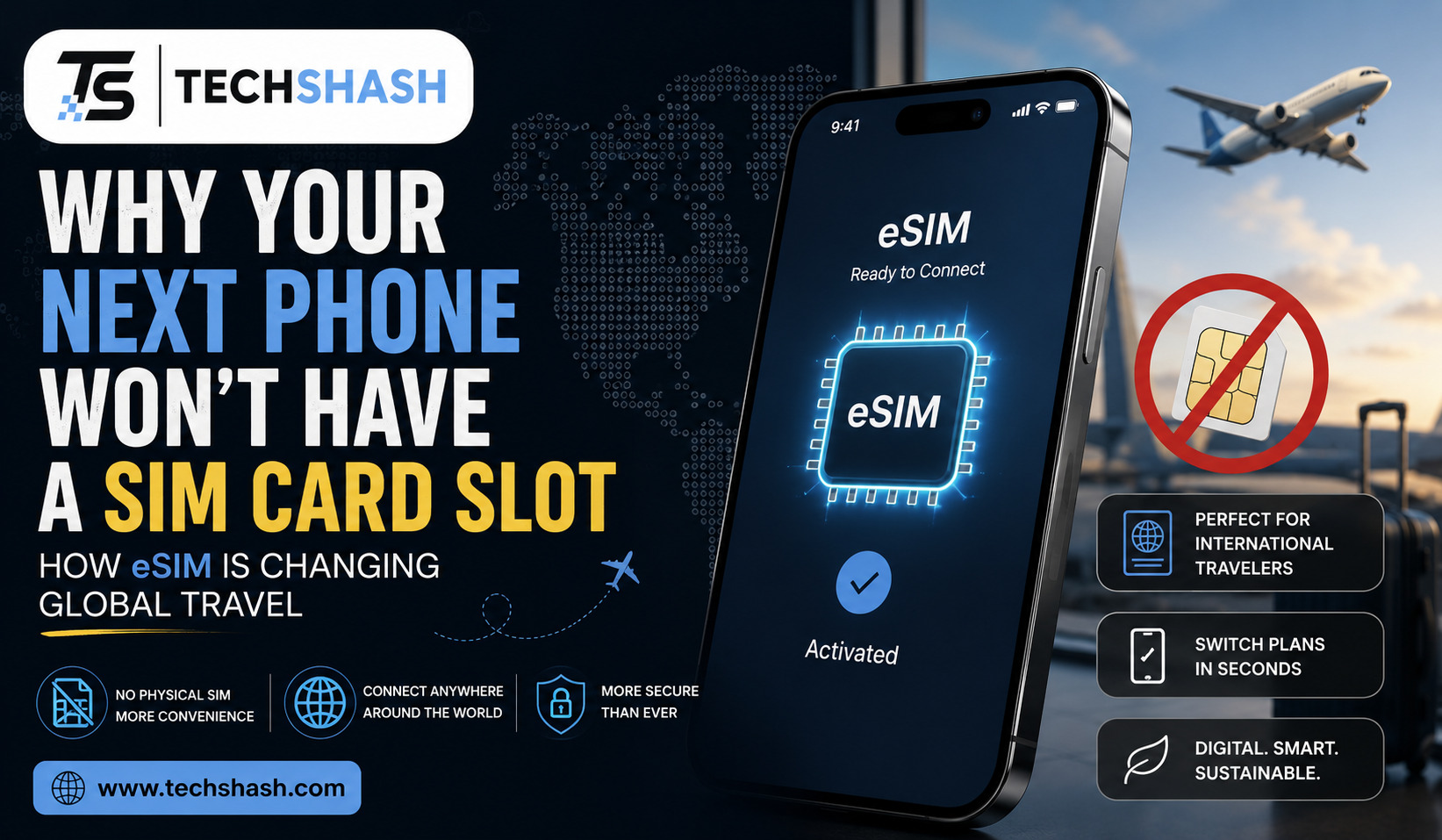
An eSIM is not a smaller SIM card. It is a chip built directly into a phone’s circuitry, and the mobile plan itself is loaded onto that chip as a software profile rather than swapped in as a physical object.
This is a change in philosophy as much as hardware. Getting connected used to mean buying a product and physically inserting it into a device. Now it increasingly means downloading a service, often activated with nothing more than a QR code or a few taps in an app.
Most current eSIM-capable phones can store several profiles at once, commonly eight or more, even though only one or two are typically active at a given time. That alone changes how people think about connectivity while traveling, since switching networks no longer requires finding a shop or waiting for a card to arrive in the mail.
How Far eSIM Adoption Has Come
The pace of change here has been fast by telecom standards. Global eSIM smartphone penetration was around 23 percent in 2024, according to analytics firm Counterpoint, with the United States already ahead of that average at roughly 41 percent of devices launched that year.
Momentum has kept building since. The GSMA forecasts that eSIM adoption will reach 72 percent of new smartphones shipped globally by 2027, and industry estimates put the number of eSIM-enabled devices shipped in 2026 at more than 633 million.
Apple has been one of the more aggressive drivers of this shift. The company removed the physical SIM tray entirely from iPhones sold in the United States starting with the iPhone 14 generation, then extended eSIM-only models to additional countries with devices like the iPhone Air. Google has followed a similar path with recent Pixel hardware. Analyst forecasts from Juniper Research point to global eSIM connections surpassing 1.5 billion, part of a projected 250 percent increase over the following several years.
Why Travelers Are Driving the Shift
Travel is widely cited as the single biggest reason ordinary consumers have started paying attention to eSIM technology at all. The appeal is fairly direct: instead of hunting for a SIM card kiosk after landing, a traveler can buy and activate a local or regional data plan before ever leaving home.
This has created an entire market of dedicated travel eSIM providers offering coverage across 200 or more destinations from a single app, alongside carrier-branded travel eSIM options from major mobile operators who are now competing directly for that business. Multiple profiles stored on one device also means a traveler can keep a home number reachable for calls and texts while running a separate local data plan for day-to-day use abroad.
The security and simplicity angle matters too. Because an eSIM profile cannot be physically removed and swapped the way a SIM card can, phone theft becomes somewhat less useful to criminals interested in reselling connectivity, and losing a tiny plastic card in a hotel room is no longer something travelers need to worry about.
Where the Physical SIM Refuses to Die
Despite the momentum, “the death of the physical SIM” is not a global, finished story yet. Several major markets still restrict or complicate consumer eSIM use in ways that matter directly to travelers.
China remains the clearest example. Consumer eSIM access is still tightly restricted there, tied to state-owned carriers, real-name registration requirements, and infrastructure that treats the physical SIM as a point of network control rather than a simple convenience. As of a March 2026 update to Apple’s own support documentation, only the iPhone 17e and iPhone Air support eSIM within mainland China, while every other iPhone model sold there still relies on dual physical nano-SIM slots.
China is not alone. Reports describe Turkey, India, and the United Arab Emirates as countries where eSIM purchase or activation is restricted or made difficult for incoming travelers, generally for a mix of financial, regulatory, and national security reasons. India does support eSIM technology broadly, but activation can involve extra regulatory checks that make pre-arrival setup more reliable than trying to activate after landing.
Regulation is shaping the transition in the other direction too. The European Union’s 2025 Radio Equipment Regulation requires eSIM support in new devices sold in member states, but notably does not ban physical SIM slots outright, and the US FCC has taken a similar encourage-rather-than-mandate approach. Most forecasts expect physical and embedded SIMs to coexist through at least 2030, particularly in budget devices and industrial or IoT hardware where a removable card remains the cheaper option.
The Practical Downsides Travelers Should Know
None of this means eSIM is a strictly better experience in every situation. A handful of practical wrinkles are worth knowing before relying on it entirely.
Regional device variants complicate things more than most travelers expect. A Hong Kong or Macau iPhone, for instance, uses two physical nano-SIM slots with no eSIM chip at all, despite superficially similar hardware to models sold elsewhere. Buying a phone in one region and assuming it will behave identically in another is a common and avoidable mistake.
Activation timing matters as well. Some travel eSIM plans cannot be activated after arrival in a destination due to local telecom rules, which is why most providers now explicitly recommend installing and activating a plan before departure, ideally while still connected to reliable home Wi-Fi.
Security has become a live regulatory concern too. Some eSIM providers route traveler data through third countries, occasionally without making that clear to the customer, which has drawn scrutiny in markets like Brazil on legal compliance grounds and in others on national security grounds. The “buy anywhere, connect anywhere” pitch is largely true, but it now comes with more fine print than it did even a year or two ago.
How to Travel Smart With an eSIM
A few habits go a long way toward avoiding the common pitfalls above. Check destination-specific restrictions before departure rather than assuming eSIM will simply work, particularly for China, Turkey, India, and the UAE.
Install and activate a travel eSIM profile before leaving home whenever the provider allows it, rather than waiting to do so after landing. Keep a home-network eSIM or physical SIM active alongside a travel profile if staying reachable at your existing number matters, since most modern phones support running both simultaneously.
Finally, treat the provider’s routing and privacy practices as part of the decision, not an afterthought. Where a travel eSIM provider routes your data, and which country’s regulations that data passes through, is now a genuine factor in choosing one plan over another.
Key Takeaways
- What changed: eSIM replaces a physical card with a software profile built into the phone itself.
- Adoption pace: Global smartphone eSIM penetration reached about 23 percent in 2024 and is forecast to hit 72 percent of new shipments by 2027.
- Travel is the driver: Instant activation and multiple stored profiles solve real pain points for people crossing borders.
- Not universal yet: China, Turkey, India, and the UAE all restrict or complicate consumer eSIM access for travelers.
- Regulation cuts both ways: The EU requires eSIM support in new devices but does not ban physical SIM slots.
- Coexistence, not replacement: Physical and embedded SIMs are expected to coexist through at least 2030.
Frequently Asked Questions
Is the physical SIM card completely gone in 2026?
No, physical SIM slots remain common outside flagship phones and in several major markets, including China.
Which countries make eSIM difficult for travelers?
Reports point to China, Turkey, India, and the United Arab Emirates as places where consumer eSIM purchase or activation is restricted or complicated.
Do all iPhones sold today skip the physical SIM tray?
No, only specific regions and models are eSIM-only, while iPhones sold in places like mainland China and Hong Kong still use physical nano-SIM slots.
Can a phone use an eSIM and a physical SIM at the same time?
Yes, most current dual-SIM phones support running an eSIM profile alongside a physical SIM simultaneously.
Should travelers activate an eSIM before or after arriving at their destination?
Providers generally recommend installing and activating a travel eSIM before departure, since some plans cannot be activated after landing.
Conclusion
The shift toward eSIM is real, fast-moving, and reshaping how people stay connected while traveling, but it is not yet a finished transition. Adoption numbers are climbing quickly, and travel has become the clearest reason ordinary consumers care about the technology at all. At the same time, countries like China, Turkey, India, and the UAE show that the physical SIM still has a real, if shrinking, role to play, and travelers who plan around those gaps will have a much smoother experience than those who assume eSIM simply works everywhere.
