Introduction
Ask your phone a quick question and it answers almost instantly. Ask it something more complex and it might pause, clearly reaching out to a server somewhere far away. That gap is the entire story of edge AI versus cloud AI.
This article breaks down what a dedicated NPU actually does, why it has become one of the most important specs in a modern phone, and where cloud processing still wins despite all the progress on-device chips have made.
1. What Edge AI and Cloud AI Actually Mean
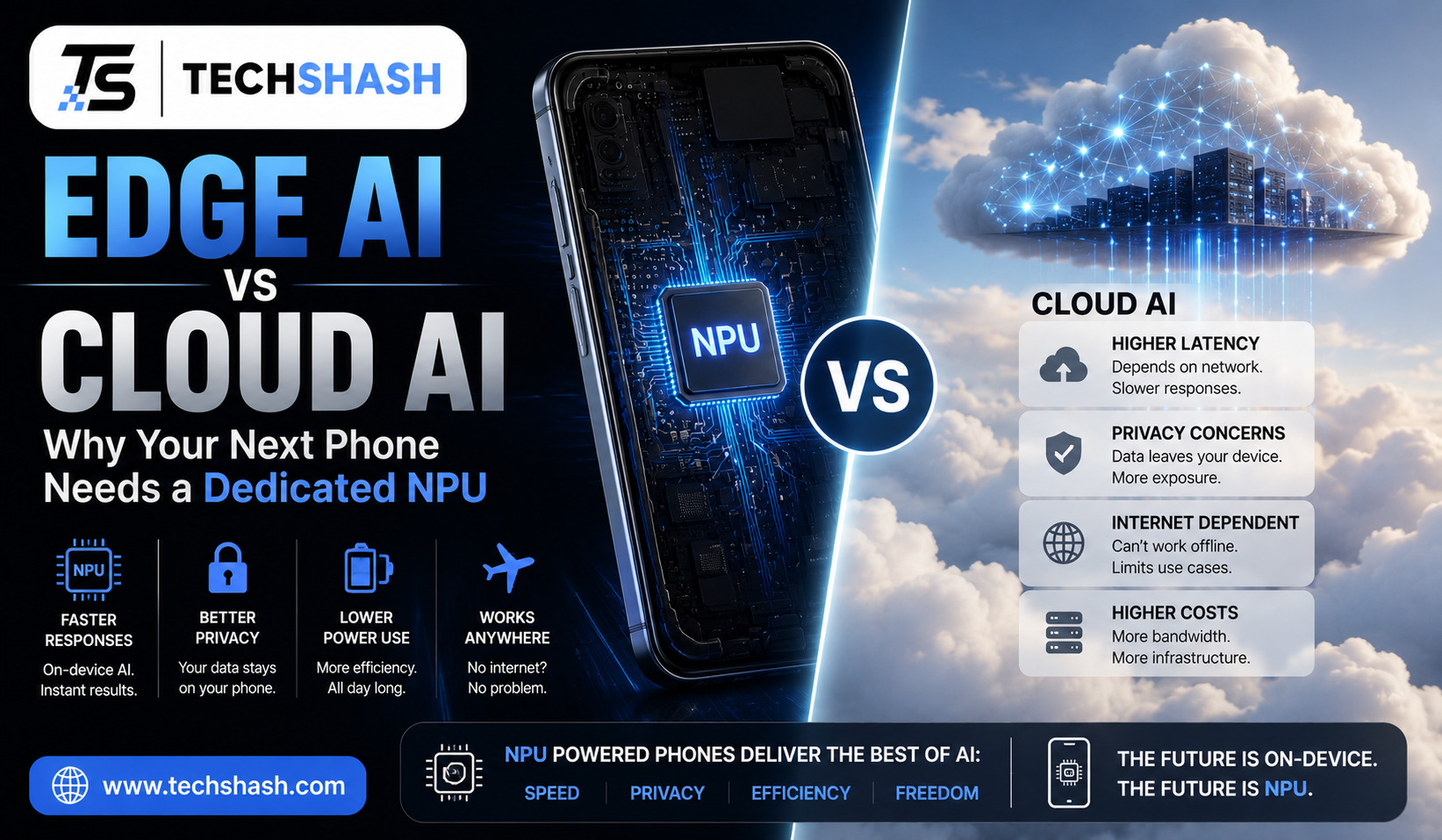
Edge AI, sometimes called on-device AI, refers to artificial intelligence that runs directly on your phone, laptop, or other local hardware, rather than sending data to a remote server for processing.
Cloud AI works the opposite way. Your request travels over the internet to a data center, where far more powerful hardware processes it before sending a response back to your device.
Neither approach has fully replaced the other. Instead, 2026 has become the year both models run side by side inside the same phone, each handling the tasks it is genuinely better suited for.
2. The Chip Making Edge AI Possible: The NPU
None of this on-device progress would be possible without a Neural Processing Unit, or NPU, a dedicated block on a phone’s chip built specifically for machine-learning workloads like language models, vision processing, and audio analysis.
Unlike a general-purpose processor, an NPU is optimized for the specific kind of math that AI models rely on, which lets it run these workloads far more efficiently, using less battery and generating less heat than routing the same task through a standard CPU or GPU.
Every major chipmaker now ships a version of this technology: Apple’s Neural Engine, Qualcomm’s Hexagon NPU, and Google’s Tensor chip all serve the same basic purpose, even though each is built differently under the hood.
3. What Runs Well on a Phone Today
Modern flagship NPUs have gotten genuinely powerful. Current chips like Qualcomm’s Snapdragon 8 Elite and Apple’s A18 Pro Neural Engine offer tens of trillions of operations per second, hardware that would have been considered server-class just a few years ago.
That processing power enables a growing list of real, everyday features that run entirely on the device:
- Real-time language translation, without needing an internet connection.
- Computational photography, including scene detection and multi-frame image processing.
- Voice recognition and dictation, processed locally for faster response times.
- Small on-device language models, such as Gemini Nano and other compact models built specifically to run within a phone’s memory and power limits.
The common thread across all of these features is speed and privacy. Processing happens instantly, without a network round trip, and your data never has to leave the device to get an answer.
4. What Still Needs the Cloud
Despite all this progress, cloud AI is not going away, and there are clear reasons why. Large, general-purpose models like GPT-4o, Gemini 1.5 Pro, and Claude require far more computing power and memory than any phone chip can currently provide.
Cloud-scale models built for complex reasoning, generating full documents, or answering open-ended questions with deep context simply cannot fit onto edge hardware today. A model requiring 40 or more gigabytes of memory is nowhere close to what a phone’s NPU can handle locally.
A few situations still consistently favor sending a request to the cloud:
- Infrequent, high-value tasks, like generating a detailed business plan or a long-form document, where a short delay is an acceptable tradeoff for higher quality output.
- Mid-range devices without a capable NPU, where local processing is either too slow or unavailable entirely.
- Tasks requiring very long context or complex reasoning, which still exceed what compact on-device models can handle reliably.
5. Why Manufacturers Are Racing to Add Bigger NPUs
The competition around NPU power has intensified sharply. AMD’s Ryzen AI 300 series chips reached up to 50 NPU TOPS, and Qualcomm has pushed its Hexagon NPU designs even further with newer chips targeting spatial computing and on-device large language model support.
This race matters because raw NPU power directly determines what kind of AI features a phone can realistically run without leaning on the cloud. A phone with a stronger NPU can keep more processing local, which tends to mean faster responses and lower ongoing data costs for the manufacturer running the AI service.
Samsung has taken this further than most, reportedly planning to integrate AI features across close to 800 million devices in 2026, building heavily on Google’s Gemini models layered on top of its own on-device processing.
6. The Hybrid Approach Most Phones Actually Use
Very few modern phones rely purely on one model or the other. Instead, most flagship devices use a hybrid approach, running lightweight, frequent tasks locally on the NPU while reserving heavier, less frequent requests for the cloud.
This hybrid design lets a phone balance three competing priorities at once: speed, privacy, and raw capability. A quick photo edit or a voice command stays fast and private on-device, while a complex generative request still gets access to the far larger models only cloud infrastructure can currently support.
Developers building apps face a similar decision point. On mid-range phones without strong NPU support, cloud processing with smart caching often remains the more practical choice, while flagship-focused apps increasingly lean toward local processing wherever it makes sense.
7. Privacy, Speed, and Cost: The Real Tradeoffs
Choosing between edge and cloud processing comes down to three consistent tradeoffs that show up across nearly every AI feature.
Privacy almost always favors the edge. Data that never leaves your device cannot be intercepted in transit or stored on a remote server you do not control, which matters more for sensitive tasks like health tracking or personal messages.
Speed also typically favors local processing, since there is no network round trip involved. This matters most for real-time tasks like translation or dictation, where even a small delay feels noticeable.
Cost tends to favor the edge from the manufacturer’s side, since every cloud AI request carries a real, ongoing server cost. Running more tasks locally reduces that expense at scale, which is part of why chipmakers keep investing so heavily in stronger NPUs.
8. What to Look For in Your Next Phone
If on-device AI features matter to you, whether that is faster translation, offline voice commands, or private photo editing, the NPU spec is genuinely worth paying attention to, not just the CPU or camera details most buyers focus on first.
Look specifically for a phone whose manufacturer highlights a recent-generation NPU, since this is one part of the chip that has seen dramatic year-over-year improvement, unlike some other components that have plateaued.
If your priority leans more toward complex, less frequent AI tasks, like generating detailed written content or handling deep research questions, the NPU matters less, since those tasks will likely keep relying on cloud processing regardless of how powerful your phone’s chip becomes.
Key Takeaways
- The core split: Edge AI runs directly on your phone’s NPU, while cloud AI processes requests on remote servers with far more computing power.
- What the NPU does: A dedicated chip built specifically for AI workloads, enabling faster, more private, on-device processing.
- Local strengths: Real-time translation, computational photography, and voice recognition all run well entirely on-device today.
- Cloud strengths: Complex reasoning, long-form generation, and very large models still require cloud-scale computing power.
- The real trend: Most flagship phones now use a hybrid approach, balancing on-device speed and privacy with cloud-based capability.
FAQs
What does NPU stand for and what does it do? NPU stands for Neural Processing Unit, a dedicated chip component built specifically to handle AI workloads more efficiently than a standard processor.
Is edge AI more private than cloud AI? Yes, edge AI processes data directly on the device, so information generally does not need to leave your phone to generate a response.
Can phones run large AI models like GPT-4 entirely on-device? No, models of that scale currently require far more memory and computing power than any phone’s NPU can provide, so they still rely on cloud processing.
Do all phones use a hybrid AI approach? Most current flagship phones do, running lightweight tasks locally on the NPU while sending more complex requests to the cloud.
Why does NPU power matter when buying a new phone? A stronger NPU enables more AI features to run locally, which typically means faster responses, better privacy, and continued offline functionality.
Conclusion
Edge AI and cloud AI are not really competing for the same job anymore; they are splitting the work based on what each one does best. A dedicated NPU lets your phone handle translation, photography, and voice commands instantly and privately, while the cloud still steps in for the heaviest, most complex requests. As NPUs keep getting more powerful each year, expect more of that balance to tip toward your device, making a capable on-device chip one of the more meaningful upgrades in your next phone.