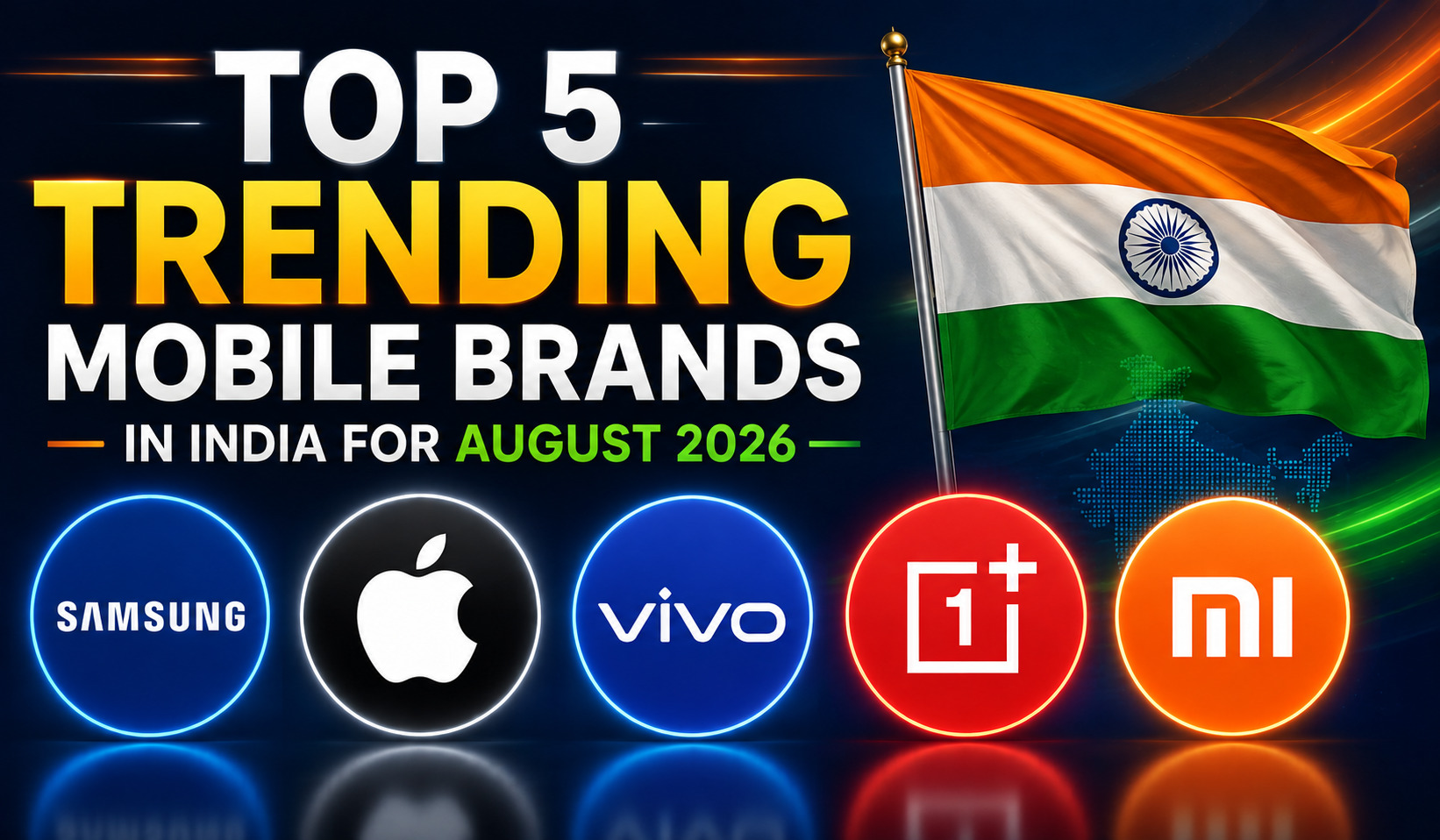

A decade ago, flash sales ruled the Indian smartphone market, and buyers had to queue online just to grab a budget device. That’s changed. Offline store availability, trade-in financing, and camera quality now shape most buying decisions, in cities and small towns alike. Knowing which brands lead the market also helps buyers pick companies that back their phones with solid software updates and real repair networks.
Market share numbers, festive discounts, and trade-in valuations move around every quarter, so treat the figures below as a snapshot rather than gospel — check current pricing and warranty terms with your local retailer before you buy. The rankings and brand details here reflect industry data as of August 2026.
Vivo
Vivo holds the top spot in India by volume, largely on the strength of its retail footprint in smaller towns. Rather than chasing gaming benchmarks, the company puts its R&D into portrait camera algorithms and slim, curved designs — the kind of phone people want to hold and show off.
Specifications
- Market Position: No. 1 vendor by volume in India
- Target Price Range: ₹10,000 to ₹75,000
- Key Product Lines: V Series, T Series, X Series, Y Series
- Primary Focus: Portrait photography and offline retail distribution
Pick up a Vivo phone and the first thing you notice is how light it feels, paired with camera filters tuned for studio-style portraits. It’s aimed at fashion-conscious buyers who want good-looking photos for social media without digging into manual camera settings.
Key Highlights
- Heavy physical store presence across Tier 2 and Tier 3 cities
- Studio lighting features built into the mid-range V-series cameras
- Zeiss optics on the top-tier flagships
The Key Advantage Vivo’s edge comes from pairing store availability with camera tuning. Online-only brands leave buyers guessing from spec sheets; Vivo lets people test the camera in person before they pay. That in-store trial matters more to a lot of shoppers than another few points on a benchmark chart.
Who Should Buy This Anyone who wants a physical store to walk into and an easy way to take good portrait shots.
Samsung
Samsung covers the whole spectrum, from entry-level phones to foldables that cost more than a used car. It leans on brand trust, AMOLED screens, and a software update policy that outlasts most of its rivals — which matters if you’re not planning to upgrade every two years.
Specifications
- Market Position: No. 2 vendor, with strong leadership at the premium end
- Target Price Range: ₹9,000 to ₹150,000
- Key Product Lines: Galaxy S Series, A Series, M Series, Z Fold and Flip Series
- Primary Focus: AMOLED displays, Knox security, extended software support
A Samsung phone gives you a sharp, bright display and software that doesn’t slow down as much over time as some competitors’. It’s a fit for professionals and families who value a known brand name and service centers they can actually find.
Key Highlights
- Up to seven years of security and OS updates on flagship models
- Dynamic AMOLED panels that stay readable in direct sunlight
- Knox security suite for protecting financial data
The Key Advantage Most rivals stop pushing OS updates after two years, which leaves the phone exposed over time. Samsung’s seven-year update window is unusually long for the category, and it’s the main reason people are willing to pay more upfront.
Who Should Buy This Professionals and long-term owners who want guaranteed software support and a display that holds up in daylight.
OPPO
OPPO has grown its share by focusing on things that matter for everyday use — a phone that survives a drop and charges fast — rather than chasing top gaming scores. It’s a practical pitch, and it’s worked well with people who travel a lot for work.
Specifications
- Market Position: No. 3 vendor, with strong year-over-year shipment growth
- Target Price Range: ₹11,000 to ₹65,000
- Key Product Lines: Reno Series, A Series, F Series, K Series
- Primary Focus: Drop durability, battery life, SuperVOOC fast charging
An OPPO phone feels sturdier in hand than most, thanks to reinforced internal frames under a fairly ordinary-looking casing. It’s built for people who can’t afford to crack a screen on a busy commute.
Key Highlights
- Military-grade drop protection on mid-tier models
- SuperVOOC charging that can fill the battery in under thirty minutes
- ColorOS software with tighter RAM management
The Key Advantage While other brands cut costs with thin plastic casings, OPPO builds in shock-absorbing frames that act like a built-in bumper. That structural choice is what separates OPPO from phones in the same price bracket that crack on the first drop.
Who Should Buy This Commuters and outdoor workers who need a phone that can take a hit and charge back up fast.
Xiaomi
Xiaomi made its name in India by stuffing high-end specs — fast processors, high refresh rate screens, big batteries — into phones that cost a fraction of the flagships. It’s still the brand most people compare others against when they’re shopping on a budget.
Specifications
- Market Position: No. 4 vendor, strong in the budget segment
- Target Price Range: ₹7,000 to ₹65,000
- Key Product Lines: Redmi Note Series, Xiaomi Series, POCO
- Primary Focus: Maximum specs per rupee, feature-rich software
Using a Xiaomi phone means dealing with a software interface packed with customization options, on a screen that’s smoother than the price would suggest. It’s popular with students and anyone who reads spec sheets before opening their wallet.
Key Highlights
- HyperOS software with deep personalization
- High refresh rate AMOLED screens at budget prices
- Infrared blasters included even on entry-level models
The Key Advantage Other brands quietly cut features — a slower charger, a lower refresh rate screen — to protect margins on cheap phones. Xiaomi tends to keep the fast screen and throw in an infrared remote even at the low end, so the phone can double as a universal remote for the TV and AC.
Who Should Buy This Students and anyone hunting for high-end specs without the high-end price tag.
Apple
Apple leads the premium end of the Indian market, and trade-in programs have made flagships reachable for more buyers than in past years. For a lot of professionals, the iPhone isn’t just a phone — it’s a work tool and a status symbol rolled into one.
Specifications
- Market Position: Premium market leader, growing fast in cities
- Target Price Range: ₹45,000 to ₹180,000
- Key Product Lines: iPhone base models, Pro Series, Pro Max Series
- Primary Focus: Bionic and Pro chips, video recording, ecosystem integration
An iPhone runs apps smoothly and shoots video that’s a step above most Android competitors. It suits executives, creators, and anyone who wants strong resale value a few years down the line, plus tight integration with a Mac or iPad.
Key Highlights
- 4K video recording with cinematic stabilization
- Custom silicon that keeps performing well years after purchase
- Strong resale value in the second-hand market
The Key Advantage Most phones lose a big chunk of their value within two years. iPhones hold onto theirs better than almost anything else on the market, which means owners recover more money when they trade in for the next model — closer to how a solid financial asset behaves than a typical gadget.
Who Should Buy This Creators and business users who need strong video tools and want to get real money back at resale time.
FAQs
Which mobile brand currently leads the market share in India? Vivo leads by volume as of 2026, thanks to its offline retail network and popular V-series phones. Samsung and OPPO aren’t far behind, holding solid ground across both budget and flagship price bands.
Why does an offline retail network matter so much for mobile brands in India? It lets buyers in smaller cities check build quality and test the camera before they spend money, and it gives them somewhere to go for after-sales help — something online-only channels still struggle to match.
Which smartphone brand holds its resale value best in India? Apple, by a clear margin, thanks to steady demand and long software support. Samsung flagships also hold up better at trade-in time than most budget-focused brands.