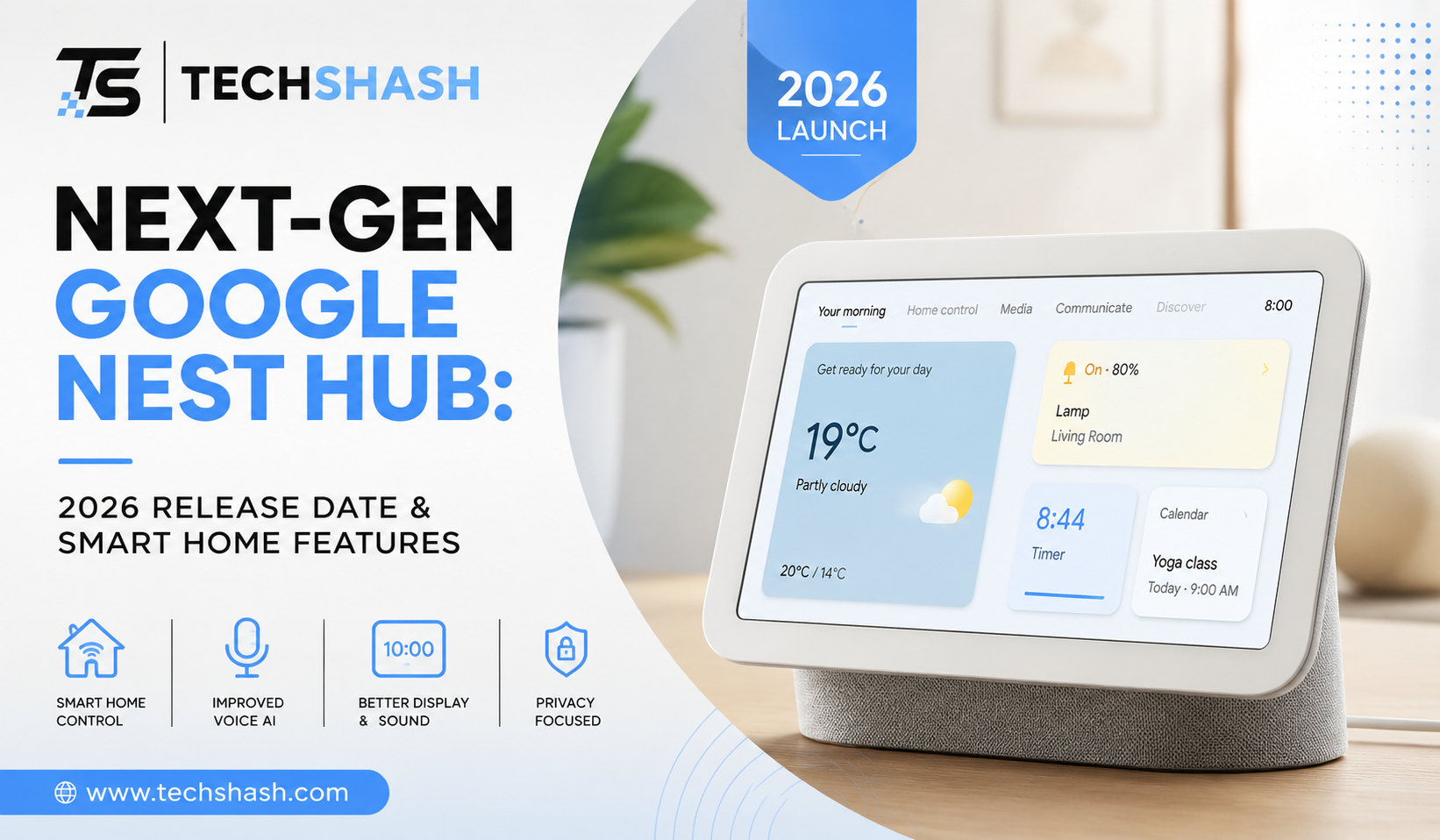
A new Google smart display could be one of the most interesting smart home launches to watch in 2026. The Next-Gen Google Nest Hub has not been officially announced yet, but recent developments point toward Google working on a new display designed around Gemini for Home.
Google has already moved its smart home strategy toward Gemini, launched a new Google Home Speaker, and continued updating existing Nest displays. In this article, we will look at the possible 2026 release timeline, expected smart home features, Gemini integration, display design, and what is actually confirmed so far.
1. Next-Gen Google Nest Hub: What We Know So Far
Google has not officially announced a product called the Next-Gen Google Nest Hub or Nest Hub 3. That distinction matters because many details currently discussed online are based on reports, software discoveries, and comments from Google executives rather than a formal product announcement.
The current second-generation Nest Hub was introduced in 2021, while the larger Nest Hub Max dates back to 2019. Google has continued supporting these displays, but there has not been a major hardware refresh for several years.
A notable clue appeared in May 2026 when references to a Google Home Display were reportedly discovered inside the Google Home application. The name suggests that Google could be preparing a new smart display under the Google Home branding rather than continuing with the Nest Hub name.
That does not confirm a launch, specifications, or even the final product name. Still, the timing makes the discovery interesting because Google has been rebuilding its smart home platform around Gemini.
Why the name may change
Google introduced its new Google Home Speaker as hardware specifically designed for Gemini for Home. The company has also described a new generation of home devices built around this AI platform.
A future display could therefore become part of a broader Google Home hardware family instead of being marketed simply as another Nest Hub.
No official Nest Hub 3 announcement has been made by Google as of August 2026.
2. Possible 2026 Release Date
The biggest question is simple: when will the new Google smart display arrive?
At present, Google has not provided a confirmed release date for a next-generation Nest Hub or Google Home Display. Any specific date should therefore be treated as speculation rather than established information.
There are, however, several reasons to watch the second half of 2026 closely. Google has been actively expanding Gemini for Home, and its new Google Home Speaker became the first dedicated hardware device built around the Gemini-based home assistant.
Google Home’s leadership has also indicated that smart displays remain an important form factor for the company’s home strategy. Reports in 2025 said Google viewed the display format as particularly useful for bringing together a microphone, speaker, screen, and other smart home functions.
What the timeline means
A 2026 launch is possible, but it should not be presented as confirmed.
The software discovery of a Google Home Display is stronger evidence that development may be underway than a random rumor, but development does not guarantee a retail launch. Google could also change the name, design, features, or release schedule before announcing anything publicly.
For now, release date remains unconfirmed.
3. Gemini for Home Could Be the Biggest Upgrade
Hardware may get the attention, but Gemini could be the real reason for a new Google smart display.
Google introduced Gemini for Home as a new voice assistant designed to understand more natural requests and handle more complex interactions than the traditional Google Assistant. The company says Gemini for Home is intended to replace Google Assistant on compatible speakers and displays.
Existing Nest devices are already receiving Gemini-related improvements. Google has even confirmed that first-generation Nest Hub devices can support Gemini for Home, although Gemini Live is not supported on those models.
A new display designed specifically for Gemini could go further.
More natural conversations
Instead of relying on rigid commands, Gemini for Home is designed to handle conversational requests and follow-up questions.
Google has also introduced Gemini Live for compatible home devices. Users can have back-and-forth conversations without repeatedly using the wake phrase during the conversation.
Better help around the house
Google says Gemini for Home can assist with everyday tasks, household questions, cooking ideas, media, reminders, and smart home controls.
A display would make these interactions more useful because information could appear visually instead of being delivered only through a speaker.
Gemini integration is therefore likely to be one of the most important parts of any future Google smart display.
4. Expected Smart Home Features
Google has not published an official feature list for the rumored display, so expected features should be separated from confirmed capabilities already available across Google Home.
Existing Nest Hub models can act as control points for compatible smart home devices. The second-generation Nest Hub also supports Matter and can work as a Thread border router, making it useful as part of a compatible connected home.
A future display could build on that foundation.
Central home control
One of the biggest advantages of a screen-based smart home device is having visual controls in one place.
Users could potentially view and control:
- Smart lights
- Compatible cameras
- Thermostats
- Smart plugs
- Locks
- Media devices
- Other supported Matter devices
Google has also been expanding automation controls inside the Google Home app. Its 2026 updates include more automation capabilities and broader device management.
Better automation with Gemini
Google has already introduced AI-assisted automation features through Google Home.
The company previously showed how Gemini can help users create automations by describing what they want in ordinary language instead of manually building every step.
A new display could make that experience easier by putting automation controls directly in front of household members.
Visual information
A smart display can show information that is difficult to communicate through audio alone.
Recipes, timers, calendars, weather information, camera activity, reminders, and home controls could all benefit from a screen-based interface.
A central smart home dashboard would likely remain one of the main reasons to choose a display instead of a smart speaker.
5. Display, Design, and Hardware Expectations
There are no verified specifications for the rumored Google Home Display. That means screen size, resolution, processor, speakers, camera hardware, and other specifications should not be presented as confirmed.
Google’s previous Nest Hub design provides some useful context, though.
The second-generation Nest Hub uses an edgeless glass display and a compact design intended to fit naturally into different rooms. Google also designed it without a camera, which made it suitable for private spaces such as bedrooms.
A future model could keep some of those ideas while updating the hardware for modern AI.
A camera could change the experience
There is no confirmation that a new display will include a camera.
However, Google has increasingly focused on multimodal AI across its products, and a display with microphones, speakers, and visual hardware could offer more ways to interact with Gemini.
That does not mean Google will definitely add a camera. Privacy has been an important part of the Nest Hub design, and the second-generation model deliberately avoided one.
Better audio is also possible
Google’s second-generation Nest Hub already improved audio compared with the original model, using speaker technology related to Nest Audio and offering 50 percent more bass than the first-generation Hub.
A new model would likely need strong audio performance if Google wants it to serve as both a smart display and a household assistant.
6. Privacy and Connected Home Support
Privacy will be an important consideration for any new smart display.
The second-generation Nest Hub includes a physical microphone switch, and Google has highlighted controls that let users manage their activity and microphone access. The device also does not include a camera.
A future Google Home Display would need to maintain user trust while offering more capable AI.
Matter support
Matter is another important part of Google’s smart home strategy.
Google says Matter-enabled Nest and Android devices can connect with compatible Matter products from other brands. The second-generation Nest Hub and Nest Hub Max can also work as Thread border routers.
That means a future display would have a strong foundation to build on if Google continues supporting current smart home standards.
Privacy controls and Matter support could be just as important as a faster processor or larger screen for everyday use.
7. What Existing Nest Hub Owners Can Expect
People who already own a Nest Hub do not necessarily need to wait for new hardware to experience Google’s latest smart home software.
Google has continued releasing firmware updates for the Nest Hub, Nest Hub Max, and second-generation Nest Hub during 2026. Its July 2026 release notes also mention Gemini Live support for some existing Google smart speakers and displays through Google Home Premium.
Gemini for Home is therefore not limited to a future device.
Existing hardware still has value
The second-generation Nest Hub continues to provide a screen, smart home controls, media playback, and compatibility with Google’s connected home platform.
Google’s newer AI features may make older hardware more useful than its age suggests.
Subscription features
Some advanced Gemini for Home features are connected to Google Home Premium.
Google’s Premium plans include features such as Gemini Live, automation assistance, video history, and advanced camera-related capabilities depending on the plan.
That means the experience on a future smart display may depend not only on the hardware but also on which Google Home services are available.
Key Takeaways
- Release status: Google has not officially announced a Next-Gen Google Nest Hub or confirmed a 2026 release date.
- Possible new name: References to a “Google Home Display” have appeared in Google Home app code, suggesting a possible successor may use Google Home branding.
- Main software upgrade: Gemini for Home is becoming the central AI platform for Google’s smart home devices.
- Smart home control: A future display could provide a central interface for compatible lights, cameras, thermostats, locks, and other devices.
- Matter support: Existing Nest Hub hardware already supports Matter and Thread-related smart home functions.
- Existing devices: Current Nest Hub models continue receiving software and security updates in 2026.
FAQs
Is Google launching a new Nest Hub in 2026?
Google has not officially confirmed a new Nest Hub launch or a specific 2026 release date.
What is the Google Home Display?
Google Home Display is a name reportedly found in Google Home app code that may refer to a future smart display from Google.
Will the next Nest Hub use Gemini?
A future Google smart display is expected to be closely connected to Gemini for Home, although Google has not published final specifications for the rumored device.
Will the new Google smart display have a camera?
There is currently no confirmed information showing whether the rumored Google Home Display will include a camera.
Do existing Nest Hubs support Gemini for Home?
Yes, Google has confirmed Gemini for Home support for existing Nest Hub devices, although feature availability varies by model and some capabilities require Google Home Premium.
Conclusion
The Next-Gen Google Nest Hub remains an unconfirmed product, but Google’s recent smart home activity makes the category worth watching. The company is building its home experience around Gemini, expanding Matter support, updating existing Nest displays, and introducing new Google Home hardware.
A future display could combine those efforts into one device with a screen, voice assistant, smart home controls, and Gemini-powered help. For now, though, the release date and final specifications remain unknown, so any detailed claims about a Nest Hub 3 should be treated as speculation until Google makes an official announcement.