
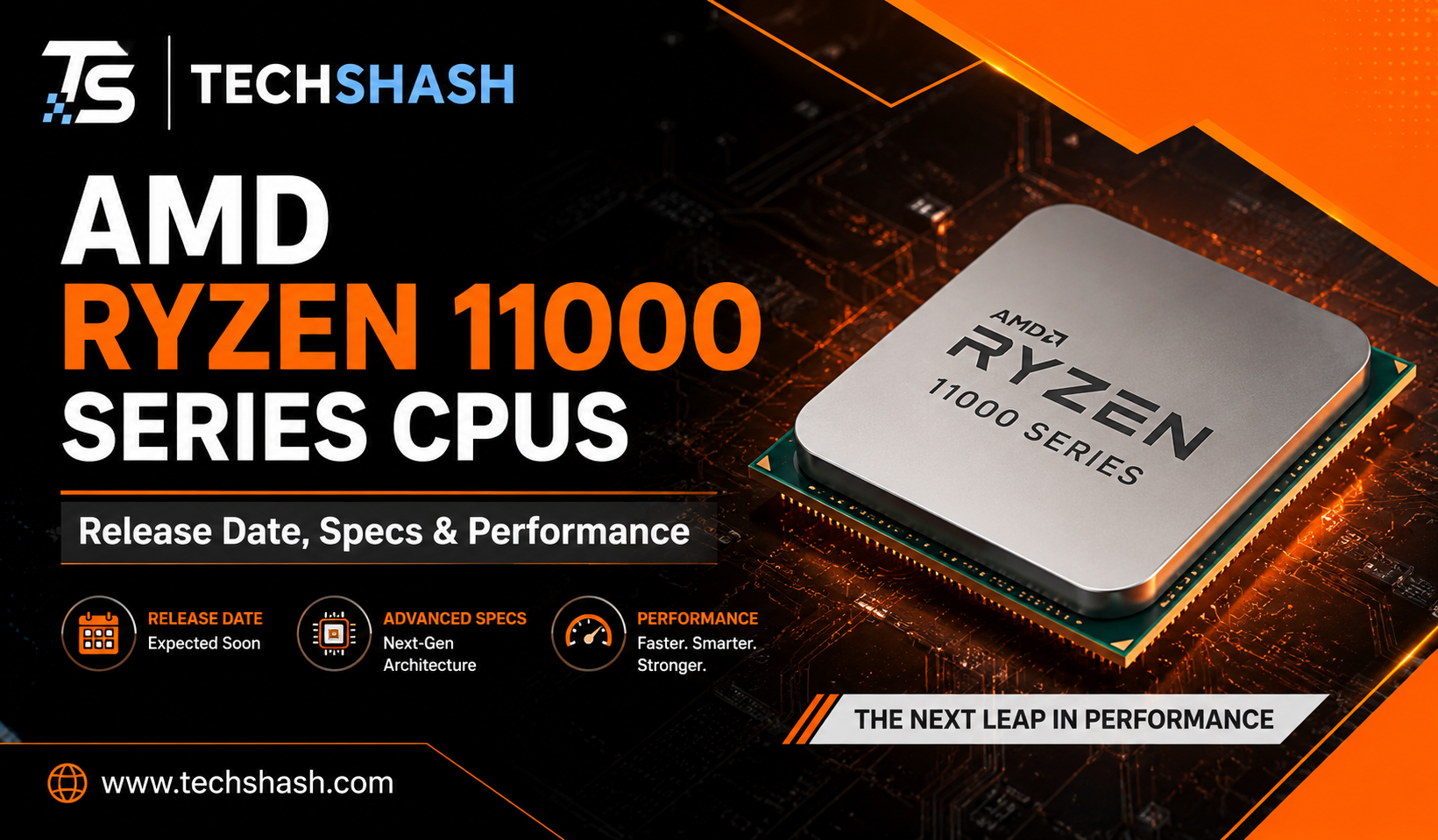
A new Ryzen generation is always worth watching, especially when it could bring a major change in core design and platform support. The AMD Ryzen 11000 Series CPUs are widely discussed in connection with AMD’s next-generation Zen 6 desktop processors, but there is an important catch: AMD has not officially confirmed the Ryzen 11000 name or a complete consumer desktop specification sheet.
This article separates what is known from what is still based on reports and leaks, covering the expected release date, architecture, specifications, platform support, performance, and what buyers should realistically expect.
1. AMD Ryzen 11000 Series: What We Know So Far
AMD’s current mainstream desktop lineup is the Ryzen 9000 Series, built around the Zen 5 architecture. AMD officially identifies Ryzen 9000 as its Zen 5 desktop generation, using a 4nm process and delivering about a 16 percent single-threaded IPC improvement over Zen 4.
The next generation is expected to use Zen 6, with leaked reports referring to the desktop chips by the codename Olympic Ridge. However, the final retail branding remains uncertain.
Some reports call the upcoming generation Ryzen 10000, while others suggest AMD could continue its naming pattern with Ryzen 11000. A February 2026 report specifically noted that both names were still possibilities.
That distinction matters. Calling these processors “Ryzen 11000 Series” is useful for discussion, but it should not be treated as an officially confirmed product name.
Zen 6 is the important part of the story because it represents the architectural generation expected to power these processors.
2. Expected Release Date and Launch Timeline
The release date remains one of the biggest unanswered questions surrounding the next Ryzen desktop generation.
AMD has previously indicated that Zen 6 is part of its 2026 roadmap, and several reports have pointed toward a late-2026 launch window. Earlier reporting suggested a possible Computex 2026 announcement, while later reports have raised the possibility of a launch moving toward 2027.
More recent information provides stronger evidence that Zen 6 desktop processors are being prepared for the AM5 platform. Reports published in August 2026 say AMD documentation identifies upcoming Zen 6 desktop families with AM5 support.
That does not provide a confirmed retail launch day.
Why the date is still uncertain
Several factors can affect a processor launch, including manufacturing readiness, motherboard firmware support, product segmentation, and AMD’s wider product schedule.
For that reason, readers should be careful with websites that present an exact Ryzen 11000 release date as confirmed.
At present, the safest expectation is that Zen 6 desktop Ryzen processors could arrive around late 2026 or 2027, with the final timing depending on AMD’s official announcement.
3. AMD Ryzen 11000 Series Specs and Zen 6 Architecture
The biggest expected change is the move from Zen 5 to Zen 6.
AMD describes Zen as a scalable architecture that uses chiplets to build processors with different performance levels. This design allows AMD to combine CPU chiplets with separate I/O components rather than relying on one large monolithic die.
Leaked information suggests that Zen 6 desktop chiplets could contain up to 12 CPU cores, compared with up to eight cores per CCD in the current Ryzen 9000 desktop generation.
That could allow AMD to increase core counts without simply making each chiplet much larger.
A possible 12-core CCD
Reports from February 2026 suggested a Zen 6 CCD could contain 12 cores and 48 MB of L3 cache. If accurate, that would represent a substantial increase compared with the eight-core, 32 MB L3 configuration associated with Zen 5 CCDs.
The important word here is “could.” These figures are based on reports rather than a complete AMD specification announcement.
Smaller manufacturing technology
Zen 6 is also expected to benefit from a more advanced manufacturing process, although the exact consumer desktop process configuration has not been fully confirmed by AMD.
A smaller process can potentially allow more transistors and greater efficiency within a similar physical area, but manufacturing technology alone does not determine real-world performance.
4. Expected Core Counts, Cache and Platform Support
Core count is where the upcoming generation could become especially interesting.
One leaked configuration points to single-chiplet models with 6, 8, 10 and 12 cores, while dual-chiplet designs could potentially reach 16, 20 and 24 cores.
If AMD actually launches a 24-core mainstream Ryzen desktop processor, it would represent a major change from the current Ryzen 9000 generation, where the regular desktop flagship reaches 16 cores.
Possible configuration
Reported configurations include:
- 6 cores and 12 threads
- 8 cores and 16 threads
- 10 cores and 20 threads
- 12 cores and 24 threads
- 16 cores and 32 threads
- 20 cores and 40 threads
- 24 cores and 48 threads
These numbers should be treated as rumored configurations, not confirmed retail specifications.
AM5 support
Platform compatibility is a more promising area.
Recent reports indicate that Zen 6 desktop processors are being associated with the AM5 socket, meaning existing AM5 users may have a future upgrade path without replacing the entire motherboard.
Actual compatibility can still depend on the motherboard manufacturer and BIOS support.
That means an AM5 motherboard bought today could potentially have a longer useful life than expected, although users should wait for official CPU and motherboard compatibility lists before upgrading.
5. Ryzen 11000 Series Performance Expectations
Performance is where speculation becomes particularly difficult.
AMD has not released independent benchmark results for a retail Ryzen 11000 processor, and there is no official performance chart that can establish how these CPUs will compare with Ryzen 9000 models.
Still, several architectural changes point toward potential gains.
Zen 6 is expected to improve CPU core performance, while higher core counts could produce larger gains in workloads that use many threads. AMD has also been working on more detailed power and performance management at the core level.
Higher core density could be one of the biggest advantages if the leaked configurations prove accurate.
For everyday tasks, the difference may be less dramatic. Web browsing, office applications, and many common programs do not scale perfectly across large numbers of CPU cores.
Video editing, 3D rendering, compiling, simulation work, and other heavily threaded applications could benefit much more from additional cores.
6. Gaming and Productivity Improvements
Gamers will probably pay close attention to Zen 6 because CPU performance is not only about average frame rates.
AMD’s upcoming Zen 6 architecture has been linked with changes designed to improve how workloads are distributed between CPU cores. Reports have discussed features such as performance prioritization and power management that could help reduce inconsistent frame delivery in some situations.
Gaming performance
A faster CPU can help games that depend heavily on processor performance, particularly when paired with a powerful graphics card.
However, the actual improvement will depend on the game, GPU, resolution, memory configuration, and specific Ryzen model.
Gamers should also watch for future X3D versions. AMD has used 3D V-Cache in gaming-focused Ryzen processors, and Zen 6 products are expected to continue that approach, although exact models and specifications remain unconfirmed.
Productivity performance
Content creators and professionals may have more obvious reasons to consider a high-core-count Zen 6 processor.
Applications that can distribute work across many CPU threads can make better use of additional cores. A possible 24-core Ryzen desktop processor would therefore be particularly interesting for demanding workloads.
Casual users, however, may gain more from improvements in efficiency and single-thread performance than from simply having more cores.
7. Should You Wait for Ryzen 11000 Series CPUs?
Whether waiting makes sense depends on what you are doing with your PC.
Someone building a computer immediately should not delay an important purchase indefinitely based only on leaks. Ryzen 9000 processors are already an established generation, while the exact branding, pricing, clock speeds, and release date of the next generation remain uncertain.
Existing AM5 owners are in a different position.
If your current Ryzen processor already handles your games and applications comfortably, waiting could be sensible because Zen 6 may offer a direct upgrade path while keeping the same socket. Recent reports provide evidence supporting AM5 compatibility.
For buyers who need maximum productivity performance, the rumored increase in core count makes waiting more interesting.
Still, official specifications should decide the purchase, not leaked numbers.
A sensible approach is to compare the final Ryzen 11000 or Ryzen 10000 models against their Ryzen 9000 counterparts after AMD publishes specifications, pricing, benchmarks, and supported motherboard details.
8. Key Takeaways
- Product name: Ryzen 11000 is not officially confirmed and may instead be branded Ryzen 10000.
- Architecture: The next generation is expected to use AMD Zen 6.
- Release timing: Late 2026 or 2027 is currently the safest broad expectation based on available reports.
- Core count: Leaks suggest configurations ranging from 6 to as many as 24 cores.
- Cache: Reports suggest Zen 6 CCDs could carry 48 MB of L3 cache.
- Socket: Upcoming Zen 6 desktop processors are strongly associated with AMD’s AM5 platform.
- Gaming: Better core performance and scheduling could improve gaming consistency.
- Productivity: Higher core counts could make demanding multi-threaded workloads much faster.
- Important warning: Detailed specifications, prices, clock speeds, and benchmark results should be considered unconfirmed until AMD publishes them.
FAQs
Is AMD Ryzen 11000 Series officially confirmed?
AMD has not officially confirmed that the upcoming Zen 6 desktop processors will use the Ryzen 11000 name.
When will AMD Ryzen 11000 Series CPUs launch?
Current reports point to late 2026 or 2027, but AMD has not announced a final consumer desktop launch date.
Will Ryzen 11000 Series CPUs use AM5?
Recent reports based on AMD documentation indicate that Zen 6 desktop processors will support the AM5 platform.
Could Ryzen 11000 processors have 24 cores?
Leaked information suggests that a dual-CCD Zen 6 design could reach 24 cores and 48 threads, but AMD has not officially confirmed such a retail model.
Will Ryzen 11000 be faster than Ryzen 9000?
Zen 6 is expected to improve performance over Zen 5, but exact gains cannot be confirmed until AMD releases final specifications and independent benchmarks.
Conclusion
The AMD Ryzen 11000 Series CPUs could become one of AMD’s most interesting desktop upgrades if the reported Zen 6 specifications prove accurate. Higher core counts, possible improvements in single-thread performance, and continued AM5 support would give existing Ryzen users several reasons to pay attention.
For now, though, the Ryzen 11000 name, exact specifications, prices, clock speeds, and final release date remain uncertain. The clearest picture is that AMD’s next major desktop generation is built around Zen 6, with late 2026 or 2027 remaining the broad window to watch.