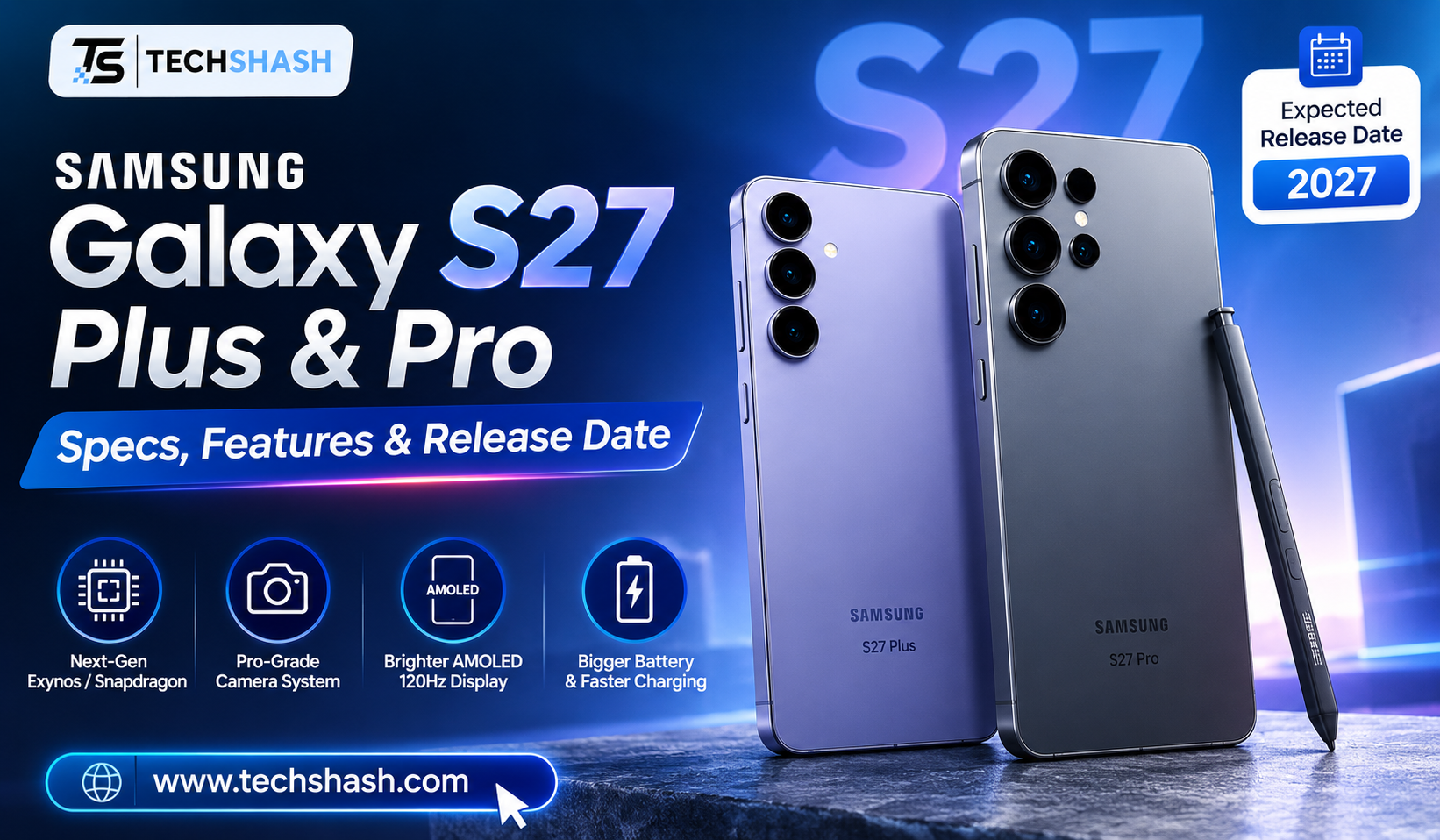
Mobile technology moves at a very rapid pace every year. Early details regarding the next flagship lineup from South Korea have already begun to surface. Excitement surrounding the Samsung Galaxy S27 Plus continues to build as supply chain reports reveal major hardware shifts.
Tech enthusiasts want to know what improvements are coming to the intermediate models. Early leaks hint at a potential shake-up in the family lineup. This article will examine all the verified rumors, internal testing codes, expected specs, and launch dates in detail.
1. Expected Release Date and Announcement Timeline for Samsung Galaxy S27 Plus
Samsung usually maintains a predictable schedule for its premium mobile announcements. Historical data shows that major Galaxy launches happen early in the first quarter of each calendar year.
Current supply chain schedules point toward an announcement in early 2027. Most industry watchers expect an official Unpacked event to take place in February 2027. Units will likely hit store shelves approximately two weeks after the unveiling.
Firmware development schedules provide strong clues regarding device readiness. Test builds for One UI 9.5 have already appeared on internal server networks under model code SM-S952U.
- Expected Announcement: Early February 2027
- Pre-Order Period: Mid-February 2027
- Official Market Release: Late February 2027
Production cycles suggest assembly lines will ramp up during the final months of 2026. Component validation phase is currently underway for display panels and primary camera modules.
Any minor delays in factory calibration could push retail availability into early March 2027. However, the early testing phase indicates that development remains on schedule.
2. Design Language and Display Upgrades for Samsung Galaxy S27 Plus and Pro
Visual aesthetics remain a crucial factor for smartphone buyers today. Leaked renders show a refined rear camera arrangement that differs from older generations.
The upcoming models may adopt a streamlined horizontal camera module on the back panel. Aluminum frames will provide structure, while glass covers both sides.
Screen quality continues to be a top priority for mobile users. A large 6.7-inch OLED panel will likely grace the front of the Plus variant.
Screen Specifications and Protection
Bright sunlight readability will improve thanks to upgraded panel materials. Peak brightness levels could reach 3,000 nits under auto brightness mode.
- Display Size: 6.7 inches to 6.72 inches
- Refresh Rate: 1Hz to 144Hz variable rate
- Screen Glass: Corning Gorilla Armor 2
- Dust and Water Resistance: IP68 or IP69 rating
Color reproduction will offer rich contrast and deep blacks across all lighting environments. Built-in privacy display layers are also under consideration to limit viewing angles from side onlookers.
The new Pro edition is rumored to feature a slightly smaller 6.4-inch screen. That sizing gives buyers who prefer compact flagship devices a powerful alternative.
3. Processor and Hardware Performance Details
Processing power dictates how smoothly heavy applications and multitasking operate on modern devices. Regional chip division will continue with this upcoming series.
North American models are expected to ship with the Qualcomm Snapdragon 8 Elite Gen 6 chip. Other global regions will likely receive the in-house Exynos 2700 processor.
Both silicon architectures will utilize an advanced 2-nanometer manufacturing node. Smaller transistor sizes translate directly to lower power draw and reduced heat buildup under full load.
Memory Configurations and Storage Speed
Speedy memory modules ensure that applications stay loaded in the background without constant reloading. Storage speeds will also see a notable generation bump.
- System Memory: 12GB or 16GB LPDDR5X RAM
- Internal Storage Options: 256GB, 512GB, and 1TB
- Processing Node: 2nm manufacturing process
- Memory Type: UFS 4.0 or UFS 4.1 flash memory
Mobile gaming fans can look forward to improved graphics rendering speeds. Ray tracing support will offer more realistic lighting effects in heavy titles.
On-device artificial intelligence tasks will complete much faster than on previous generations. Local execution keeps user data secure on the device without requiring cloud access.
4. Camera Upgrades and Sony Sensor Integration
Photography setups are undergoing an interesting shift behind closed testing doors. Supply reports reveal Samsung is testing a new Sony primary sensor for non-Ultra models.
Moving away from ISOCELL sensors on main cameras represents a major tactical adjustment. The primary sensor will retain a 50-megapixel resolution while improving light capture in low-light environments.
Optical image stabilization will prevent blur during motion or night shooting modes. Secondary lenses will complete the versatile triple-camera array on the back cover.
Expected Camera Specifications
A dedicated optical zoom lens allows users to capture distant subjects without quality loss. Ultra-wide sensors help capture broad landscapes and group portraits clearly.
- Primary Sensor: 50MP Sony main camera with optical stabilization
- Ultra-Wide Lens: 12MP or 48MP sensor with wide field of view
- Telephoto Lens: 10MP sensor with 3x optical zoom
- Selfie Camera: 12MP front sensor with autofocus
Video recording options will include 8K video capture at 30 frames per second. High frame rate 4K recording at 120 frames per second will allow smooth slow-motion clips.
Software adjustments inside One UI will offer automated color correction. Night portrait modes will yield clearer skin tones without adding excessive digital noise.
5. Battery Capacity, Silicon-Carbon Tech, and Fast Charging
Battery endurance remains a chief concern for heavy daily mobile phone users. Engineers are testing new cell chemistries to pack more energy into tight internal spaces.
Silicon-carbon battery technology allows higher energy density without increasing overall physical device thickness. The Plus version is expected to carry a battery capacity between 4,900 mAh and 5,000 mAh.
Charging speeds will remain dependable while protecting long-term cell health. A 45-watt wired connection will power the device quickly during short breaks.
- Battery Capacity: 4,900 mAh to 5,000 mAh
- Wired Fast Charging: 45W fast charging capabilities
- Wireless Standard: 20W to 25W Qi2 wireless support
- Power Sharing: Reverse wireless charging for accessories
Thermal management inside the phone chassis will rely on larger vapor chambers. Heat dissipates across the frame so the battery remains cool during rapid charging sessions.
Battery longevity settings will allow owners to cap charge limits at eighty percent. That practice preserves chemical health over several years of daily usage.
6. Software Capabilities with One UI 9.5 and Android 17
Software experience dictates daily satisfaction when navigating menus and launching apps. The device will ship with Android 17 straight out of the factory box.
Samsung will overlay its custom One UI 9.5 interface over the base Android operating system. Menus will emphasize one-handed reachability and quick access settings.
System updates will remain a strong selling point for long-term ownership. Seven years of major operating system upgrades will keep the phone secure and functional.
- Base OS: Android 17
- Custom Interface: One UI 9.5
- Update Commitment: Seven years of OS and security updates
- Connectivity: Satellite messaging hub and Wi-Fi 7
Emergency satellite connectivity will allow users to send messages in remote areas without cellular coverage. Upgraded Wi-Fi standards will ensure stable home networking performance.
Interface animations will run at a smooth 120 Hz refresh rate throughout the operational system. Quick panel toggles will offer greater customization choices for individual preferences.
7. Pricing Breakdown and Model Lineup Strategy
Lineup structure may expand from three models to four options in the upcoming generation. Introducing a Pro model creates an intriguing choice between base and Ultra variants.
The Pro edition will target users who want high performance without paying maximum Ultra pricing. It will sit directly between the Plus and Ultra versions in overall specifications.
Expected pricing structures reflect current component inflation trends across the tech sector. Standard pricing tiers should align closely with preceding generation targets.
- Base Galaxy S27: Approximately $799 to $849
- Galaxy S27 Plus: Estimated starting price around $999
- Galaxy S27 Pro: Estimated starting price around $1,099
- Galaxy S27 Ultra: Estimated starting price around $1,299
Base storage options will start at 256GB for both Plus and Pro configurations. Eliminating 128GB options gives buyers ample space for apps, photos, and high-definition video files.
Trade-in promotions at launch will likely reduce initial out-of-pocket costs significantly. Carrier subsidies will offer further incentives during pre-order windows.
Key Takeaways
- Expected Launch Timeline: February 2027 announcement with late February store release.
- Lineup Expansion: A new Pro variant may join the base, Plus, and Ultra models.
- Camera Sensor Shift: Samsung is testing a 50MP Sony main sensor for the Plus model.
- Process Technology: Snapdragon 8 Elite Gen 6 and Exynos 2700 built on a 2nm node.
- Battery and Power: 5,000 mAh battery capacity supported by 45W wired charging.
- Software Support: Android 17 with One UI 9.5 backed by seven years of system updates.
Frequently Asked Questions
When will the Samsung Galaxy S27 Plus be released?
The smartphone is expected to launch officially in February 2027 during an Unpacked event.
What processor will power the Samsung Galaxy S27 Plus?
Qualcomm Snapdragon 8 Elite Gen 6 or Exynos 2700 will power the device depending on the region.
Will there be a new Pro model in the lineup?
Reports indicate Samsung is testing a Pro model to sit between the Plus and Ultra editions.
What camera changes are expected for the Plus model?
Samsung is currently testing a 50-megapixel Sony sensor for the primary rear camera position.
How many years of software updates will the device receive?
Samsung will provide seven full years of operating system and security updates for the lineup.
Conclusion
Anticipation surrounding the upcoming flagship lineup highlights how much interest remains in top-tier mobile devices. Early leaks show meaningful improvements in camera hardware, battery efficiency, screen brightness, and system silicon. The rumored addition of a Pro model offers extra flexibility for buyers looking for top performance. As production approaches, excitement for the Samsung Galaxy S27 Plus remains strong among Android enthusiasts worldwide.