
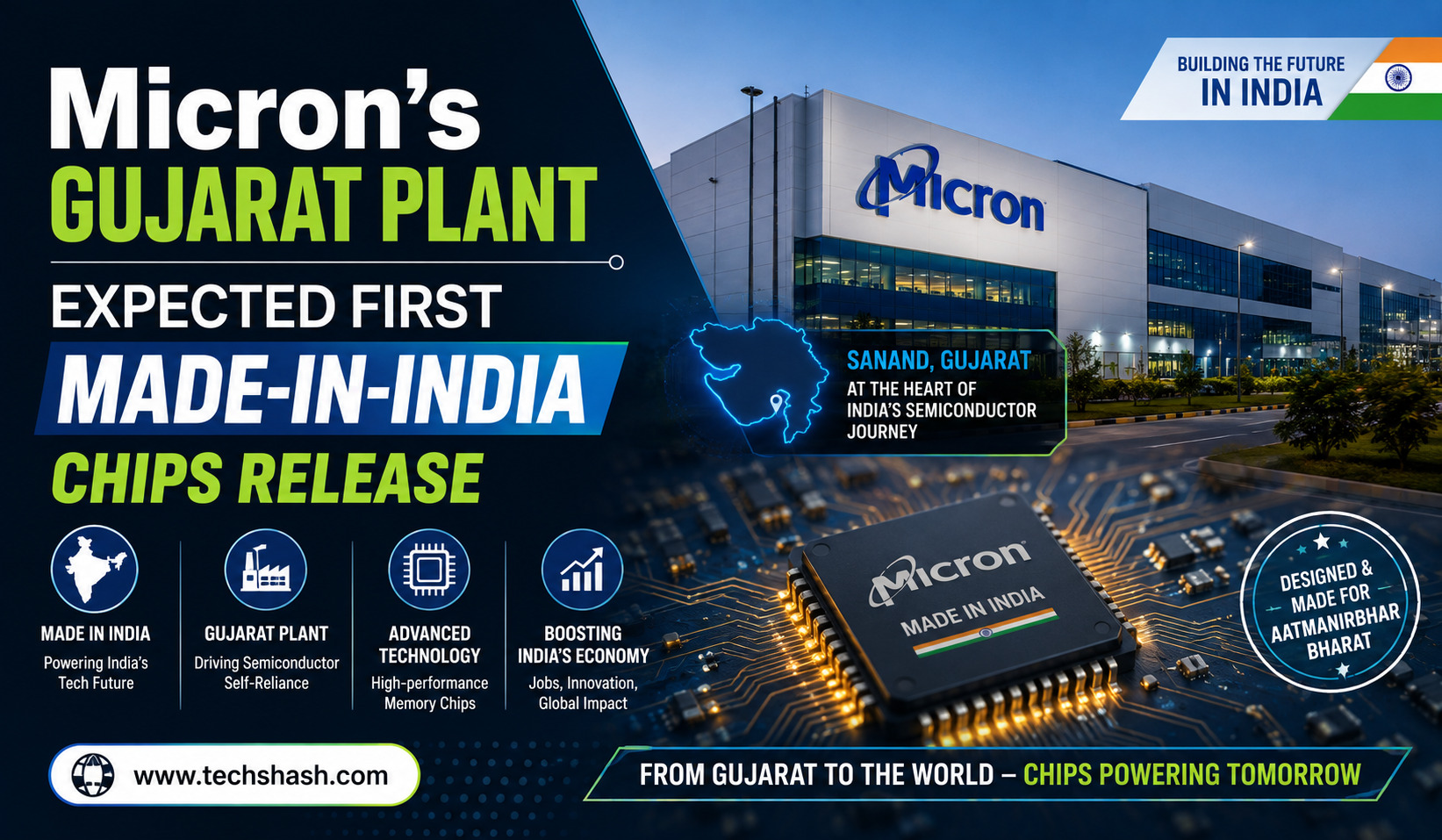
India’s first commercial semiconductor chips are no longer a future promise. Micron Technology has already opened its Sanand plant in Gujarat, shipped its first made-in-India memory modules, and started scaling toward much larger volumes through 2027.
Micron’s Sanand Plant, in Short
Micron’s facility in Sanand, Gujarat is an assembly, test, mark, and packaging plant, often shortened to ATMP. It takes DRAM and NAND wafers manufactured elsewhere in Micron’s global network and turns them into finished memory and storage products ready for customers.
The combined investment from Micron and its government partners totals approximately $2.75 billion, with the project itself valued at around ₹22,500 crore.
The Timeline From Groundbreaking to Grand Opening
Micron broke ground on the Sanand site in September 2023. Construction moved quickly by industry standards, with pilot production lines reportedly running by late 2025.
The facility was formally inaugurated on February 28, 2026, with Prime Minister Narendra Modi, Gujarat Chief Minister Bhupendra Patel, and Union IT Minister Ashwini Vaishnaw all attending the ceremony. By that point, the site had already begun commercial production.
What the Facility Actually Does
Sanand is not a wafer fabrication plant, meaning it does not grow silicon from raw material. Instead, it handles assembly, testing, marking, and packaging, the stage where finished wafers become usable memory chips and modules.
The first phase includes advanced packaging work, including modules used in AI accelerators, though Micron notes that its most advanced high-bandwidth memory stacks are still packaged at other global facilities for now.
The First Made-in-India Chips
At the grand opening, Micron presented its first shipment of made-in-India memory modules to Dell Technologies, destined for laptops manufactured in India for the domestic market. The moment marked the first time modern semiconductor products moved from an Indian factory floor to a customer’s supply chain at commercial scale.
Micron Chairman, President and CEO Sanjay Mehrotra described the milestone as part of building a resilient ecosystem underpinning the global AI economy, crediting the Indian and Gujarat governments for their support throughout construction.
How Big the Facility Is
Once fully ramped, the first phase of the Sanand operation will include more than 500,000 square feet of cleanroom space, making it one of the largest single-floor semiconductor assembly and test cleanrooms in the world. The site is ISO 9001:2015 certified.
What Comes Next for Micron in India
Micron expects to assemble and test tens of millions of chips at Sanand during 2026, with that figure scaling to hundreds of millions of chips in 2027 as production ramps further. The pace of that scale-up will be one of the clearest signals of how quickly India’s broader semiconductor ambitions are progressing.
Where Sanand Fits Into Micron’s Global Plans
Sanand is one piece of a much larger global expansion by Micron. In January 2026, the company began building a $24 billion wafer fabrication facility in Singapore focused on NAND flash memory, expected to become operational in 2028. Just weeks before that, Micron also broke ground on a new DRAM megafab in Clay, New York, part of a planned investment of up to $100 billion over the next two decades.
Sanand strengthens Micron’s global assembly and test network alongside these fabrication investments, spreading production across North America, Southeast Asia, and now India to build a supply chain more resilient to geopolitical disruption.
Key Takeaways
- Location and type: Sanand, Gujarat, an assembly, test, and packaging facility rather than a wafer fab.
- Investment: Approximately $2.75 billion combined from Micron and its government partners.
- Opening date: Formally inaugurated on February 28, 2026, with commercial production already underway.
- First customer: Dell Technologies, receiving the first shipment of made-in-India memory modules.
- Scale: More than 500,000 square feet of cleanroom space, one of the largest single-floor facilities of its kind globally.
- 2026-2027 output target: Tens of millions of chips in 2026, scaling to hundreds of millions in 2027.
- Global context: Part of Micron’s wider expansion, alongside new fabs in Singapore and New York.
Frequently Asked Questions
Has Micron’s Gujarat plant already released made-in-India chips?
Yes, Micron shipped its first made-in-India memory modules to Dell Technologies at the facility’s official opening on February 28, 2026.
Is Micron’s Sanand plant a full chip fabrication facility?
No, it is an assembly, test, mark, and packaging facility that finishes wafers made elsewhere in Micron’s global network rather than growing silicon wafers on-site.
How much did Micron invest in the Sanand facility?
The combined investment from Micron and its government partners is approximately $2.75 billion.
How many chips will the Sanand plant produce?
Micron expects to assemble and test tens of millions of chips in 2026, scaling to hundreds of millions in 2027.
Who attended the Sanand plant’s opening ceremony?
Prime Minister Narendra Modi, Gujarat Chief Minister Bhupendra Patel, and Union IT Minister Ashwini Vaishnaw attended, alongside Micron’s leadership team.
Conclusion
Micron’s Gujarat plant has already delivered on what was once just a construction milestone, opening in February 2026 and shipping its first made-in-India chips to Dell Technologies the same day. With production scaling from tens of millions of chips this year to hundreds of millions in 2027, Sanand stands as one of the clearest early proof points for India’s broader semiconductor manufacturing push.