Introduction
Floors get dirty within hours of cleaning, and laundry piles up faster than anyone can manage. Busy individuals and families constantly search for ways to reclaim their precious free time from endless chores. Enter autonomous home robots, the modern technology designed to shoulder heavy domestic burdens. This article covers how automated machines change daily routines and provide practical household assistance.
1. Understanding the Evolution of Autonomous Home Robots
Robots used to belong strictly to science fiction movies or heavy industrial factories. Today, engineers build compact machines designed specifically for residential spaces. Early models simply bumped randomly into furniture until they changed direction. Modern engineering allows machines to map entire houses with remarkable precision. Advanced sensor technology enables these units to avoid obstacles and clean efficiently without human supervision.
2. Current Capabilities of Household Assistance Robots
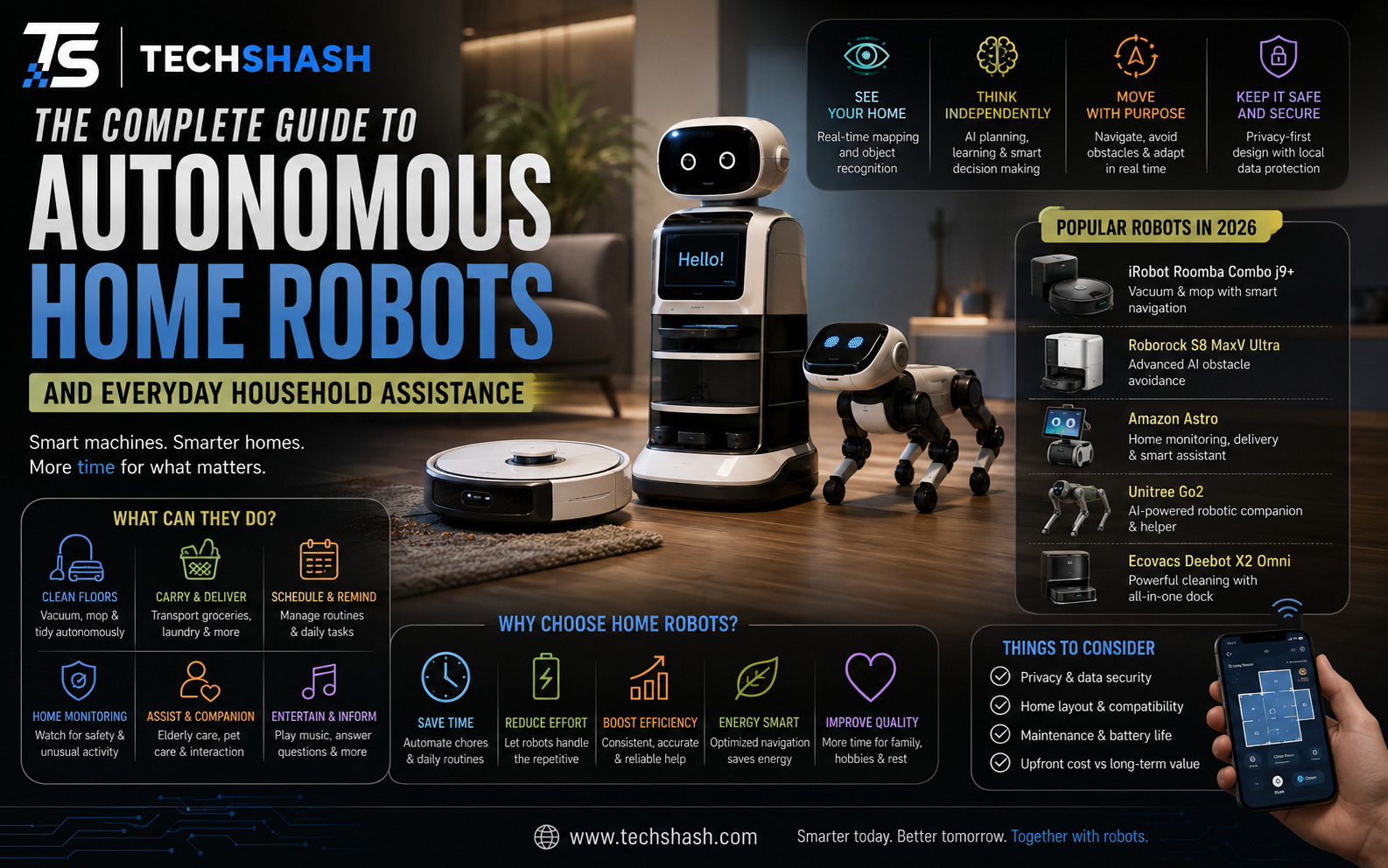
Domestic machines handle far more tasks than simple floor sweeping today. Robotic vacuums now empty their own dustbins into charging bases. Window cleaning units scale glass panes to keep exterior views clear. Small mechanical arms even fold laundry and load dishwashers in experimental test homes. Autonomous vacuum cleaners represent the most common and reliable tool currently available for daily cleaning.
3. Integrating Smart Home Automation Systems
Modern homes feature interconnected devices that communicate through wireless networks. Autonomous machines connect directly to these networks to optimize their performance. Smart thermostats tell a robot when rooms are empty so cleaning cycles can begin. Smart home automation creates a unified ecosystem where machines work together without human triggers. Central hubs let users schedule chores remotely using simple smartphone applications.
4. Managing Maintenance and Everyday Domestic Robotics
Mechanical helpers require routine upkeep to function at peak performance levels. Owners must clean brushes, clear tangled hair, and replace worn filters regularly. Software updates arrive frequently to improve navigation algorithms and fix operational bugs. Regular hardware maintenance ensures that expensive electronic assistants last for many years. Ignoring these basic upkeep tasks leads to reduced battery life and mechanical failures.
5. Overcoming Privacy Concerns and Safety Challenges
Cameras and microphones built into smart machines raise valid questions about personal data security. Manufacturers store floor maps and video feeds on cloud servers to improve software capabilities. Hackers might potentially access these connected devices if security protocols remain weak. Data encryption protocols protect user privacy by securing internal video feeds and mapped floor layouts. Users should always review privacy settings before activating new robotic devices in private bedrooms.
6. The Cost and Accessibility of Automated Home Appliances
Advanced technology often comes with a steep price tag during initial market releases. High-end robotic assistants cost thousands of dollars, placing them out of reach for average households. Budget models offer basic cleaning functions at much lower price points. Market competition drives down manufacturing costs and makes automated tools accessible to more families. Prices continue to drop as manufacturing techniques improve worldwide.
7. What the Future Holds for Personal Robotic Companions
Future generations of household machines will feature humanlike dexterity and artificial intelligence. These upcoming devices will prepare meals, tend indoor plants, and care for elderly family members. Artificial intelligence integration allows robots to learn individual user preferences and adapt to changing household routines. Society stands on the brink of a major shift in how domestic work gets completed.
Key Takeaways
- Primary machine function: Floor cleaning and basic room mapping remain the core strengths of current home robots.
- Network connectivity: Smart home integration allows automated routines to run without manual activation.
- Upkeep requirements: Regular filter changes and brush cleaning prevent unexpected mechanical breakdowns.
- Security measures: Strong data encryption protects household privacy from unauthorized external access.
- Cost trends: Increasing market competition makes helpful domestic technology affordable for broader audiences.
FAQs
What tasks can current home robots handle?
Current home robots primarily handle floor vacuuming, mopping, lawn mowing, and window cleaning.
Are home robots safe around pets and children?
Modern robots use infrared sensors and bumper triggers to stop safely when encountering pets or children.
How do autonomous home robots map a house?
These machines use laser distance sensors and optical cameras to create a digital floor plan of rooms.
Do automated household machines require internet access?
Internet access is required for software updates and remote smartphone control, though basic offline operation is often possible.
Conclusion
Autonomous home robots offer a practical solution for reclaiming valuable time from tedious daily chores. As technology improves, these helpful machines will become standard fixtures in households around the world.