
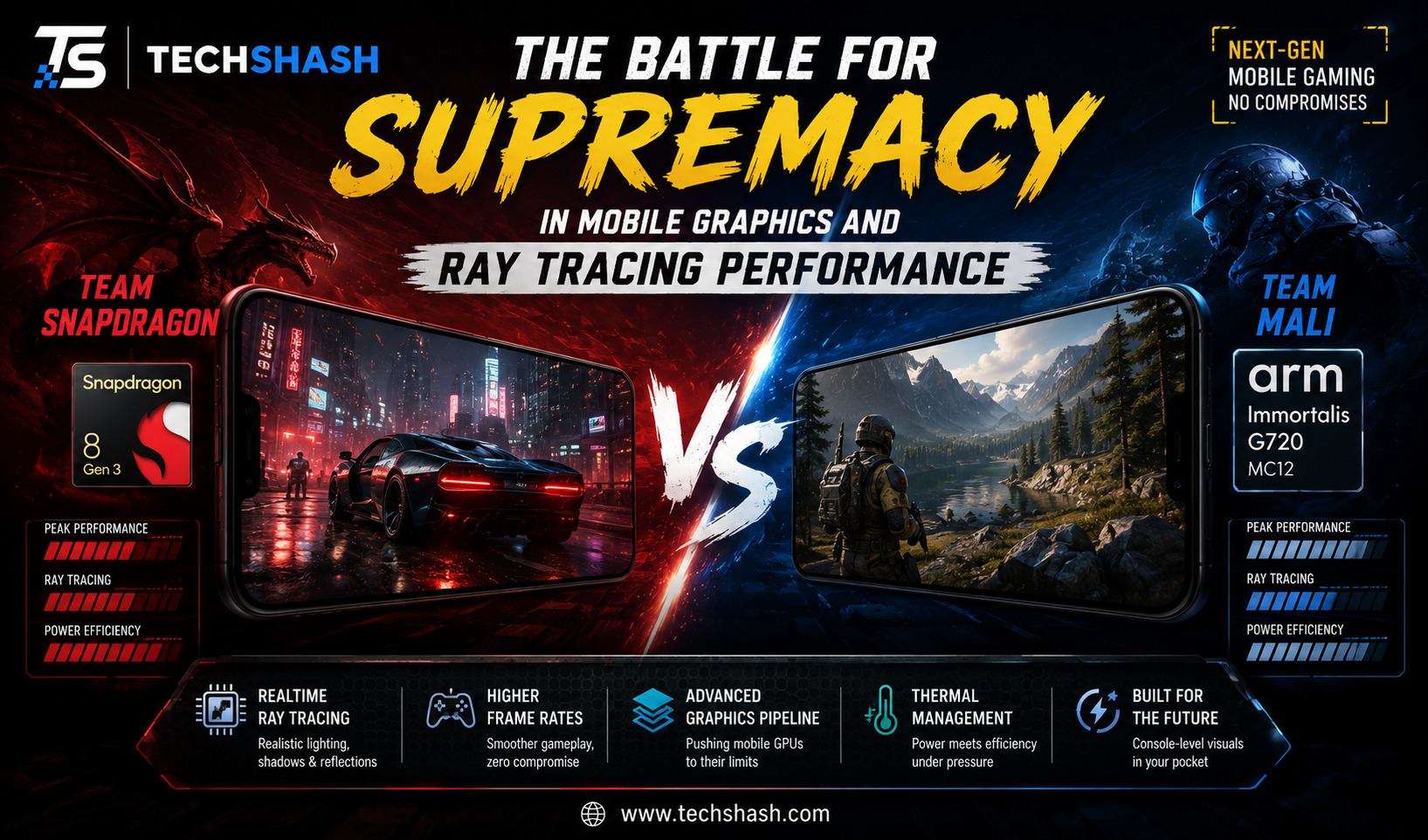
High end video games are no longer bound to bulky desktop computers or living room consoles. Modern pocket devices now run detailed graphical experiences with realistic lighting and reflections.
Understanding mobile graphics ray tracing performance helps gamers and technology fans see how small handheld devices handle heavy graphics workloads. Silicon creators are pushing processor designs to squeeze desktop features into tight mobile frames. This article explains how chip makers build mobile hardware, where major brands compete, and what lies ahead for portable rendering.
1. The Evolution of Smartphone Graphics Hardware
Mobile games used to rely on simple two-dimensional shapes and basic sprite animations. Early color screens could barely handle pixelated character models.
As display screens grew sharper, phone manufacturers added dedicated graphics cores to handle three-dimensional rendering. Early mobile graphics relied entirely on pre-calculated lighting tricks. Artists painted light directly onto wall textures so the hardware did not need to calculate shadows during gameplay.
That approach worked well for simple mobile titles, but players wanted immersive virtual worlds. Silicon engineers expanded mobile GPU architectures to process millions of triangles per second. Modern mobile processors now compute real lighting behaviors live as players move through game environments.
Transitioning to rasterization with spatial reflections allowed mobile platforms to mimic desktop visual effects. Modern mobile gaming graphics now feature active lighting, real particle interactions, and dense shadow maps that rival older gaming consoles.
2. Understanding Hardware Accelerated Ray Tracing in Mobile Chips
Traditional rasterization draws three-dimensional objects onto a two-dimensional screen by flattening geometry. Ray tracing calculates individual light paths as light bounces off objects, glass, and water.
Software-based ray tracing slows mobile frame rates down to unplayable levels because standard compute units get overwhelmed. Processor designers solved this issue by embedding dedicated ray acceleration cores directly into the graphics silicon.
These hardware blocks take over heavy ray triangle intersection calculations. Specialized fixed-function units test bounding volume hierarchies without draining standard shader resources.
Offloading ray calculations keeps basic frame rendering smooth while adding realistic visual details. Puddles reflect moving cars, metal surfaces mirror ambient room lights, and shadows soften based on light distances.
3. Apple Silicon Versus Android Flagship GPUs
Apple introduced hardware ray tracing capabilities with its A17 Pro processor and continued refining it in newer chips. Their custom graphics architecture uses tight hardware integration with the Metal graphics library to keep frame rates stable.
Android device makers rely on silicon choices from Qualcomm and MediaTek. Qualcomm equips its Snapdragon processors with high-performance Adreno graphics cores that feature dedicated hardware ray engines. MediaTek utilizes ARM Immortalis GPU designs that include hardware ray tracing pipelines tailored for high efficiency.
Comparing these system architectures highlights different design choices. Apple focuses on high peak thread bandwidth and deep memory integration. Qualcomm builds fast clock speeds and broad developer API compatibility across many device manufacturers.
Competition among flagship smartphone GPUs forces every manufacturer to optimize silicon space and power output. Each brand seeks to claim top scores in synthetic benchmark tests while preserving day-long battery life.
4. Thermal Throttling and Power Efficiency Challenges
Smartphones do not have internal cooling fans to blow hot air away from internal chips. Heat builds up rapidly inside sealed glass and metal phone bodies when running demanding games.
High temperature levels trigger built-in safety controls to slow chip clock speeds down. A fast phone can experience a noticeable sustained performance drop after just ten minutes of continuous ray tracing gameplay.
Power consumption adds another hurdle for phone hardware designers. Standard smartphone batteries can safely output between three and six watts of power for sustained gaming sessions without overheating.
Engineers must design ray tracing hardware blocks that draw minimal wattage while calculating millions of light intersections every second. Efficient thermal management often matters more than short bursts of high peak benchmark scores.
5. Upscaling Tech and Software Optimization
Rendering ray-traced lighting effects at full native display resolution causes excessive heat and battery drain. Silicon vendors use intelligent upscaling algorithms to balance visual quality with processing speed.
MetalFX Spatial and Temporal Scaling
Apple uses MetalFX upscaling to render games at a reduced internal resolution before sharpening the image output. Temporal upscaling merges frame data across multiple frames to produce crisp visuals with reduced GPU effort.
Qualcomm Game Super Resolution and ARM ASR
Android processors use open scaling techniques such as Qualcomm Game Super Resolution and ARM Accuracy Super Resolution. These technologies reconstruct high-definition frames from low-resolution source files.
Combining super resolution scaling algorithms with ray acceleration keeps frame rates consistent during intense action sequences. Players enjoy sharp character models and clear environments without maxing out GPU core clocks.
6. Measuring Real World Mobile Graphics Ray Tracing Performance
Evaluating mobile graphics ray tracing performance requires examining real game titles rather than synthetic benchmark scores alone. Game developers must carefully choose which visual elements use ray tracing.
Real World Game Implementations
Titles like Arena Breakout and War Thunder Mobile highlight ray-traced water reflections and mirror surfaces. Developers limit ray tracing to specific reflective surfaces so action scenes remain responsive and fast.
Console Ports on Handheld Devices
Major gaming studios have ported full console titles to modern mobile hardware. Games like Resident Evil Village use ray tracing options to deliver detailed visual presentation on small screens.
Sustained frame rates usually hover between thirty and sixty frames per second when upscaling tools operate in tandem with ray cores. Frame pacing stability remains the primary goal for game developers creating graphics settings for mobile players.
7. Future Trends in Pocket Sized Graphical Realism
Next generation mobile processors will leverage smaller manufacturing nodes like two-nanometer production processes. Smaller transistor sizes yield better energy efficiency and allow engineers to add extra ray acceleration logic to GPU dies.
Hybrid rendering techniques will continue evolving to blend traditional rasterization with targeted ray tracing passes. Game engines will automatically scale down reflection details when internal chip temperatures rise.
Cloud computing and local hardware processing may eventually link together to share visual workloads. Local hardware will draw responsive player inputs while remote servers send pre-calculated global illumination data over fast wireless networks.
Adopting hybrid rendering pipelines will allow future phones to run complex visual worlds without battery depletion. Portable devices will narrow the visual gap separating high-end home gaming consoles and everyday pocket phones.
Key Takeaways
- Primary rendering shift: Mobile graphics have evolved from basic two-dimensional models to hardware accelerated ray tracing.
- Dedicated hardware logic: Modern mobile GPUs use fixed-function acceleration units to calculate light rays without overloading standard shaders.
- Main hardware rivals: Apple A-series Pro silicon, Qualcomm Snapdragon Adreno GPUs, and MediaTek Dimensity Immortalis architectures compete for leadership.
- Thermal limits: Passive cooling causes performance throttling during long, heavy ray tracing gaming sessions.
- Upscaling necessity: Tools like MetalFX and Qualcomm GSR reconstruct sharp images from lower internal resolutions to save battery power.
FAQs
What is hardware ray tracing in a mobile phone?
It is a technology where dedicated hardware on the phone processor calculates how light bounces off surfaces in real time.
Does ray tracing drain mobile phone battery quickly?
Yes, running real-time light calculations requires extra electrical power from the battery during gaming sessions.
Which processors support mobile graphics ray tracing performance today?
Modern chips like Apple A17 Pro, Qualcomm Snapdragon 8 Gen 2 and Gen 3, and MediaTek Dimensity 9200 and 9300 support it natively.
Why do mobile games use upscaling alongside ray tracing?
Upscaling renders the image at a lower internal resolution to keep frame rates smooth while reducing heat production.
Can all mobile games run with ray tracing enabled?
Only specific mobile games designed by developers with built-in ray tracing support can turn on these visual effects.
Understanding mobile graphics ray tracing performance reveals how fast handheld silicon is advancing. Modern mobile GPUs now bring console-style reflections, realistic shadows, and believable lighting into compact smartphone designs. While thermal limitations and battery limits remain real challenges, clever upscaling technologies help bridge the gap. Mobile hardware continues to refine real-time light rendering with every annual processor generation.