Introduction
Buying a smart lock used to mean checking whether it worked with your specific ecosystem before checking whether it actually worked well. That kind of fragmentation frustrated smart home shoppers for years.
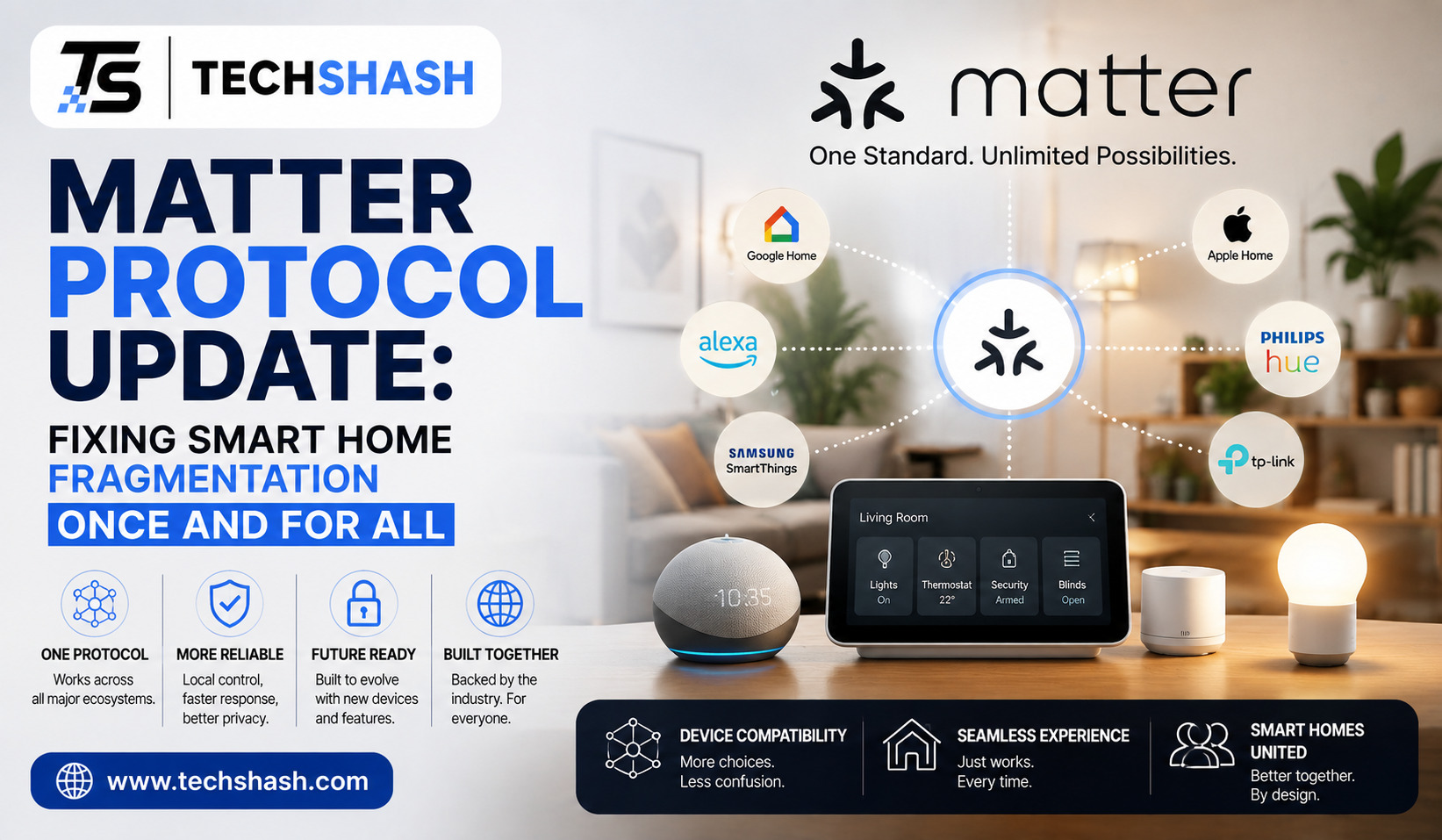
Matter, the connectivity standard backed by Apple, Google, Amazon, and hundreds of other manufacturers, was built specifically to end that problem. This article looks at how far Matter has actually come through its recent updates, and whether it is really solving fragmentation or just adding a new layer to it.
1. Why Smart Homes Got So Fragmented
Before Matter, buying smart home devices meant navigating a maze of incompatible ecosystems. A lock built for Apple HomeKit often could not be added to Google Home. A sensor designed around Amazon Alexa might never receive Google Assistant support at all.
That left shoppers locked into whichever ecosystem they picked first, often without realizing it until they tried to add a new device and hit a wall. Multiple hubs, multiple apps, and inconsistent automation support became the normal cost of building a smart home.
Matter set out to replace that patchwork with a single, open, royalty-free standard, backed by the Connectivity Standards Alliance, the same organization behind Zigbee.
2. What Matter Was Built to Fix
The core promise behind Matter is simple: a device certified for Matter should work with any major smart home platform, without a proprietary bridge and without locking the buyer into one ecosystem.
Matter achieves this by standardizing communication over existing IP-based networks, including Wi-Fi, Thread, and Ethernet, rather than inventing an entirely new proprietary protocol. That choice reduces certification hurdles and firmware complexity for manufacturers building new devices.
Matter 1.0 officially launched in October 2022, but the initial release was widely criticized as rushed and limited, covering only a small handful of basic device types like smart plugs and light bulbs.
3. Matter 1.4: The Energy Management Update
Matter 1.4 arrived in late 2024 and expanded coverage significantly, adding support for batteries, solar systems, water heaters, heat pumps, and electric vehicle chargers.
This update also introduced stronger multi-admin capabilities, letting a single device be controlled from multiple ecosystems at once, which matters for households where one person uses an iPhone and another uses an Android device.
Battery-powered devices got a quieter but meaningful improvement too. Matter 1.4 optimized how often sensors and wireless buttons need to check in with the network, reducing power draw and extending battery life for the small, low-power devices that make up much of a typical smart home.
Follow-up updates in 2025, labeled Matter 1.4.1 and 1.4.2, added NFC-based onboarding for easier device setup and tightened security requirements, including a mandate that network infrastructure devices support at least 150 connected devices.
4. Matter 1.5: Cameras Finally Join the Standard
Matter 1.5, released in late 2025, brought one of the most requested additions yet: support for security cameras, video doorbells, and intercoms.
This closed a long-standing gap. Cameras had remained one of the most ecosystem-specific product categories in the smart home, forcing users to juggle a separate app for nearly every camera brand they owned. Matter 1.5 allows footage and live streams from different brands to appear inside a single, unified app instead.
The update covers a wide range of camera types, including Wi-Fi, Power over Ethernet, and wired Ethernet cameras, and supports any resolution or aspect ratio. It does not, however, handle video storage or automation triggers based on what a camera sees, leaving those pieces to individual manufacturers.
Matter 1.5 also folded in smarter energy features, integrating pricing, utility tariffs, and grid carbon intensity data directly into its data model, paving the way for more automated, cost-aware energy management across compatible devices.
5. Matter 1.6 and Where Things Stand Now
Matter 1.6, released in mid-2026, is the current specification, though it does not introduce new device categories. Instead, it focuses on refining what earlier versions already added.
A more targeted update, Matter 1.5.1, released in early 2026, focused specifically on camera improvements, including better multi-stream video and audio delivery, support for HEIC snapshots, and refined behavior for doorbells, chimes, and intercoms.
Here is a quick summary of the recent release timeline:
- Matter 1.4 (late 2024): Energy management, multi-admin support
- Matter 1.4.1 / 1.4.2 (2025): NFC onboarding, stronger security requirements
- Matter 1.5 (late 2025): Camera and video doorbell support, energy pricing data
- Matter 1.5.1 (early 2026): Camera-focused maintenance improvements
- Matter 1.6 (mid-2026): Refinements to existing categories, no new device types
6. The Real Problem: Platforms Lag Behind the Standard
Here is the uncomfortable truth behind all this progress: writing a specification is only half the job. Matter only works in practice once the major platforms actually implement what the standard defines.
In 2026, that implementation gap remains a real problem. A manufacturer might release a cutting-edge Matter 1.5 sensor, only for a platform like Google Home or Amazon Alexa to still be lagging behind, fully supporting only much earlier versions like Matter 1.0 or 1.2 features.
Not every platform moves at the same pace either. Samsung’s SmartThings has been recognized for implementing new Matter features quickly, in some cases rolling out full support just weeks after a new specification’s release, while other major platforms have stayed stuck on older versions for far longer.
This mismatch means two devices that are both technically “Matter certified” may still behave differently depending on which ecosystem controls them, which undercuts the simplicity Matter was designed to deliver in the first place.
7. What This Means for Your Current Devices
If you already own Matter devices, there is good news: a device certified under Matter 1.4 or 1.5 will generally continue receiving firmware support as newer specifications roll out, so there is rarely a strong reason to delay a purchase just because a newer version exists.
For anyone building a smart home from scratch, a Thread border router remains an important piece of the puzzle, since many battery-powered Matter devices rely on Thread rather than Wi-Fi for more reliable, lower-power connectivity.
A practical setup tip worth following: if your household spans multiple ecosystems, such as a mix of iPhone and Android users, keeping a hub from each major platform, rather than betting everything on just one, tends to avoid the most common compatibility headaches.
8. Is Fragmentation Actually Getting Fixed?
The honest answer sits somewhere in the middle. The Matter standard itself has matured considerably, expanding from basic plugs and bulbs into cameras, energy devices, and increasingly sophisticated multi-admin support.
What has not fully caught up is how consistently the major ecosystems actually implement those features. Until Apple, Google, Amazon, and other platforms move in closer lockstep with each new Matter release, buyers will likely keep running into a smaller, subtler version of the same fragmentation Matter was built to eliminate.
For most households, 2026 still represents genuine progress over the pre-Matter era, even if the promise of true universal compatibility remains a work in progress rather than a finished job.
Key Takeaways
- The goal: Matter aims to let any certified smart home device work across Apple, Google, Amazon, and Samsung ecosystems without proprietary bridges.
- Recent progress: Matter 1.4 added energy management, and Matter 1.5 finally brought camera and video doorbell support.
- Current version: Matter 1.6, released mid-2026, refines existing categories without adding new device types.
- The real bottleneck: Major platforms often lag behind the latest Matter specification, undercutting consistent cross-ecosystem behavior.
- Buying advice: Devices certified under Matter 1.4 or 1.5 generally continue receiving support, so waiting for the newest version is rarely necessary.
FAQs
What problem was Matter designed to solve? Matter was designed to let smart home devices from different brands work across any major platform without needing separate hubs, apps, or proprietary bridges.
What did Matter 1.5 add to the standard? Matter 1.5 added support for security cameras, video doorbells, and intercoms, along with expanded energy pricing data.
Why does smart home fragmentation still exist despite Matter? Fragmentation persists largely because major platforms like Google Home and Amazon Alexa often implement new Matter specifications more slowly than the standard itself evolves.
Do I need to upgrade my Matter devices when a new version releases? No, devices certified under earlier versions like Matter 1.4 or 1.5 generally continue receiving firmware support as newer specifications roll out.
What is a Thread border router and why does it matter for Matter devices? A Thread border router bridges the low-power Thread mesh network to your home Wi-Fi, and it is important for reliably connecting many battery-powered Matter devices.
Conclusion
Matter has made real, measurable progress toward fixing smart home fragmentation, expanding from a limited set of plugs and bulbs into cameras, energy devices, and stronger multi-ecosystem support. The standard itself is no longer the weak link; inconsistent implementation across major platforms is. Until Apple, Google, Amazon, and the rest catch up to the specification at the same pace, Matter will keep closing the fragmentation gap gradually rather than solving it all at once.