Introduction
A tiny piece of metal on your finger is now outselling one of the biggest wearable categories in tech. That is not a stretch of the imagination; it is what the sales data shows.
Smart rings have moved from a niche curiosity to a dominant force inside the fitness tracker market in a remarkably short time. This article looks at the numbers behind that shift, the brands driving it, and whether a ring can really replace a watch on your wrist.
1. The Numbers Behind the Shift
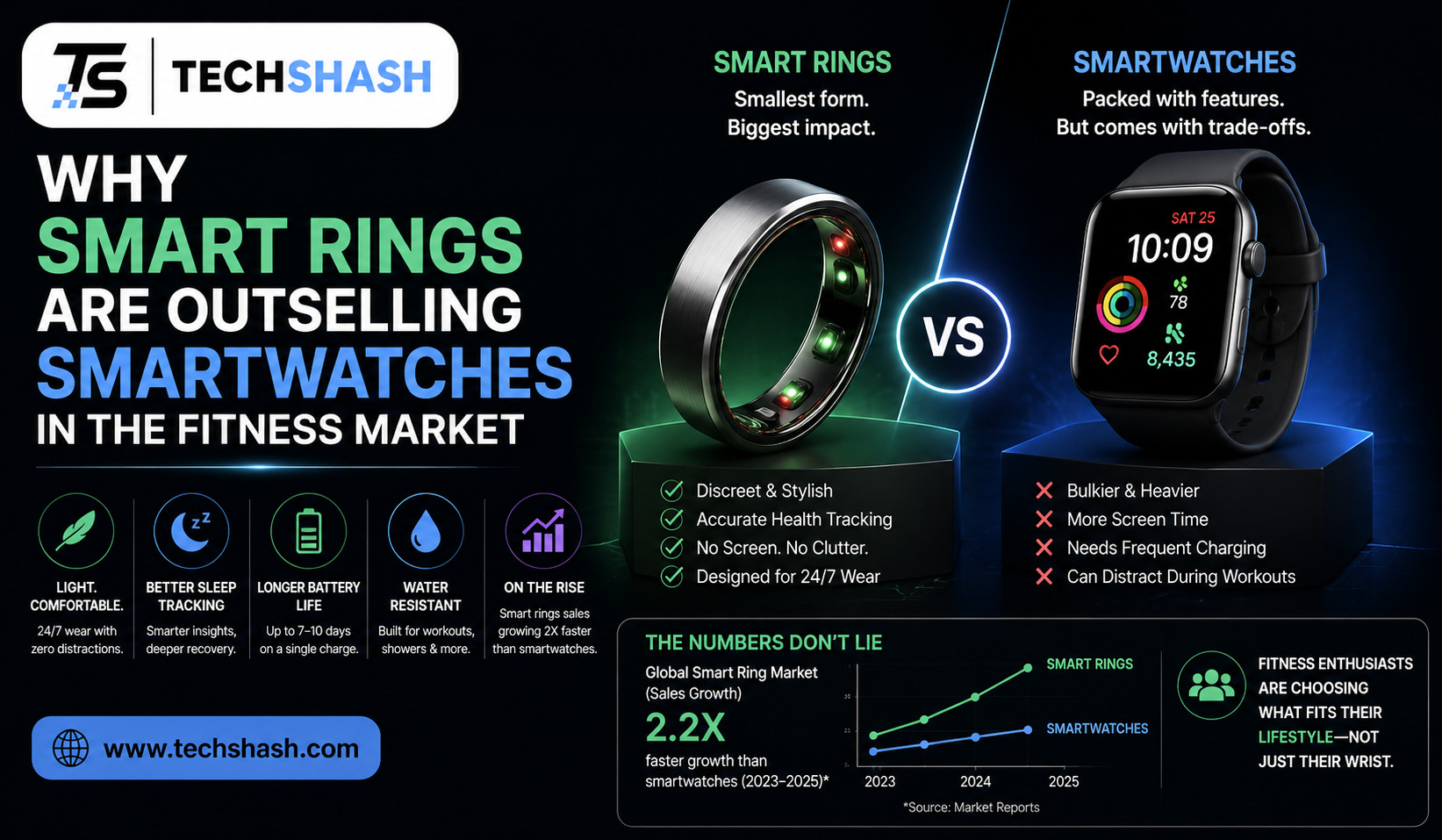
The scale of this shift is hard to ignore. Smart rings now account for roughly 75 percent of all fitness tracker revenue in the United States, up sharply from about 46 percent just a year earlier.
Shipment growth tells a similar story. Smart ring shipments were on track for a 49 percent jump in a recent year, according to IDC data, compared with an estimated 6 percent gain for smartwatches over the same stretch.
Oura alone has sold more than 5.5 million rings worldwide, generating close to a billion dollars in revenue in a single recent year. North America made up roughly 45 percent of global smart ring revenue during that period.
2. What Makes a Smart Ring Different
A smart ring strips away almost everything you associate with a smartwatch. There is no screen, no notifications buzzing on your wrist, and no charging cable you need every single night.
What is left is a small band, usually a few grams in weight, packed with sensors that track sleep, heart rate, temperature, and daily activity. The discreet design is the entire pitch: you get most of the health data without wearing a visible gadget.
Battery life is another selling point. Where a smartwatch often needs daily or every-other-day charging, many rings run for several days to a week or more between charges.
3. Oura’s Dominant Position
Oura remains the name most people associate with this category, and the sales figures back that up. The company holds an estimated 74 percent share of global smart ring shipments.
Oura’s newest model, the Ring 5, launched with hardware components shrunk by roughly 40 percent compared to earlier generations, while still holding battery life in the range of six to nine days. The company has also introduced AI-driven health monitoring features aimed at spotting cardiovascular and respiratory trends before they become obvious symptoms.
Part of Oura’s continued lead comes from circumstance as much as strategy. Samsung has not released a true second-generation Galaxy Ring, which has left a gap that Oura has been happy to fill.
4. The Rest of the Field
Oura is not alone in this space, even if it leads by a wide margin.
- Samsung Galaxy Ring: Holds around 9 percent of global shipments, and appeals most to Android users who already own a Samsung phone.
- Ultrahuman: Also holds close to a 9 percent share, and recently reported its first full year of profitability, a sign of a sustainable business model outside the market leader.
- RingConn: Sits around a 5 percent share, and has built its reputation as the leading subscription-free option in the category.
Each competitor tends to carve out a specific niche, whether that is price, platform integration, or freedom from a monthly fee.
5. Why Buyers Are Switching
Comfort is probably the single biggest driver behind this shift. A ring simply disappears on your hand in a way a watch never quite does, especially for people who find wrist-worn devices bulky or distracting.
Sleep tracking accuracy is another factor. Many users report that a ring, worn snugly against a finger with less motion than a wrist, produces more consistent readings overnight than a watch.
There is also a style argument at play. Wearing a ring lets someone pair a traditional analog watch with full health tracking underneath it, something a smartwatch cannot really offer since it takes the wrist spot for itself.
6. Where Smartwatches Still Win
None of this means smartwatches are fading away. The category is still shipping around 163 million units annually worldwide, dwarfing the smart ring category in raw volume.
Smartwatches keep an edge in a few clear areas:
- Screens, which let you glance at notifications, respond to messages, and use apps directly on your wrist.
- Mobile payments, a feature no smart ring currently matches at scale.
- Broader fitness tracking, including GPS-based workout mapping that benefits from a larger device and antenna.
For anyone who wants a single device to handle communication, payments, and fitness in one place, a smartwatch still makes more sense than a ring.
7. The Subscription Question
One detail trips up a lot of first-time ring buyers: the subscription model that some brands, including Oura, require to unlock full features.
Oura’s increased base price and mandatory monthly subscription have opened the door for subscription-free alternatives like RingConn and, to a lesser extent, Ultrahuman, which appeal to buyers who want ongoing insights without an ongoing bill.
Samsung’s Galaxy Ring avoids a required subscription for Android users, which is part of why it remains a popular pick despite lacking a true next-generation refresh.
Before buying any ring, it is worth checking whether the core features you want are locked behind a paywall after the first few months.
8. What This Means If You Are Shopping Now
If your main goal is sleep and recovery tracking without wearing anything bulky, a ring is likely the better fit today. If you rely on your wrist device for notifications, payments, or serious GPS-tracked workouts, a smartwatch still covers more ground.
Cost matters too. Ring prices vary widely depending on brand and subscription requirements, so it pays to compare the full first-year cost, not just the sticker price of the hardware itself.
Whichever direction you lean, this is clearly no longer a fringe category. Rings have earned their spot as a serious, mainstream option in the fitness wearable market.
Key Takeaways
- Market shift: Smart rings now generate about 75 percent of US fitness tracker revenue, up from 46 percent a year earlier.
- Market leader: Oura holds roughly 74 percent of global smart ring shipments and has sold more than 5.5 million units.
- Main appeal: Comfort, longer battery life, and more accurate overnight sleep tracking compared to a watch.
- Smartwatch advantage: Screens, mobile payments, and GPS-based workout tracking remain smartwatch strengths.
- Cost consideration: Some rings require a mandatory subscription, while brands like RingConn skip that fee entirely.
FAQs
Are smart rings really more accurate than smartwatches for sleep tracking? Many users report more consistent overnight readings from rings, largely because a finger stays steadier during sleep than a wrist.
Do all smart rings require a subscription? No, brands like RingConn and the Samsung Galaxy Ring do not require a mandatory subscription, unlike Oura’s core plan.
Which company leads the smart ring market? Oura leads with an estimated 74 percent share of global smart ring shipments.
Can a smart ring replace a smartwatch completely? Not for everyone, since smart rings lack screens, notifications, and mobile payment support that many smartwatch owners rely on.
Why are smart rings growing faster than smartwatches right now? Smart ring shipments grew around 49 percent in a recent year compared to about 6 percent for smartwatches, driven largely by demand for a more discreet, comfortable wearable.
Conclusion
Smart rings have quietly become the dominant force in fitness tracker revenue, driven by comfort, long battery life, and increasingly sophisticated sleep and recovery insights. Smartwatches are not going anywhere, since screens and payments still matter to a large share of buyers, but the sales data makes one thing clear: the smart ring is no longer a niche accessory. It has become a real, mainstream competitor in the wearable tech market.