
Introduction
Pointing a phone at the night sky and expecting a sharp Milky Way shot rarely works out. Stars are moving targets, even though they look perfectly still, and getting a clean shot means solving a small equation before the shutter ever opens. This article breaks down the math behind smartphone astrophotography, from the basic exposure triangle to the specific formulas photographers use to stop stars from smearing into short white lines.
1. Why Phone Astrophotography Is a Math Problem
Earth rotates constantly, and that rotation means the night sky appears to drift across the frame during a long exposure. Leave the shutter open too long, and a pinpoint star turns into a short streak instead of a dot. Close the shutter too soon, and there is not enough light gathered to reveal the faint glow of the Milky Way at all.
Balancing those two limits is the entire challenge. Photographers solve it with two well-known formulas, the 500 Rule and the more precise NPF Rule, both built to answer one question: how long can the shutter stay open before the stars start to trail.
2. The Exposure Triangle at Night
Every exposure setting fights over the same limited amount of starlight. Three settings control that balance.
- Aperture controls how much light reaches the sensor at once. A wider aperture, shown as a lower f-number such as f/1.8 or f/2.8, lets in more light.
- Shutter speed controls how long the sensor gathers light. Longer exposures gather more light but risk star trailing.
- ISO controls how much the sensor amplifies the signal it captures. Raising ISO brightens the image but also amplifies noise.
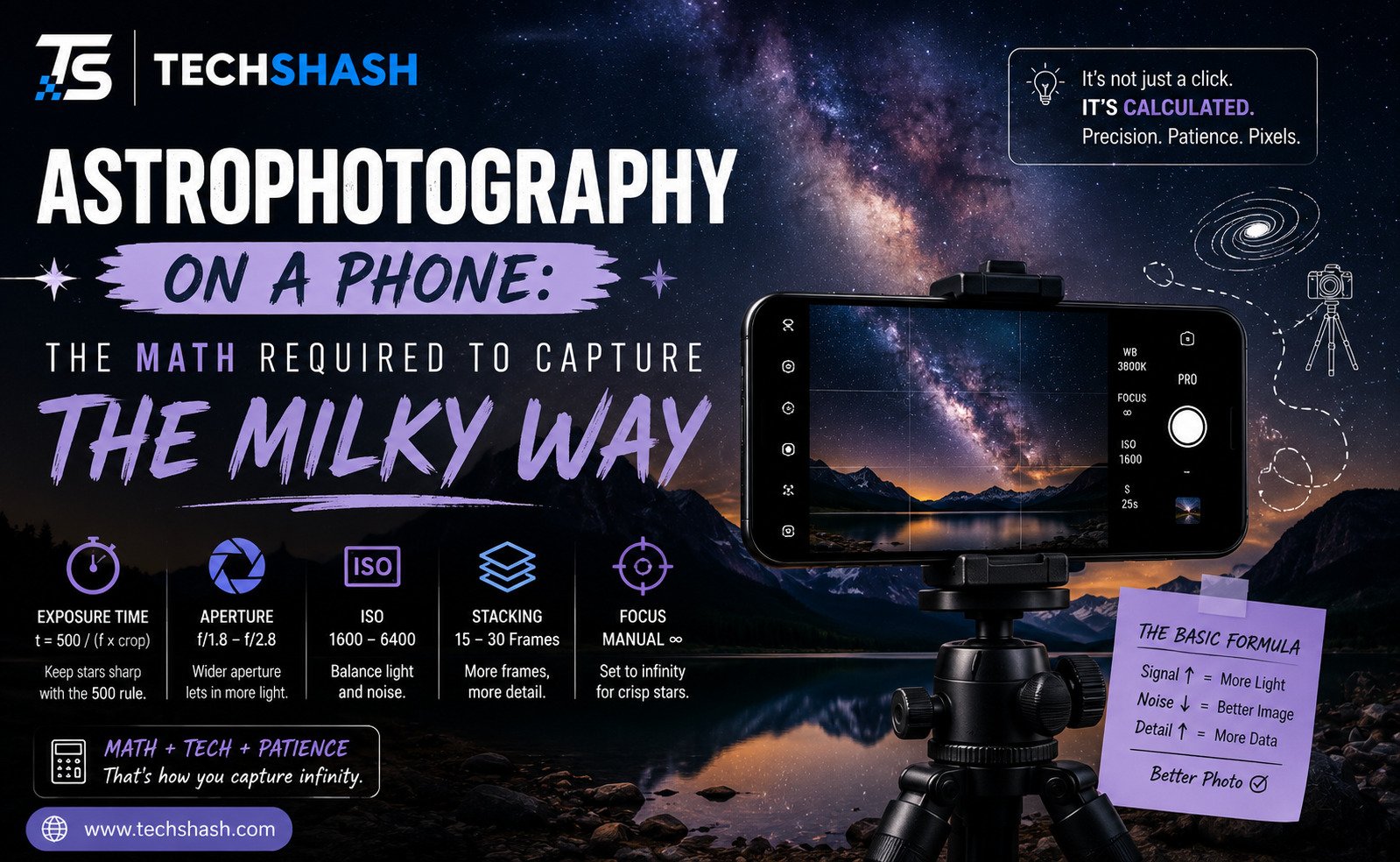
For Milky Way shots, most photographers open the aperture as wide as the lens allows, since a wider aperture gathers more light without adding noise the way a higher ISO does. From there, shutter speed and ISO get balanced against each other using the math below.
3. The 500 Rule Explained
The simplest formula for finding a safe shutter speed is the 500 Rule. The math is straightforward: divide 500 by the focal length of the lens, using its full-frame equivalent value, and the result is the maximum number of seconds you can expose before stars begin to trail.
At a 24mm focal length, for example, 500 divided by 24 works out to roughly 20 seconds. At 14mm, the same math allows closer to 35 seconds. The wider the lens, the longer the shutter can safely stay open, since a wide field of view makes the sky’s apparent movement less noticeable in the frame.
This rule works fine as a starting point, but it has a real weakness. It ignores the resolution of the sensor. A high-megapixel camera, including many modern phone sensors, can reveal star trailing well before the 500 Rule’s number suggests it should.
4. Why the NPF Rule Exists
The NPF Rule was built to fix that gap. Instead of only considering focal length, it factors in the lens aperture and the pixel pitch of the sensor, which is a measure of how tightly packed the sensor’s individual pixels are. Smaller, more tightly packed pixels reveal star trailing sooner, since even a small amount of drift covers more pixels on a dense sensor.
The full equation looks intimidating: 2.6 divided by t equals k times the quantity 16.856N plus 0.0997f plus 13.713p, all divided by f times the cosine of declination. In practice, nobody solves this by hand. Photographers plug their camera’s aperture, focal length, and pixel pitch into an app or online calculator, and the tool spits out a maximum shutter speed in seconds.
The NPF Rule generally produces a shorter maximum exposure time than the 500 Rule, especially on high-resolution sensors, which makes it the more reliable choice for anyone planning to view or print their Milky Way shots at full detail.
5. Working Out the Numbers on a Real Phone
Most phone camera lenses sit around a 24 to 28mm full-frame equivalent focal length. Running the 500 Rule on a 26mm phone lens gives 500 divided by 26, which comes out to roughly 19 seconds. A cautious photographer would round that down to around 15 seconds to leave a safety margin, since phone sensors tend to be smaller and more densely packed than a dedicated camera’s sensor.
Once the shutter speed ceiling is set, the remaining two variables have to make up the difference in brightness. With aperture already fixed at the phone’s widest setting, ISO becomes the main lever left to adjust, typically landing somewhere between 1600 and 6400 depending on how dark the sky actually is.
6. Focus, Aperture, and the Limits of Phone Hardware
Autofocus does not work reliably in near-total darkness, so manual focus set to infinity is required for sharp stars. On many phones, true infinity focus sits slightly short of the very end of the focus slider, which means a quick test shot and a zoomed-in check are worth the extra minute before committing to a full sequence.
Phone lenses generally cannot match the wide apertures available on dedicated camera lenses, and most phones do not offer manual aperture control at all. That limitation puts more pressure on ISO and shutter speed to make up for the light a wider aperture would otherwise capture, which is part of why phone astrophotography leans so heavily on computational tricks like multi-frame stacking to reduce the resulting noise.
7. Reading the Histogram Instead of Guessing
A histogram shows the distribution of brightness values across the frame, and it is far more reliable than judging exposure by eye on a small phone screen in the dark. The goal for a Milky Way shot is to separate the “sky hump,” the bump representing the night sky’s brightness, from the far left edge of the histogram, which represents pure black.
If that hump sits crushed against the left edge, the image is underexposed and will show excessive noise once brightened in editing. If it pushes too far right, faint stars and detail in the Milky Way’s core risk getting lost. Checking the histogram after a test shot, rather than trusting the phone’s brightened preview screen, catches this problem before an entire shooting session gets wasted.
8. A Simple Settings Checklist to Start With
For a first attempt at Milky Way photography on a phone, this baseline works well:
- Set the widest available aperture, or rely on the phone’s dedicated Astrophotography or Expert RAW mode if manual aperture is not available.
- Set manual focus to infinity and confirm sharpness with a zoomed-in test shot.
- Set shutter speed to roughly 15 seconds as a safe starting point for a typical phone lens.
- Start ISO around 1600, and raise it toward 3200 or higher if the histogram shows underexposure.
- Shoot in RAW format if the phone supports it, since RAW files hold far more detail for noise reduction and color correction during editing.
- Review the histogram after each test shot and adjust ISO before adjusting shutter speed further.
Key Takeaways
- The core challenge: Earth’s rotation limits how long a shutter can stay open before stars begin to trail.
- The 500 Rule: Divide 500 by the lens focal length to estimate a safe maximum shutter speed.
- The NPF Rule: A more accurate formula that also factors in aperture and sensor pixel pitch, generally producing shorter, safer exposure times.
- Typical phone settings: Roughly 15 seconds shutter speed, ISO 1600 to 6400, widest available aperture, manual focus set to infinity.
- Verification tool: The histogram, not the naked eye on a phone screen, is the most reliable way to judge exposure at night.
FAQs
What is the 500 Rule in astrophotography? It is a formula that divides 500 by a lens’s focal length to estimate the longest shutter speed before stars start to trail.
Why is the NPF Rule considered more accurate than the 500 Rule? The NPF Rule also accounts for aperture and sensor pixel pitch, which the 500 Rule ignores, making it more reliable on high-resolution sensors.
What ISO should I use for Milky Way photos on a phone? Most photographers start around ISO 1600 and adjust up toward 6400 depending on how dark the sky is.
Can a regular smartphone camera capture the Milky Way? Yes, if the phone has a Pro, Night, or Astrophotography mode and the shot is taken under sufficiently dark skies.
Why does my phone’s autofocus fail at night? Autofocus systems rely on contrast and light to lock focus, both of which are largely absent in a dark night sky, so manual focus set to infinity is required.
Conclusion
Capturing the Milky Way on a phone comes down to solving a small equation before you ever press the shutter: how long can the exposure run before the sky’s rotation blurs the stars, and how much brightness needs to come from ISO to make up the difference. The 500 Rule gets a beginner in the right range quickly, while the NPF Rule offers a sharper, more precise answer once the results start mattering. Either way, the math is not decoration. It is the difference between a photo full of crisp pinpoint stars and one full of short, disappointing streaks.