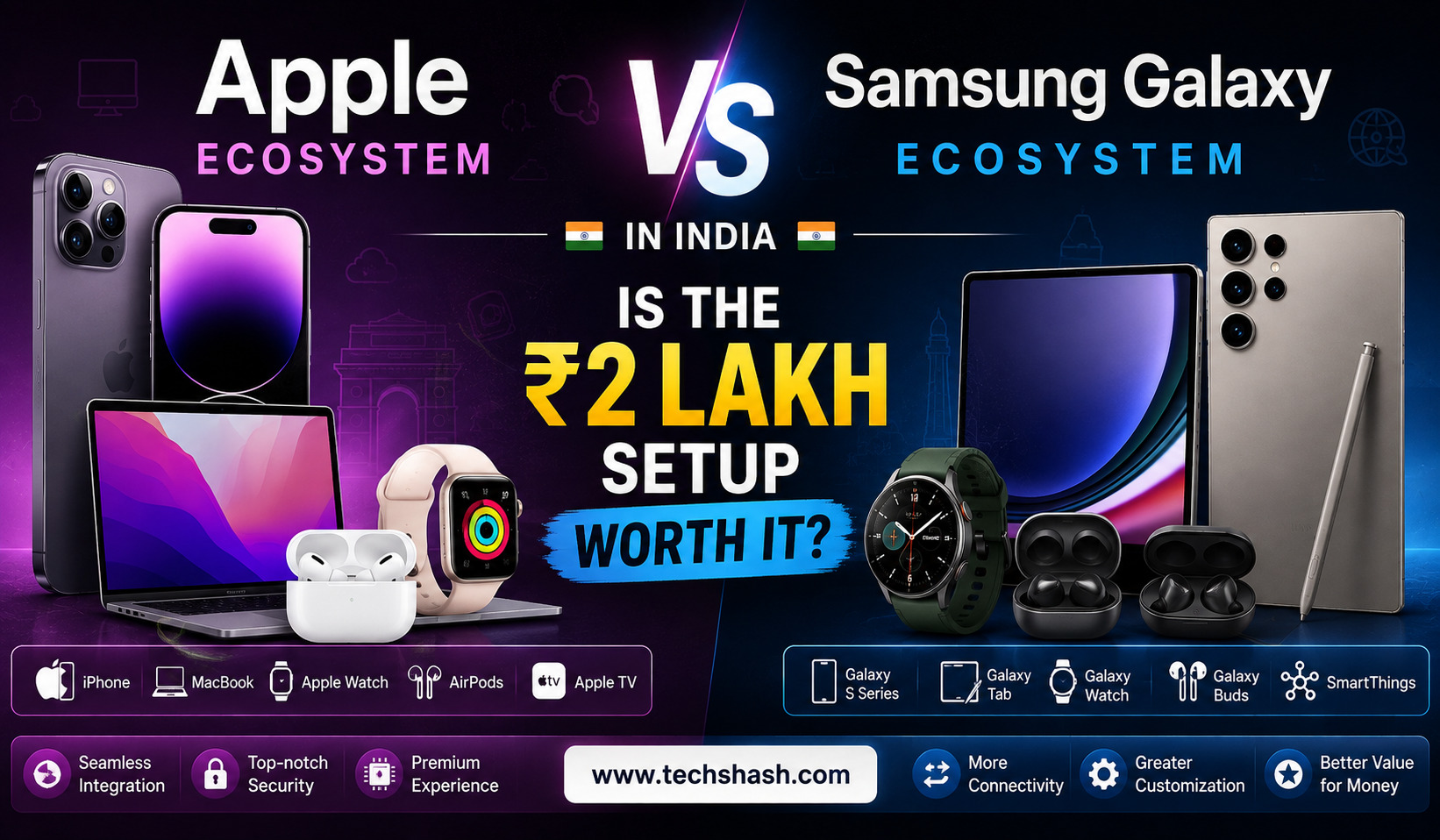

A single flagship phone used to be the biggest purchase decision in a person’s tech life. That is no longer true. Once you add a smartwatch and a pair of premium earbuds, both Apple and Samsung can walk you to a bill north of ₹1.8 lakh before you have bought a single app or subscription. This piece breaks down what that money actually buys in each ecosystem, what genuinely improves once every device is from the same brand, and where the “buy into the ecosystem” pitch is more marketing than substance for someone shopping in India specifically.
What ₹2 Lakh Actually Buys You
Here is a realistic phone-plus-watch-plus-earbuds basket for each brand, priced at current Amazon and Samsung India listings.
Apple basket
- iPhone 17 Pro Max, 256GB: ~₹1,43,990
- Apple Watch Series 11, 42mm GPS: ₹46,900
- AirPods Pro 3: ₹24,900
- Total: ~₹2,15,790
Samsung basket
- Galaxy S26 Ultra, 12GB/256GB: ₹1,39,999
- Galaxy Watch 8: ₹20,999
- Galaxy Buds 4 Pro: ₹21,999
- Total: ~₹1,82,997
Samsung’s three-device basket comes in roughly ₹33,000 cheaper than Apple’s, mostly because the iPhone 17 Pro Max itself now costs more than the Galaxy S26 Ultra, and Apple’s watch and earbuds both carry a premium over their Samsung equivalents. If you want an apples-to-apples ₹2 lakh spend on the Samsung side, that gap leaves room for the Galaxy Watch Ultra instead of the standard Watch 8, or a Galaxy Tab thrown into the mix.
Continuity: How Well the Devices Actually Talk to Each Other
This is the entire pitch behind buying into either ecosystem, so it is worth being specific about what you get.
On the Apple side, Handoff lets you start an email on your iPhone and finish it on a Mac or iPad without touching a share button, Universal Clipboard copies text or images across devices instantly, and AirDrop remains the fastest way to move files between Apple hardware in the room. Your Apple Watch unlocks your Mac automatically when you sit down at it, and Find My ties your phone, watch, and earbuds into one map if any of them go missing. These features have been refined over roughly a decade and it shows; they work quietly and rarely break.
Samsung’s answer is Multi Control, which lets you use a single mouse and keyboard across a Galaxy phone and a Galaxy Book laptop, plus Quick Share for fast file transfers between Galaxy devices. The genuinely interesting development this year is that Samsung has extended Quick Share compatibility to work with Apple’s AirDrop directly on the Galaxy S26 series, letting Galaxy and iPhone users exchange files without a third-party app. That is a meaningful concession from Samsung, and it quietly undercuts one of the classic arguments for staying locked into a single ecosystem, since Android and iOS users can now share files a lot more easily than they could two years ago.
Where Samsung pulls ahead is desktop-class productivity: Samsung DeX turns a Galaxy phone or tablet into a functional desktop environment the moment you plug it into a monitor, something Apple has no direct equivalent for on iPhone. If your ₹2 lakh setup needs to double as an occasional laptop replacement, that is a genuine, hard-to-replicate advantage on the Samsung side.
AI Across the Ecosystem
Apple Intelligence is fully available in India as of iOS 18.4, with English (India) supported as a first-class language rather than an afterthought, and it now spans the iPhone, iPad, Mac, Apple Watch, and AirPods in varying degrees, handling Writing Tools, Image Playground, Siri improvements, and Live Translation on AirPods Pro 3 specifically. Coverage is consistent but still rolling out feature by feature across iOS updates.
Samsung’s Galaxy AI ships with a broader feature set out of the box on the S26 series specifically for Indian buyers, including Now Brief for personalised daily summaries, an enhanced Bixby with better natural language handling, and AI-powered features baked into the Galaxy Buds 4 Pro like Interpreter mode for real-time conversation translation. Samsung has also been faster to bring Google Gemini integration across its wearables and earbuds lineup than Apple has been to expand Siri’s own capabilities.
Neither company has a decisive lead here. Apple’s advantage is consistency and privacy-first on-device processing; Samsung’s advantage is breadth of features shipped sooner, particularly for Hindi and other Indian language support in Bixby, which Apple’s Siri still trails on.
India-Specific Factors That Actually Matter
A few things matter more in India than they do in most Apple-vs-Samsung comparisons written for a global audience.
Manufacturing and price stability. iPhones sold in India, including the 17 Pro Max, are assembled locally by Foxconn and Tata Electronics, which has helped keep phone pricing relatively more stable than Apple’s other hardware. Products still imported in greater volume, like the iPad and Mac lineup, have shown far more price volatility this year: the iPad Air M4 jumped roughly 24 percent in a single month during mid-2026, and MacBook Air pricing has fluctuated by similar margins tied to a broader global memory chip cost crisis. If your ₹2 lakh Apple setup leans toward a Mac or iPad rather than a watch and earbuds, budget for the possibility that the price you see today will not be the price next month.
Service network density. Samsung’s authorised service centre footprint reaches far deeper into India’s tier-2 and tier-3 cities than Apple’s, which still concentrates support around a smaller number of authorised resellers and a handful of flagship stores in major metros. If you live outside a large city, getting an Apple Watch battery replaced or an AirPods case repaired can mean a longer trip or a courier-based service process, while Samsung’s wider network makes that friction less likely.
Resale value. iPhones have historically held resale value better than Galaxy flagships in the Indian secondhand market, particularly the Pro Max models, which partially offsets the higher upfront cost over a typical two to three year ownership cycle. This is a real financial factor worth weighing against Samsung’s lower sticker price.
Beyond the Big Three: The Home Ecosystem Gap
This is the part of the comparison that often gets left out, and it matters more in India than almost anywhere else. Samsung sells televisions, refrigerators, washing machines, and other appliances across India at genuine scale, all of which can connect through SmartThings alongside your phone, watch, and earbuds. That means a Samsung ecosystem purchase can realistically extend into your living room and kitchen in a way an Apple purchase cannot, since Apple has no comparable appliance business in India and a much smaller footprint for products like HomePod or Apple TV here.
If home automation and appliance integration matter to you, Samsung’s ecosystem is objectively wider, even if Apple’s phone-watch-earbuds trio is more tightly polished within its own smaller circle.
So, Is It Worth It?
For a straightforward phone-plus-watch-plus-earbuds purchase, buying into either ecosystem pays off if you actually use more than one device daily and care about the continuity features working invisibly in the background. If you only ever use your phone and treat the watch or earbuds as accessories rather than daily tools, the ecosystem premium buys you less than the marketing suggests, and you might get equal daily value from a cheaper standalone watch or earbuds pairing with either phone.
For an Indian power user specifically, Samsung currently offers more ecosystem for less money: a lower total basket price, DeX for desktop-class productivity, wider service coverage outside major cities, and a genuine path into home appliances through SmartThings that Apple simply does not offer at the same scale here. Apple’s case rests on tighter integration polish, generally better resale value, and now-stable iPhone pricing thanks to local assembly, but that case weakens if your ₹2 lakh also needs to stretch toward an iPad or Mac, where Apple’s recent India pricing has been considerably less predictable.
FAQs
Do I need to buy the phone, watch, and earbuds from the same brand to get ecosystem benefits?
No, but you lose most of the deeper integration features like Handoff, Find My as a unified network, or Samsung DeX if your devices are split across brands. Basic functions like Bluetooth pairing and music playback work fine across brands; it is the invisible, automatic continuity features that require staying within one ecosystem.
Is Apple’s ecosystem still worth the premium if I only buy a phone and earbuds, not a watch?
The premium is smaller and easier to justify with just two devices, since AirPods’ automatic switching between Apple devices and simple pairing remain genuinely convenient even without a watch in the mix. The ecosystem case gets meaningfully stronger with each additional Apple device you add, so a two-device basket sees proportionally less of the “network effect” than a three or four-device one.
Has Samsung’s ecosystem gotten better at working with non-Samsung devices?
Yes, noticeably. The extension of Quick Share to work directly with Apple’s AirDrop on the Galaxy S26 series is a real step toward reducing ecosystem lock-in, and Samsung’s earbuds and watches have generally supported basic functionality with any Android phone for longer than Apple’s equivalents have supported non-Apple hardware.
Which ecosystem has better long-term software support in India?
Both Apple and Samsung now offer multi-year update commitments on their flagship hardware, with Samsung promising seven major OS updates on devices like the Galaxy S26 Ultra and Tab S11 series, matching or exceeding what Apple has historically delivered on iPhones. Neither brand has a clear advantage here anymore, a shift from a few years ago when Apple’s update support was the more obvious differentiator.